
AustraliaTGAprescription
Australia's green rush, on prescription
Australia never legalised cannabis. It built a booming prescription market instead, now led by flower, and its regulators are scrambling to keep up.
In this story
Australia has not legalised cannabis. In May 2024 a Senate committee looked at the Greens' Legalising Cannabis Bill 2023 and recommended, in one line, that the Senate not pass it. Recreational use remains illegal in every state.
And yet Australia now has a large and fast-growing legal cannabis market. It just runs through the prescription pad. In 2020 the Therapeutic Goods Administration (TGA) approved 57,711 applications to prescribe unapproved medicinal cannabis under its Special Access Scheme. In 2024 it approved 177,762. Dried flower is now the most-approved form, most of what is sold is THC-dominant, and almost none of it has been assessed by the regulator for safety or effectiveness.
That is not a scandal; it is how the schemes were designed. It is also why, as of 13 October 2026, the TGA, the national practitioner regulator and several state and territory parliaments are all trying to work out what they have built.
How the system works, and how big it got#
Only two medicinal cannabis medicines are registered on the Australian Register of Therapeutic Goods, the list of medicines the TGA has evaluated. Everything else, more than 1,000 products according to sponsors' reports to the TGA, is "unapproved". The TGA says over 99% of the medicinal cannabis prescribed in Australia falls into that bucket.
Unapproved medicines reach patients mainly through two schemes: Special Access Scheme Category B (SAS-B), where a doctor applies for each patient, and the Authorised Prescriber scheme, which covers a class of patients without case-by-case applications. Both were built for exceptional clinical circumstances. Neither involves the TGA checking whether a product works.
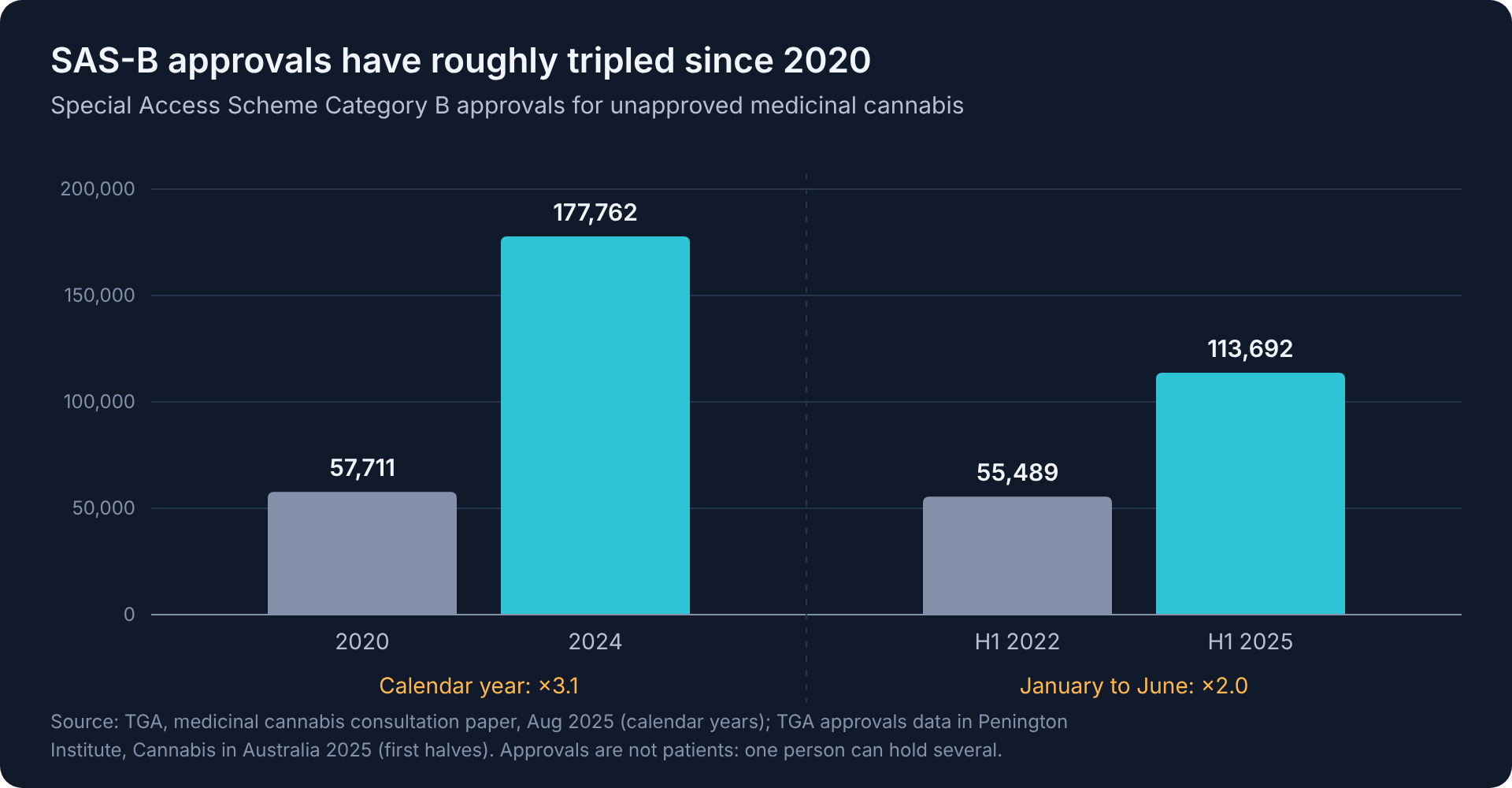
The growth has not slowed much. The Penington Institute's Cannabis in Australia 2025 report, working from TGA data, counts 113,692 SAS-B approvals in the first half of 2025, double the 55,489 of the first half of 2022. Authorised Prescriber approvals, a separate tally, peaked at 428,841 in the first half of 2024 and were 378,136 in the first half of 2025.
The national household drug survey puts the patient side in perspective. In 2022–23, about 700,000 Australians aged 14 and over (3.0%) said they had used cannabis for medical purposes in the past year, according to the Australian Institute of Health and Welfare (AIHW). One in five of them (22%) said they had always had it prescribed by a doctor. In 2019 the share who had used cannabis for medical purposes was 1.8%, an estimate the AIHW flags for caution.
Mostly flower, mostly THC-dominant#
What gets approved has changed as fast as how much.
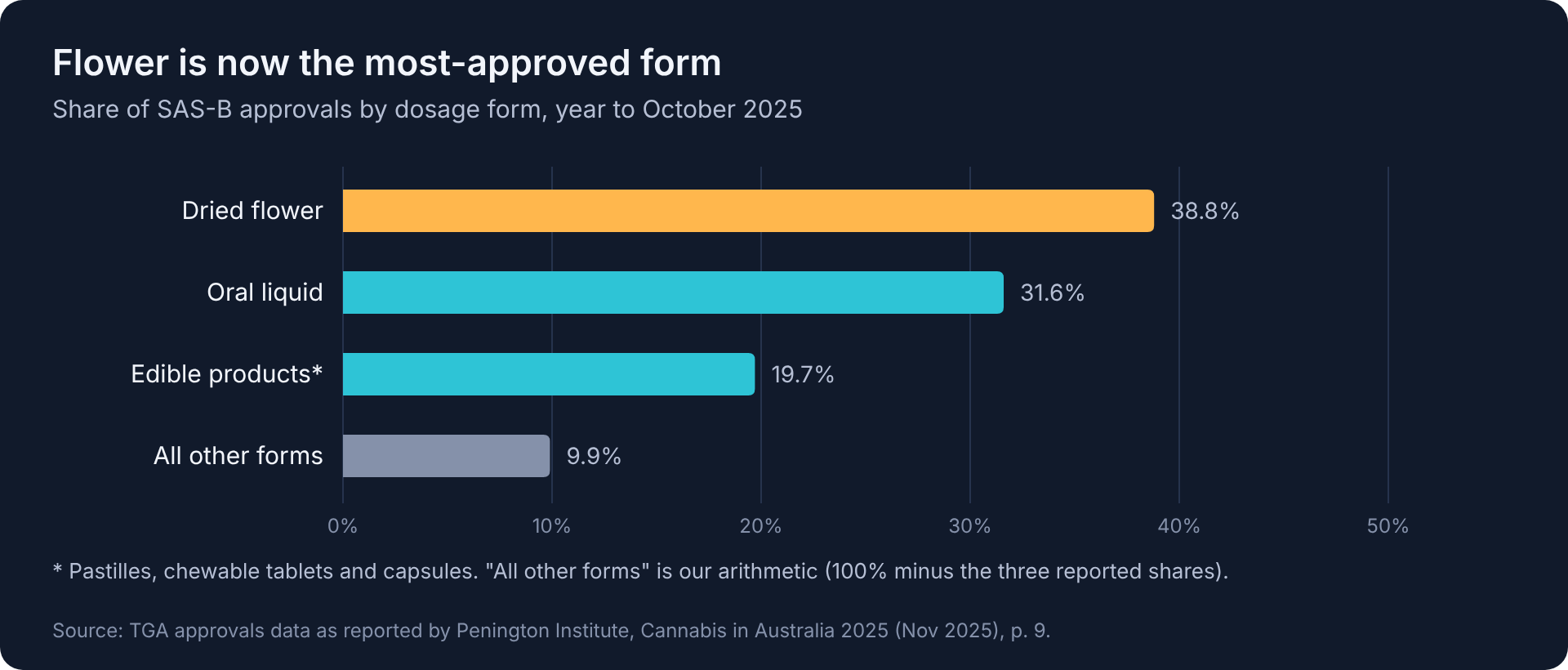
In the year to October 2025, 38.8% of SAS-B approvals were for dried flower, ahead of oral liquids (31.6%) and edible products (19.7%). August 2024 was the first month since legalisation of medical use in which flower approvals outnumbered oral liquids, and they have done so every month since.
The TGA sorts unapproved products into five categories by how much of their cannabinoid content is CBD. Category 5 is the THC-dominant end, with CBD below 2%. (The categories describe a ratio, not potency.) The TGA's August 2025 consultation paper said Category 5 made up nearly half of all applications. Measured by units sold, using sales data the TGA released under freedom of information, Penington puts it at 85% in the first half of 2025.
The conditions written on approvals are just as concentrated. In the Penington data, chronic pain accounted for 43.8% of SAS-B approvals and anxiety for 31.2%, and 59.2% of approvals in the year to October 2025 were for men. Read cold, the numbers describe a market that is mostly men, mostly flower and mostly THC-dominant. The regulators have read them too.
The practitioner regulator's red flags#
On 9 July 2025, the Australian Health Practitioner Regulation Agency (Ahpra) and the National Boards issued guidance for practitioners who prescribe medicinal cannabis. The trigger, in Ahpra's words, was concern about patients arriving at emergency departments with medicinal cannabis-induced psychosis, and prescribing data showing "red flags": eight practitioners had each issued more than 10,000 scripts in a six-month window, and one appeared to have issued more than 17,000.
The guidance reads like a list of things someone, somewhere, had been doing. Among the practices the Boards call poor: consultations "lasting between a few seconds and a few minutes", online questionnaires that coach patients to justify a prescription, and "only prescribing the product supplied by the company you are associated with". Prescribers are expected to take a full social, mental health and substance use history ("This cannot be achieved in a short online consultation"), to treat THC products like any other Schedule 8 drug, and never to prescribe medicinal cannabis as first-line treatment. "Asynchronous prescribing and health care is not supported by the Boards," and an online chat does not count as a real-time consultation.
"We don't prescribe opioids to every patient who asks for them, and medicinal cannabis is no different," said Dr Susan O'Dwyer, chair of the Medical Board of Australia. "Patient demand is no indicator of clinical need." Ahpra's chief executive, Justin Untersteiner, added that the regulator would investigate practitioners with high rates of prescribing any scheduled medicine, "even if we have not received a complaint".
The TGA asks, and 786 people answer#
The TGA opened its own consultation on the safety and oversight of unapproved medicinal cannabis on 11 August 2025 and closed it on 7 October 2025. It received 786 submissions, 615 of them (78%) from consumers, patients, carers or others with a personal interest. Its consultation paper had already put some numbers on the table: 1,101 adverse event reports linked to medicinal cannabis in its database between 2016 and July 2025, a quarter of them classed as serious, with under-reporting "highly likely".
The summary of submissions, published in February 2026, contains the line that made the headlines. Stakeholders told the TGA that "the current access framework, used for exceptional clinical circumstances, is not fit-for-purpose". That is the regulator reporting what it heard, not a ruling of its own, but it is an unusually blunt thing for a regulator to publish about its own framework.
Submitters' concerns were specific: high-THC products and the risk of psychosis and cannabis use disorder; dried herb and vaped extracts; gummies and pastilles that look like lollies to a child; product and device quality; and labelling, including plain packaging. Reform was broadly supported, with a rider that patient access be considered carefully.
What the TGA committed to was gentler. It would use the feedback to inform options for future amendments, consult again on any proposed reforms, improve the information available to practitioners and patients, and explore joint clinical education with other regulators. A TGA presentation for prescribers, posted on its website in May 2026, boiled its message down to three words: "Access ≠ Approval".
As of 13 October 2026, we can find no announced rule change limiting THC content or dosage forms. Consultations, it turns out, are quicker to approve than rules.
The driving question#
For many patients, the change they will actually feel is on the road.
Most of Australia runs a presence offence: drive with any detectable THC and you have committed an offence, whether or not it was prescribed and whether or not you were impaired. In NSW the current penalty is an immediate three-month loss of licence. That is the rule NSW has now rewritten.
The Road Transport Legislation Amendment (Medical Cannabis and Driving Offences) Bill 2026 was introduced by the Minns Government on 25 June 2026, passed the Legislative Assembly on 5 August and passed the Legislative Council, with amendments, on 17 September 2026. It received assent on 23 September as Act No. 33 of 2026.
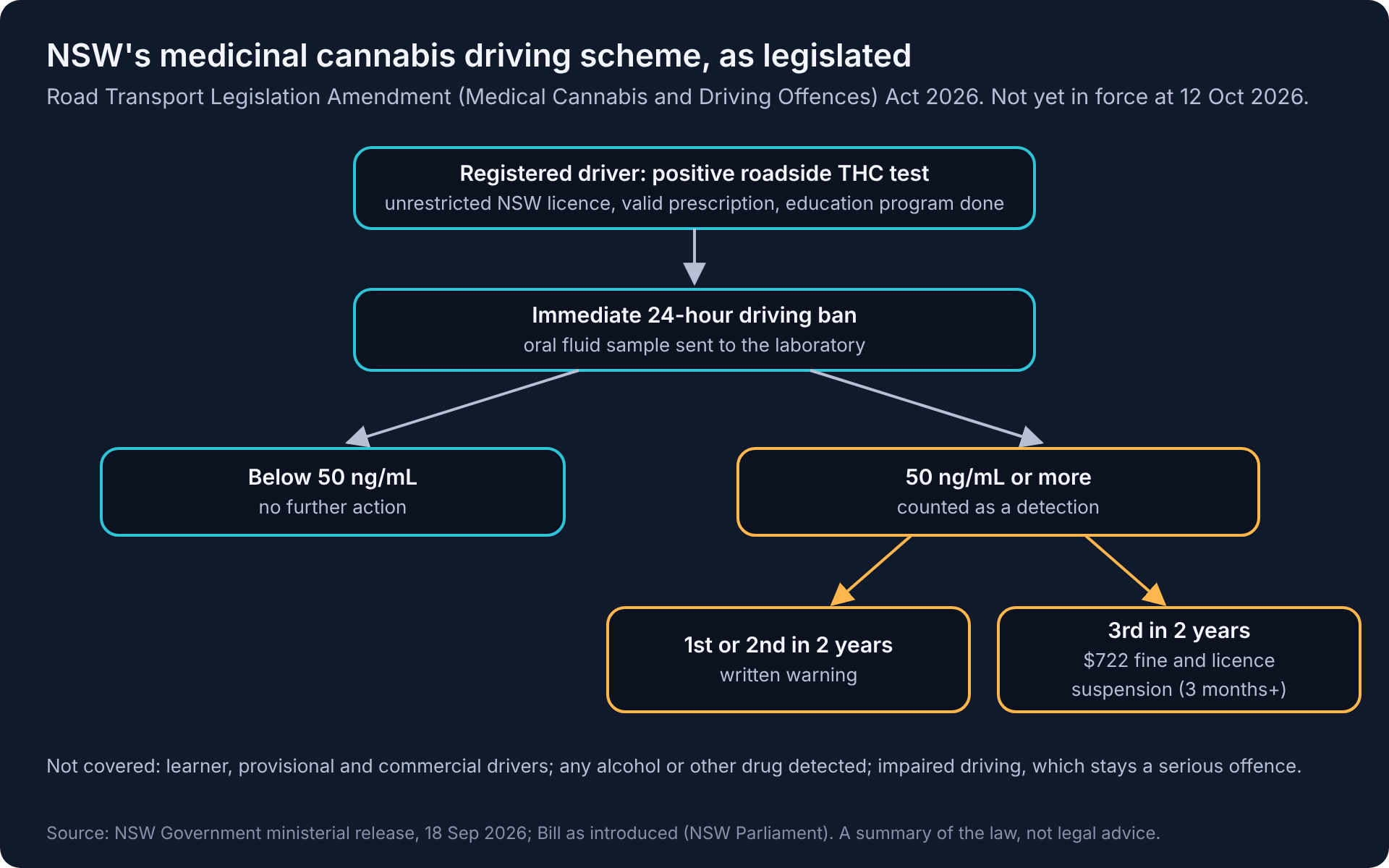
As the NSW Government describes it:
- The scheme covers only drivers with an unrestricted NSW licence who register with Transport for NSW, show a valid prescription and complete an online education program. Learner, P-plate and commercial drivers are excluded.
- Roadside testing does not change: a positive test brings an immediate 24-hour driving ban while the sample goes to a laboratory.
- Below 50 ng/mL of THC, no further action. At or above it, a first or second detection within two years brings a warning; a third brings a $722 fine and a minimum three-month licence suspension.
- The scheme does not apply if alcohol or any other drug is detected. Impaired driving remains a serious offence, and post-crash blood and urine testing still applies.
The Act commences by proclamation. The government says the registry and education program will launch in late 2026 or early 2027, and that the scheme will be reviewed after a year. Until then, the existing rules apply. Around 300,000 people in NSW hold a prescription for medicinal cannabis, according to the government.
"We cannot be any clearer: nobody should drive while impaired by cannabis, alcohol or any other drug," said the Roads Minister, Jenny Aitchison. Jeremy Buckingham of the Legalise Cannabis Party, a long-time campaigner on the issue, said in June that "no patient should be forced to choose between following their doctor's advice and keeping their driver's licence". The NRMA's Peter Khoury put the unanswered question plainly: "How do you measure impairment?" Dr Vikram Puttaswamy of the Royal Australasian College of Surgeons was unconvinced: "On the current evidence, these changes do not pass that test."
The best-known evidence in that argument is a 2020 randomised trial led by Thomas Arkell of the University of Sydney's Lambert Initiative, published in JAMA and run in the Netherlands: 26 healthy adults vaporised cannabis and then drove on a public highway in a dual-control car. CBD-dominant cannabis caused no measurable impairment; THC-containing cannabis caused mild impairment at 40 minutes but not at four hours. It is one small trial of healthy volunteers, not patients, and it says nothing about what is legal. It is a large part of why the debate is now about impairment rather than presence.
Everyone else, as of 13 October 2026#
| Jurisdiction | Prescribed THC and driving |
|---|---|
| NSW | New registration scheme legislated (Act No. 33 of 2026); not yet commenced. |
| Tasmania | No presence offence if the drug was "obtained and administered in accordance with the Poisons Act 1971". In January 2025 a magistrate held that a prescription from an interstate doctor did not qualify. |
| Victoria | Still an offence. Since 1 March 2025, magistrates may decide not to cancel the licence of a driver using prescribed medicinal cannabis. |
| Queensland | Zero tolerance kept, including for people with a prescription. Drug-driving penalties double from 1 December 2026. |
| ACT | Still an offence. A Greens bill to create a defence is before a Legislative Assembly inquiry, still listed as ongoing on 13 October 2026. Attorney-General Tara Cheyne (Region Canberra, 30 Sep 2026): "I absolutely think there's a technology answer to this. It's just we're not there yet." |
| WA, SA, NT | Still an offence; no prescription defence. |
A legal market by another name#
Australia's medicinal system now sits alongside a much larger one it doesn't touch. About 2.5 million Australians (11.5% of people aged 14 and over) used cannabis in 2022–23, according to the AIHW, most of them outside any medical channel. Economists cited by Penington estimate the illicit market was worth more than $5 billion in 2024, and that governments spend about $2.1 billion a year enforcing cannabis prohibition.
Against that backdrop, the prescription market is both the country's only legal one and the one its regulator's own consultation heard described as not fit for purpose. What comes next looks incremental: more scrutiny of prescribers, another round of TGA consultation, and a state-by-state patchwork on the roads. Legalisation is not on the table. The prescription pad is.
State of play as of 13 October 2026. This article reports regulation and law; it is not medical or legal advice. Sources are listed in full below.
Fact-checked 13 October 2026. Editor verdict: Pass With Edits.
Sources#
- Therapeutic Goods Administration, Reviewing the safety and regulatory oversight of unapproved medicinal cannabis products, consultation paper (August 2025), pp. 4, 6, 7, 10: https://consultations.tga.gov.au/medicines-regulation-division/test-soms/user_uploads/final---consultation-paper---medicinal-cannabis-review---august-2025.pdf
- Therapeutic Goods Administration, consultation hub page for the same review (open 11 Aug 2025, closed 7 Oct 2025; "We asked / You said / We did" summary; feedback updated 21 April 2026): https://consultations.tga.gov.au/medicines-regulation-division/test-soms/
- Therapeutic Goods Administration, Unapproved Therapeutic Goods: Medicinal Cannabis Consultation, Practitioner Obligations and Patient Understanding (presentation, posted May 2026): https://www.tga.gov.au/sites/default/files/2026-05/medicinal-cannabis-consultation-practitioner-obligations-patient-understanding.pdf
- Therapeutic Goods Administration, Medicinal cannabis: access pathways and usage data: https://www.tga.gov.au/products/unapproved-therapeutic-goods/medicinal-cannabis-hub/medicinal-cannabis-access-pathways-and-usage-data
- Penington Institute, Cannabis in Australia 2025 (November 2025), pp. 3, 7–9, 13, 17, 27: https://www.penington.org.au/wp-content/uploads/2025/11/Penington_Institute_Cannabis-in-Australia_Nov_2025.pdf
- Australian Institute of Health and Welfare, National Drug Strategy Household Survey 2022–2023, "Medical marijuana/cannabis in the NDSHS": https://www.aihw.gov.au/reports/illicit-use-of-drugs/national-drug-strategy-household-survey-2022-2023/contents/detailed-findings/medical-marijuana-cannabis ; and Summary: https://www.aihw.gov.au/reports/illicit-use-of-drugs/national-drug-strategy-household-survey-2022-2023/contents/summary
- Ahpra, "Guidance on medicinal cannabis prescribing targets unsafe practice" (news release, 9 July 2025): https://www.ahpra.gov.au/News/2025-07-09-Medicinal-cannabis-guidance.aspx
- Ahpra and the National Boards, Medicinal cannabis prescribing (guidance page, reviewed 15 September 2026): https://www.ahpra.gov.au/Resources/Medicinal-cannabis-prescribing.aspx
- King & Wood Mallesons (S. Madar, R. Tan, D. MacRae), "The TGA's medicinal cannabis products review: what stakeholders said and what comes next" (19 March 2026), for the 20 February 2026 publication date: https://pulse.mallesons.com/global/the-tgas-medicinal-cannabis-products-review-what-stakeholders-said-and-what-comes-next/
- RACGP newsGP, "RACGP backs medicinal cannabis reform" (25 February 2026), corroborating the February publication: https://www1.racgp.org.au/newsgp/professional/major-public-health-risk-racgp-backs-medicinal-can
- Parliament of Australia, Senate Legal and Constitutional Affairs Legislation Committee, Legalising Cannabis Bill 2023 report (May 2024), Recommendation 1: https://www.aph.gov.au/Parliamentary_Business/Committees/Senate/Legal_and_Constitutional_Affairs/LegalisingCannabis/Report
- Parliament of NSW, bill details, Road Transport Legislation Amendment (Medical Cannabis and Driving Offences) Bill 2026 (progress, assent 23 Sep 2026, Act No. 33 of 2026): https://www.parliament.nsw.gov.au/bills/Pages/bill-details.aspx?pk=18920 ; first print: https://www.parliament.nsw.gov.au/bill/files/18920/First%20Print.pdf ; as passed by both Houses: https://files.parliament.nsw.gov.au/fileapi/ParlFiles/GetArtifact?serverRelativeUrl=%2Fbill%2Ffiles%2F18920%2FPassed%20by%20both%20Houses.pdf
- NSW Government, "Minns Labor Government's medicinal cannabis driving reforms pass NSW Parliament" (ministerial release, 18 September 2026): https://www.nsw.gov.au/ministerial-releases/minns-labor-governments-medicinal-cannabis-driving-reforms-pass-nsw-parliament
- NSW Government, "Medicinal cannabis driving reforms introduced to Parliament by the Minns Labor Government" (ministerial release, 25 June 2026): https://www.nsw.gov.au/ministerial-releases/medicinal-cannabis-driving-reforms-introduced-to-parliament-by-minns-labor-government
- SBS News, NSW medicinal cannabis driving law (4 June 2026), for the Buckingham and Khoury quotes: https://www.sbs.com.au/news/article/medicinal-cannabis-driving-law-nsw/yewfm45hz
- The Medical Republic (M. Attard), "Driving laws changed for NSW medicinal cannabis users" (18 September 2026), for the Puttaswamy quote: https://medicalrepublic.com.au/driving-laws-changed-for-nsw-medicinal-cannabis-users/129201
- Echo (Byron Bay), "Medicinal cannabis driving reforms pass NSW Parliament" (18 September 2026), and CarExplore (26 September 2026), for the Aitchison quote and commencement status: https://www.echo.net.au/2026/09/medicinal-cannabis-driving-reforms-pass-nsw-parliament/ ; https://www.carexplore.com.au/nsw-medicinal-cannabis-driving-laws-pass-two-warnings-then-722/
- Arkell TR, et al., "Effect of Cannabidiol and Δ9-Tetrahydrocannabinol on Driving Performance: A Randomized Clinical Trial", JAMA (2020), 324(21); summarised by the University of Sydney (2 December 2020): https://www.sydney.edu.au/news-opinion/news/2020/12/02/Cannabidiol-CBD-in-cannabis-does-not-impair-driving-landmark-study-shows.html
- Tasmanian Legislation, Road Safety (Alcohol and Drugs) Act 1970, s 6A: https://www.legislation.tas.gov.au/view/whole/html/inforce/current/act-1970-077
- The Examiner, "Tasmanian ruling on medicinal cannabis driving" (27 January 2025): https://www.examiner.com.au/story/8876305/tasmanian-ruling-on-medicinal-cannabis-driving/
- Department of Transport and Planning (Victoria), Medicinal cannabis and driving laws in Victoria: https://transport.vic.gov.au/road-and-active-transport/road-rules-and-safety/alcohol-drugs-and-driving/medicinal-cannabis-and-driving
- Queensland Government, "Stronger road safety laws target dangerous drivers" (ministerial statement, 26 June 2026): https://statements.qld.gov.au/statements/105410 ; "New laws passed to crack down on dangerous driving" (17 September 2026): https://statements.qld.gov.au/statements/106068
- ACT Legislative Assembly, Road Transport (Alcohol and Drugs) Amendment Bill 2026, explanatory statement (A. Braddock MLA, June 2026): https://www.legislation.act.gov.au/DownloadFile/es/db_74553/current/PDF/db_74553.PDF
- Region Canberra, "Medicinal cannabis driving reform hits roadblock as government says technology isn't ready" (30 September 2026): https://region.com.au/medicinal-cannabis-driving-reform-hits-roadblock-as-government-says-technology-isnt-ready/1004079/
- Penington Institute, "Premiers urged to fix medicinal cannabis driving laws" (21 March 2025), for the position in WA, SA and NT: https://www.penington.org.au/?p=20610
- ACT Legislative Assembly, Standing Committee on Transport and City Services, inquiries list (inquiry into the Road Transport (Alcohol and Drugs) Amendment Bill 2026 resolved 18 June 2026, listed as ongoing on 13 October 2026): https://www.parliament.act.gov.au/parliamentary-business/in-committees/committees-11th-assembly/TCS
- CarExpert, "NSW to relax drug-driving laws for medicinal cannabis users" (21 September 2026), for commencement by proclamation and the late 2026 / early 2027 timing: https://www.carexpert.com.au/car-news/nsw-to-relax-drug-driving-laws-for-medicinal-cannabis-users
- Ahpra, News (listing checked 13 October 2026; no medicinal cannabis item after 23 September 2025): https://www.ahpra.gov.au/news
Pull the thread
Check the THC range recorded for a prescribed product's strain in CannaLib. Everything above is checkable in the same CannaLib tools we used.
This opens the real CannaLib page inside the story, so it only loads when you ask.
curl "https://api.cannalib.org/v1/corpus"
More Strain Stories
- Study05Science and health
Strong cannabis and psychosis: what the big studies can and can't say
What five major studies found on high-THC cannabis and psychosis, what they cannot prove, and why young men carry most of the population risk.
37.1%of first-episode patients used high-potency cannabisRead the story → - Ep.08Lineage Under the Limelight
Zkittlez: taste the rainbow, spell it with a Z
A candy maker sued the breeder of Zkittlez in 2021 over the name. We lay out the dated court record and both sides' statements, then say what we will test in the plant.
$250Kdamages sought by the candy makerRead the story → - Ep.01Lineage Under the Limelight
Pineapple Express: how a movie killed a lineage
Seth Rogen says Pineapple Express weed didn't exist before the movie. Now 40+ breeders sell it with 7 different family trees, and the one DNA sample we can test fits none of them.
7family trees, none fit the DNARead the story →