
Germanycannabis clubsEKOCAN
Germany, two and a half years into legal weed
Clubs barely registered, home growing quadrupled, and the action moved to medical imports. What the official evaluation found, and the bill that stalled.
In this story

On 1 April 2024, Germany became the largest country in the European Union to legalise cannabis for adults. Sort of. There were no shops. Adults could possess limited amounts, grow up to three plants at home, or join a non-profit cultivation association, a "cannabis club", that grows for its members.
It was a compromise built to fit inside EU and international drug treaties, which make commercial sales awkward for a member state. A planned second stage, licensed shops in pilot regions, was never legislated. In September 2025 the federal government confirmed that the new coalition's agreement does not provide for it.
So what did the compromise actually do? As of 13 October 2026, the best answer is the official evaluation, EKOCAN. Its message is that Germans mostly did not join clubs. They grew their own, kept getting cannabis from friends, and the medical system became the biggest legal channel of all.
What the official evaluation measured#
The law came with a built-in review. EKOCAN is run by the University Medical Center Hamburg-Eppendorf (UKE), the University of Tübingen and Düsseldorf University Hospital, and coordinated by Dr Jakob Manthey. Its second interim report appeared on 1 April 2026, the law's second birthday. It is explicitly not the final verdict; the project runs to 2028.
The headline numbers, from the report as relayed by the research team and by independent coverage:
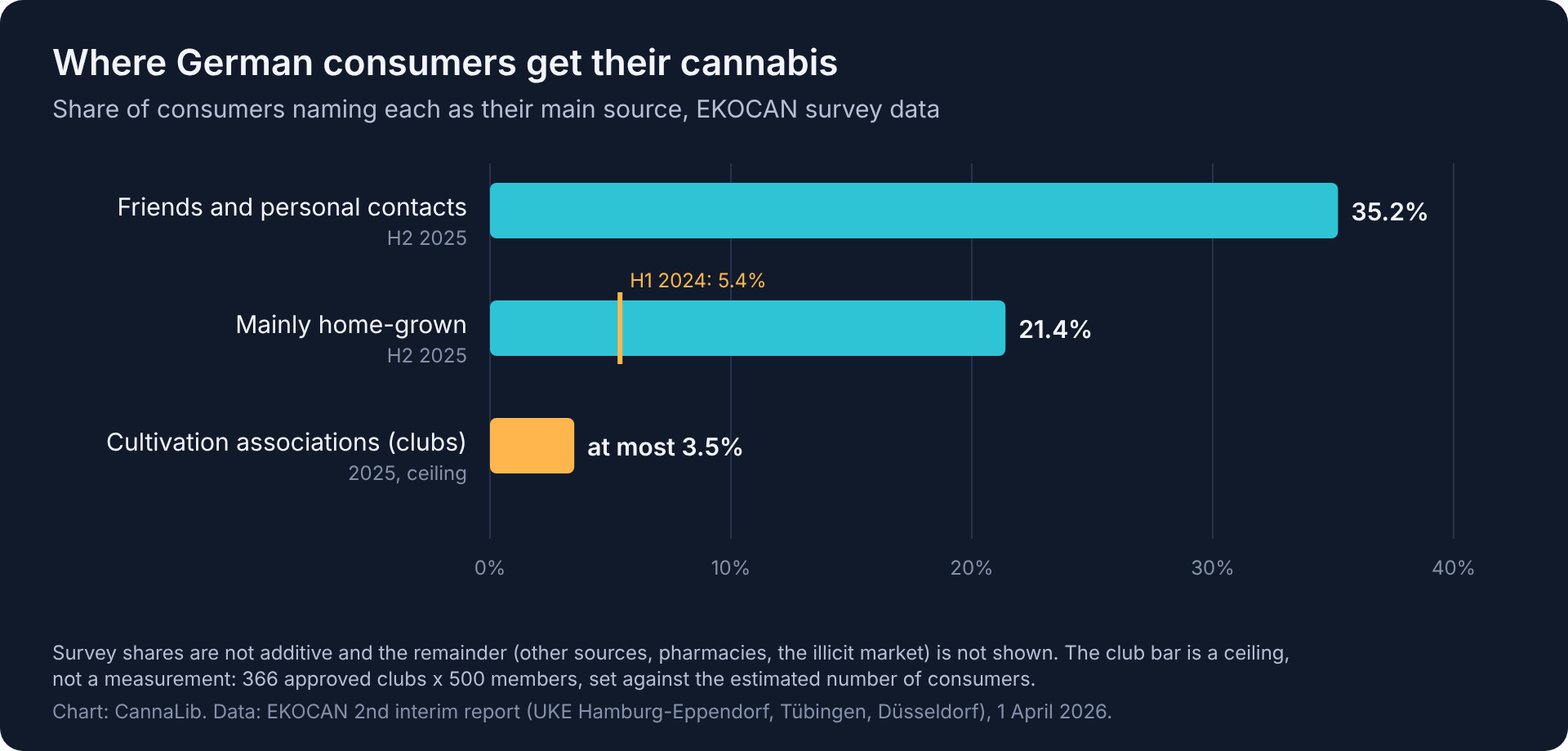
- Home growing. The share of consumers who said they mainly grow their own rose from 5.4% (first half of 2024) to 21.4% (second half of 2025).
- Friends. Social supply was still the most common main source, at 35.2% in the second half of 2025.
- Clubs. At most 3.5% of consumers could have been supplied by a club in 2025. That is a ceiling, not a survey result. It comes from the 366 clubs approved by 31 October 2025, which the researchers say operate in fewer than half of German districts.
- Use. The evaluators say no rise in consumption that can be traced to the reform is currently visible, and that the illicit market is "slowly being displaced by legal offerings" (our translation of the research team's release).
Two cautions before anyone quotes these in an argument. The 5.4% and 21.4% come from survey waves eighteen months apart, so "quadrupled" describes a change in what people told a survey, not a count of plants. And the shares are not additive: they leave out pharmacies, other sources and the illicit market.
The report also found problems. In a survey of more than 2,000 criminal police staff, respondents said it had become harder in practice to hold black-market actors to account. Young people who use cannabis are using early-intervention and counselling services less than before the reform, partly because courts no longer routinely refer them.
Clubs: the legal supply nobody could open#
Clubs were meant to be the lawful alternative to dealers. They are capped at 500 members each by statute (§ 16(2) of the Consumer Cannabis Act, KCanG), and they face strict rules on premises, record-keeping and approvals that vary by state.
The official count in the evaluation is 366 approved clubs at 31 October 2025. The number has kept climbing since. The clubs' own federal association (BCAv) compiles state data and reported 474 approvals from at least 908 applications in early September 2026, with 90 rejections, 131 withdrawals and 9 revocations. That is a trade-association tally, assembled from state authorities on dates that differ from state to state, not an official statistic. It also means that even at 474 clubs the ceiling is about 237,000 members in a country of 83.5 million.
Doctors say: not so fast#
Not everyone read the evaluation as good news. On 10 April 2026, the German psychiatric society (DGPPN), the addiction research society (DG-Sucht) and the child and adolescent psychiatry society (DGKJP) issued a joint statement. We translate their key line: "One cannot currently speak of an all-clear with regard to negative effects."
Their argument is about timing. One large representative survey (the ESA) was fielded "immediately before or shortly after the legalisation in mid-2024"; another in 2025. "There is no annual monitoring by these representative studies," the societies write, and "new reliable data are only expected for 2027." They asked that the report's signals of a possible rise in cannabis-related disorders be flagged "more decisively".
Both sides can be partly right. The early data do not show the youth surge that opponents predicted in 2024. They are also too thin to show it is not coming. Our dry observation: a two-year evaluation of a ten-year question is a progress report, and the doctors are right to say so.
The medical boom, and the two numbers for it#
The same 2024 reform took medical cannabis out of the narcotics prescription regime (no more special narcotics prescription form since 1 April 2024), and the 2025 import figures show where the volume went. EKOCAN says the quantity imported rose by 198% from 2024 to 2025, and that up to 200 tonnes were available in 2025 once 2.6 tonnes of domestic production were included. Its researchers call Germany the largest legal-commercial cannabis market in Europe.
The regulator, BfArM, publishes its own figures, and they give a different percentage. Reported by StratCann in March 2026 from BfArM's statistics, Germany imported 201,094 kg of medical flower in 2025 against 72,850 kg in 2024. That is a rise of 176%. Canada supplied 93,006 kg and Portugal 55,164 kg. Another outlet citing BfArM, Krautinvest, gave 201.1 tonnes for 2025 against 71.1 tonnes for 2024 (a rise of about 183%), so the 2024 base has moved between publications.
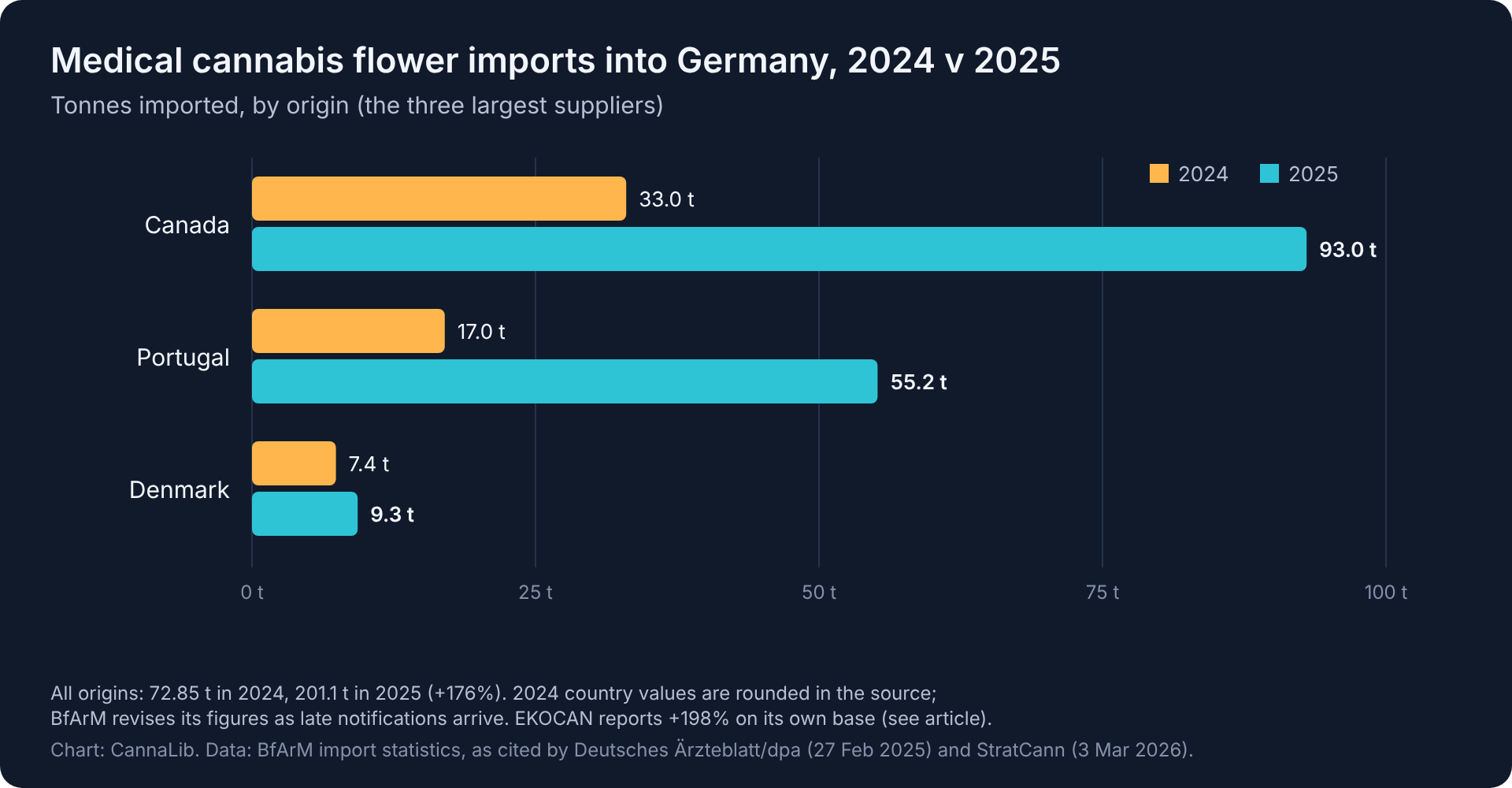
Why the gap? EKOCAN's report states 198% but we could not see its 2024 base; the 198% implies a 2024 base of roughly 67 tonnes against BfArM's 72.85 tonnes. BfArM's chart now carries a note that figures reflect the status at the time of publication, and trade press reports that late notifications have pushed recent quarters up, including a revision of the first quarter of 2026 from 50.5 to 67.6 tonnes in August 2026. Our reading, which is an inference, is that the report and the later BfArM figure rest on different data cut-offs. Either way, imports roughly tripled. We use BfArM's figure when we give a number and flag EKOCAN's as the evaluators' own.
Imports measure what entered the market, not how many patients there are. A policy change worth knowing about came on top: from 30 July 2026, a new law (the GKV-Beitragssatzstabilisierungsgesetz, in the Federal Law Gazette on 29 July) removed cannabis flowers from statutory health insurance cover. Standardised extracts and dronabinol or nabilon medicines stay covered, but since the same law insurers generally pay for them only after a trial of at least six months with an approved cannabis finished medicine. Flowers can still be legally dispensed on a private prescription. The coalition has since tabled an amendment, carried on the emergency-care reform bill, that would drop the fixed six-month period and limit the trial to the indication the finished medicine is approved for; the Bundestag is scheduled to vote on that bill on 15 October 2026. The flower exclusion is not touched by it.
EKOCAN's own recommendation here is blunt. It suggests limiting the THC content of prescribable flower, noting that the flower on offer averages about 25% THC.
The bill that stalled#
The federal government's answer to the online prescription market is an amendment to the Medical Cannabis Act (MedCanG), Bundestag Drucksache 21/3061. The cabinet approved it on 8 October 2025 and it reached the Bundestag on 3 December. As drafted:
- Cannabis flower could be prescribed only after personal contact between doctor and patient, in a practice or on a home visit. Treatment purely by telemedicine is excluded.
- Follow-up prescriptions without a new in-person contact would be allowed only if the patient had been treated in person within the last four quarters, including the current one.
- Mail-order supply of flower to end users would be banned. Pharmacy courier delivery stays.
- The rules cover flower only. Pharmacists' associations told the hearing they want extracts included.
The first reading was on 18 December 2025, and the Health Committee held a public hearing on 14 January 2026. A petition against the bill drew nearly 60,000 signatures and was taken up by the Petitions Committee on 23 February 2026.
Then it stalled. The SPD, the coalition's junior partner, has said it cannot approve the bill in this form; its deputy health spokesperson, Matthias Mieves, called blanket bans "not purposeful" (our translation). The Union's health spokesperson, Simone Borchardt, said in February that the parties were exploring compromises and she could not say when the process would end. As of 13 October 2026, we found no record of a second or third reading. In a written answer dated 22 September 2026 (Drucksache 21/8143), the federal government described the bill as "currently in parliamentary deliberation" (our translation), and it is not on the Bundestag's plenary agenda for the sitting week of 14 to 16 October 2026. Until it passes, nothing in it is law.
What to watch#
- Whether MedCanG moves. A bill that has sat for ten months is less a plan than a mood.
- Whether the reform of the clubs happens. The evaluators recommend easing the rules and strengthening club supply. Approvals are growing, but from a base of almost nothing.
- The 2027 data. That is when the societies expect reliable survey data, and when the "no rise" finding will be tested.
Germany's experiment turned out to be less about legalisation than about where people get cannabis when shops aren't allowed. Its legislators, meanwhile, are still arguing about the paperwork.
Fact-checked 13 October 2026. Editor verdict: Pass With Edits.
Sources#
- Heinrich Heine University Düsseldorf / Universitätsmedizin Düsseldorf (with Tübingen and UKE), "Neue Zwischenergebnisse zur Evaluation des Konsumcannabisgesetzes (KCanG)", 1 April 2026: https://www.medizin.hhu.de/news-detailinformation/neue-zwischenergebnisse-zur-evaluation-des-konsumcannabisgesetzes-kcang
- EKOCAN, "Evaluation des Konsumcannabisgesetzes (EKOCAN): 2. Zwischenbericht", UKE/ZIS Hamburg, 1 April 2026 (222 pages, German; English summary): https://doi.org/10.25592/uhhfdm.18530 (UKE publications page: https://www.uke.de/english/landingpage/ekocan/publications/index.html). Not directly readable from our desk; see factcheck.md.
- LTO, report on the EKOCAN second interim report (366 clubs at 31 Oct 2025, "at most 3.5 percent", THC recommendation, "größten ... legal-kommerziellen Cannabismarkt Europas"): https://www.lto.de/recht/hintergruende/h/cannabis-teillegalisierung-evaluierung-ekocan-anbauvereinigung-medizinalcannabis/print.html
- Newsweed, "EKOCAN report: cannabis legalization in Germany is working... but not as legislators intended" (5.4% to 21.4%, 35.2%, 366 clubs / 183,000 members): https://www.newsweed.fr/en/ekocan-report-cannabis-legalization-in-germany-works-but-not-as-legislators-intended/
- DGPPN, DG-Sucht, DGKJP, joint statement on EKOCAN, 10 April 2026: https://www.dgkjp.de/wp-content/uploads/2026-04-10_STN_EKOCAN_final.pdf (also https://www.dgppn.de/_Resources/Persistent/0a27971e4838c9e19811781e6473e78ac061793f/2026-04-10_STN_EKOCAN_final.pdf)
- BfArM import statistics as cited by StratCann, "Canada continued to supply bulk of German medical cannabis imports in 2025", David Brown, 3 March 2026: https://stratcann.com/?p=47569 (BfArM source page: https://www.bfarm.de/DE/Bundesopiumstelle/_FAQ/Medizinisches-Cannabis/MedCan-Einfuhr-Ausfuhr/faq-liste.html)
- Deutsches Ärzteblatt / dpa, "Massiver Anstieg bei Import von medizinischem Cannabis" (BfArM 2024 quarterly and origin figures), 27 February 2025 (updated 26 March 2025): https://www.aerzteblatt.de/news/massiver-anstieg-bei-import-von-medizinischem-cannabis
- KrautInvest and Hanfjournal on BfArM revisions to quarterly import data (20 and 24 August 2026): https://krautinvest.de/33-7-increase-of-q1-cannabis-imports-after-bfarm-update/ and https://hanfjournal.de/2026/08/24/17-tonnen-verschwunden-und-wieder-aufgetaucht-deutschlands-cannabisboom-ist-groesser-als-gedacht/
- Apotheke Adhoc, "Medizinalcannabis: Deutschland XL-Markt" (EKOCAN +198%, about 200 t): https://www.apotheke-adhoc.de/rubriken/detail/medizinisches-cannabis/medizinalcannabis-deutschland-xl-markt/
- Bundestag, Drucksache 21/3061, Entwurf eines Ersten Gesetzes zur Änderung des Medizinal-Cannabisgesetzes, 3 December 2025: https://dserver.bundestag.de/btd/21/030/2103061.pdf
- Bundestag, press notice for the Health Committee hearing of 14 January 2026: https://www.bundestag.de/presse/pressemitteilungen/2026/pm-2601071-oepm-0114-gesundheit-1135622 and hib 32/2026: https://www.bundestag.de/presse/hib/kurzmeldungen-1136652
- Pharmazeutische Zeitung: "MedCanG: Kabinett beschließt Cannabis-Versandverbot" (8 Oct 2025): https://www.pharmazeutische-zeitung.de/kabinett-beschliesst-cannabis-versandverbot-159473/ ; "Das MedCanG und das Strucksche Gesetz" (22 Dec 2025, with later teasers): https://www.pharmazeutische-zeitung.de/das-medcang-und-das-strucksche-gesetz-161476/ ; "MedCanG: Knackpunkt Cannabis-Versandverbot" (4 Feb 2026): https://www.pharmazeutische-zeitung.de/knackpunkt-cannabis-versandverbot-162488/
- Medicanova, "Cannabis-Rezept online verboten? Stand 2026", 14 September 2026 (status check; the publisher is a telemedicine platform with an interest in the outcome): https://medicanova.de/en/magazin/cannabis-rezept-online-verbot-novelle
- ABDA, "Neue Regeln für Cannabisarzneimittel, Homöopathika und Anthroposophika in Kraft" (30 July 2026): https://www.abda.de/aktuelles-und-presse/newsroom/detail/neue-regeln-fuer-cannabisarzneimittel-homoeopathika-und-anthroposophika-in-kraft/ ; Apotheke Adhoc, "BStabG: Ab morgen kein Cannabis auf Kassenrezept" (29 July 2026): https://www.apotheke-adhoc.de/nachrichten/detail/politik/bstabg-ab-morgen-kein-cannabis-auf-kassenrezept/
- Hanfjournal, "474 Cannabis-Clubs genehmigt" (6 Sept 2026, BCAv tally): https://hanfjournal.de/2026/09/06/474-cannabis-clubs-genehmigt-deutschland-vor-der-500er-marke/ ; ms-aktuell (21 Aug 2026): https://ms-aktuell.de/?p=152919
- Bundestag hib 426/2025, government answer on the "second pillar" (16 Sept 2025): https://www.bundestag.de/presse/hib/kurzmeldungen-1109938
- Konsumcannabisgesetz (KCanG) § 9 and § 16: https://gesetze.legal/bund/kcang/9 and https://lxgesetze.de/kcang/16
- Destatis, "Bevölkerung Deutschlands sinkt im Jahr 2025 um 0,1 %" (June 2026): https://www.destatis.de/DE/Presse/Pressemitteilungen/2026/06/PD26_203_124.html
- KV Baden-Württemberg, "Seit 1. April 2024 kein BtM-Rezept mehr für Cannabisverordnungen zu medizinischen Zwecken": https://www.kvbawue.de/praxis/verordnungen/aktuelles-zu-verordnungsthemen/news-artikel/seit-1-april-2024-kein-btm-rezept-mehr-fuer-cannabisverordnungen-zu-medizinischen-zwecken
- AP via drugsandalcohol.ie, "Germany legalises cannabis for recreational use despite opposition" (1 April 2024): https://www.drugsandalcohol.ie/40802
- Pharmazeutische Zeitung, "Medizinalcannabis statt Social Clubs" (April 2026), reporting the EKOCAN second interim report (5.4%, 21.4%, 35.2%, 366 clubs, 3.5% ceiling): https://www.pharmazeutische-zeitung.de/medizinalcannabis-statt-social-clubs-164126/
- Krautinvest, "Cannabis-Importe belaufen sich 2025 auf 201,1 Tonnen" (BfArM totals 2025 and 2024): https://krautinvest.de/cannabis-importe-belaufen-sich-2025-auf-2011-tonnen/ ; Gelbe Liste, "Import von Cannabis mehr als verdoppelt" (BfArM 2024 by origin, March 2025): https://www.gelbe-liste.de/allgemeinmedizin/deutschland-cannabis-import-anstieg-regulierung
- Bundestag, Drucksache 21/8143, Antwort der Bundesregierung auf die Kleine Anfrage der Fraktion Bündnis 90/Die Grünen (21/7856), "Umsetzung und Weiterentwicklung der Cannabisgesetzgebung", 22 September 2026 (MedCanG amendment "derzeit in der parlamentarischen Beratung"): https://dserver.bundestag.de/btd/21/081/2108143.pdf
- Bundestag, Tagesordnung and Ablaufplan for the 101st to 103rd sittings, 14 to 16 October 2026 (status 12 October 2026; no item on Drucksache 21/3061; item 8: Notfallreform, Drucksache 21/6808): https://www.bundestag.de/resource/blob/473450/Tagesordnung-komplett-kommende-Woche.pdf and https://www.bundestag.de/resource/blob/473454/Ablaufplan-kommende-Woche.pdf (rolling URLs; archived copy recommended)
- Bundestag hib 672/2026, 28 August 2026, on the six-month trial rule in § 31(6) SGB V introduced by the GKV-Beitragssatzstabilisierungsgesetz (passed 10 July 2026): https://www.bundestag.de/1206602 ; KVSH, "Cannabis: Neubewertung", 18 August 2026: https://www.kvsh.de/fileadmin/user_upload/dokumente/Praxis/Verordnungen/Arzneimittel/Cannabis_Neubewertung_18.08.26.pdf
- Bund Deutscher Cannabis-Patienten (BDCan), statement of 5 October 2026 on Änderungsantrag 11 (Ausschussdrucksache 21(14)107, Notfallreform) for the Health Committee hearing of 7 October 2026: https://www.bundestag.de/resource/blob/1222630/21-14-00108-19-BDCan-AeA-GKV-barrierefrei.pdf ; Apotheke Adhoc, "Zyto und Cannabis: Anhörung im Ausschuss", 1 October 2026: https://www.apotheke-adhoc.de/nachrichten/detail/politik/zyto-und-cannabis-anhoerung-im-ausschuss/ ; Pharmazeutische Zeitung, "Klarstellung zur Cannabis-Vorrangregelung": https://www.pharmazeutische-zeitung.de/klarstellung-zur-cannabis-vorrangregelung-168800/
- StratCann, "Canada supplied half Germany's cannabis imports in Q1 2026", 15 May 2026, updated 19 August 2026 (BfArM Q1 2026 revision 50,539 to 67,569 kg): https://stratcann.com/news/canada-supplied-half-germanys-cannabis-imports-in-q1-2026/
- Pharmazeutische Zeitung / dpa, "Cannabis-Anbauvereine vor allem im Norden" (RND survey of the states: 413 approved, 864 applications), 13 April 2026: https://www.pharmazeutische-zeitung.de/cannabis-anbauvereine-vor-allem-im-norden-164415/
Pull the thread
Look up the strain you grow or buy and compare its sources in CannaLib. Everything above is checkable in the same CannaLib tools we used.
This opens the real CannaLib page inside the story, so it only loads when you ask.
curl "https://api.cannalib.org/v1/corpus"
More Strain Stories
- Study01Science and health
Indica, sativa and other comforting fictions
Three studies of cannabis genetics and chemistry find indica, sativa and hybrid labels barely track the plants. What the labels do capture, and how to read a lab result.
122samples of 30 named strains in the genotyping studyRead the story → - Study05Science and health
Strong cannabis and psychosis: what the big studies can and can't say
What five major studies found on high-THC cannabis and psychosis, what they cannot prove, and why young men carry most of the population risk.
37.1%of first-episode patients used high-potency cannabisRead the story → - No.04Label vs Lab
"Award-winning"? We could confirm 43% of the claims we could check
We checked 7,627 cannabis award claims against 21,141 published cup results. 54% are too vague to check; of the 797 cleanest claims, 43% matched.
43%of checkable award claims matchRead the story →