
landraceslineagegenetics
Landraces: where the cannabis family tree runs out
Almost nine in ten strains in our lineage map trace back to a record tagged with a place. The farmer varieties underneath are fewer, and harder to find.
In this story
Pick a modern strain and follow its parents back. Gelato is credited to Sunset Sherbet and Thin Mint Cookies, a Girl Scout Cookies cut. Girl Scout Cookies is credited to OG Kush and a Durban cross. Keep going and sooner or later you hit a wall: a name with no recorded parents, and often the name of a place. Afghani. Thai. Colombian. Durban.
Those are the landraces, or at least the labels we stick on them. They are the bottom of the family tree, the point where the records run out and geography takes over. They are also easy to misread, so it is worth being precise about what is down there and what is not.
In our lineage map, 49,956 of 57,015 strains reach a record tagged with a place of origin. How few records that really is, and what they stand for, is the story here.
What a landrace is#
A landrace is a traditional farmer variety. A 2005 paper in Plant Genetic Resources by Camacho Villa and colleagues, built on a literature review, a workshop and expert interviews, defines it as a dynamic population of a cultivated plant with a historical origin and a distinct identity. Local adaptation and ties to traditional farming are on the authors' list of common traits. Mojave Richmond and Robert C. Clarke, a breeder and an ethnobotanist writing in Cannabis Business Times, add the cannabis twist: the plant is wind-pollinated, so each field is a mixed crowd of relatives, and they credit "wind-blown free love" for the diversity that resulted.
The key word is population. A landrace is not a single plant and not a single clone. It is a variable crop, shaped by generations of farmers saving seed and by the climate and soil around them.
That matters for the names on a modern seed list. An "Afghani" in a catalogue is a breeder's line, not a field in Afghanistan. Clarke and Merlin, in a 2016 review in Critical Reviews in Plant Sciences, describe the drug cannabis gene pool as having "reached a genetic bottleneck" through inbreeding, selfing and vegetative propagation. Landrace names on the menu carry landrace ancestry. They are not the landrace.
Twelve thousand years, with error bars#
The deepest history got a major update in 2021. Guangpeng Ren, Luca Fumagalli and ten co-authors from Switzerland, China, the UK, India, Pakistan and Qatar published a whole-genome study in Science Advances of 110 cannabis accessions: 82 newly sequenced and 28 from public data. The set spanned feral plants, landraces, hemp cultivars and drug cultivars.
Their reading of the genomes:
- Cannabis was probably first domesticated in East Asia, in the early Neolithic. The authors date the split between the earliest domesticated plants and the basal group to about 12,000 years ago, with a 95% confidence interval of roughly 6,500 to 15,700 years. They set this against what they call a widely accepted view of a Central Asian origin.
- All current hemp and drug cultivars in the study descend from an ancestral gene pool still represented by feral plants and landraces in China.
- The truly wild progenitors have probably gone extinct, though the authors say more sampling of feral plants is needed. The feral plants they studied are, in their words, "historical escapes from domesticated forms", not wild types.
- Their models suggest that only a small number of early domesticated lines went on to form the later hemp and drug types, around 4,000 years ago. Genes linked to suppressing branching show selection in hemp types, and genes linked to promoting it in drug types, which fits tall fibre plants on one side and shorter, branching flowering plants on the other.
Treat it as the best current genomic estimate from one study, not settled fact. The authors flag that the breeding history of drug accessions is often unclear. The wide interval is the honest part of the headline number.
How the seed got west#
For most of that history, drug cannabis spread with people and trade, settling into regional landraces. The modern Western gene pool starts much later, and the usual account is well documented in outline and fuzzy in detail.
Clarke and Merlin place the imports in two waves. In the 1960s and early 1970s, they write, commercial marijuana in North America and Europe owed its heritage to the "narrow-leaflet" landraces of places such as Mexico, Colombia, Jamaica and Thailand. Afghan landraces, from the broad-leaflet group, were introduced to Europe and North America several times from the late 1970s through the 1980s. By the mid-1980s, they say, most sinsemilla in North America owed part of its heritage to that Afghan pool.
Richmond and Clarke describe the seed as arriving mostly inside illicit flower from Afghanistan, Thailand, Colombia, Jamaica and Mexico. In "The Curse of Kush", they add that Afghan hashish-plant genetics suited growers working indoors because the plants were short, early to finish and resinous. The overland hippie trail through Istanbul, Iran and Afghanistan to Nepal did carry thousands of travellers in the late 1960s and early 1970s. Beyond that, stories of exactly who carried which seed, and when, are breeder lore. We have left the names out, because we could not source them.
The famous crosses show the pattern. Skunk #1, credited to David Watson, is described as an Afghan, Mexican and Colombian Gold hybrid. Watson left Santa Cruz, California, for Amsterdam in 1985 and started Cultivator's Choice in 1986. Blueberry, in DJ Short's work in Eugene, Oregon, started from four strains, his son JD Short says: Thai, Chocolate Thai, Afghan and Oaxacan. The pheno everyone loves showed up "probably around 1979", he adds.
Behind every one of those plants were farming families who had spent generations selecting it.
What our records show#
Here is what the bottom of our lineage map looks like. The build of 14 September 2026 joins every parent claim we hold into a single graph, and each number below has a precise meaning that is easy to blur.
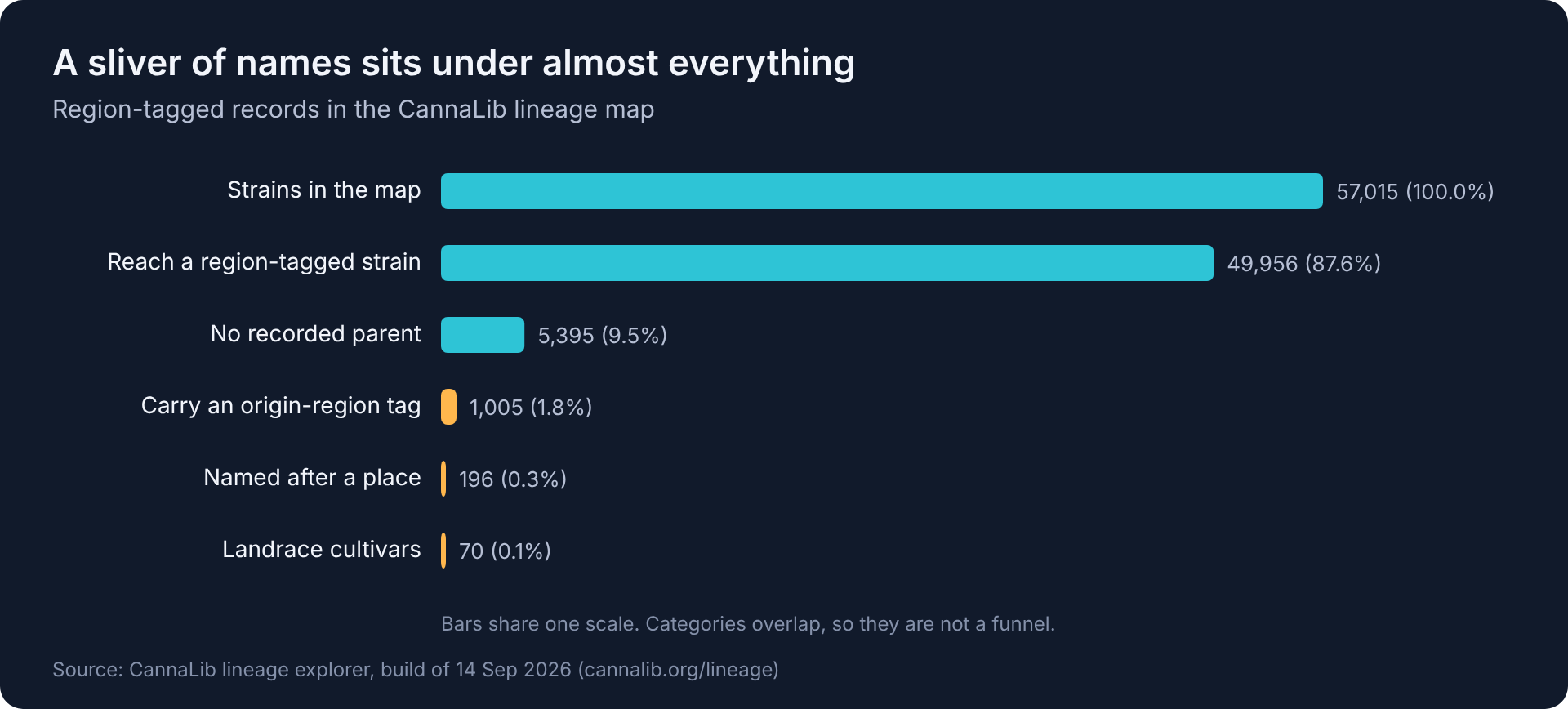
- 5,395 roots are strains with no recorded parent. As we said in our piece on the cannabis family tree, a founder is where the paperwork stops, not proof of a beginning.
- 196 place nodes are records named after a place: Afghani, Thai, Colombian, Durban. The match is by name, so it cannot tell a landrace region from a breeders' home turf.
- 70 landrace cultivars are named strains that a source ties to a landrace region, and whose only recorded parents, if any, are place nodes. This is a derived label, not a botanical one.
- 1,005 records carry an origin-region tag of any kind. That includes the 196 and the 70, plus another 739 strains that one source or another places in a region.
- 49,956 strains (87.6% of 57,015) have a region tag themselves or a tagged strain somewhere in their recorded ancestry. That counts only the 30 most common regions, and it is not a count of descendants of the 70 cultivars.
Two things follow. First, 1,005 tagged records against 5,395 roots means at least 4,390 roots carry no region at all. Most of the bottom of the tree is simply where somebody stopped writing. Second, a tag only has to appear once in a pedigree to count, so 1,005 tagged records can sit upstream of nearly nine in ten strains.
Afghani is the clearest case. It is recorded as a direct parent of 746 strains, and 47,997 strains sit below it through recorded links, 84% of the map. It is the only place name among the twelve most-used parents.
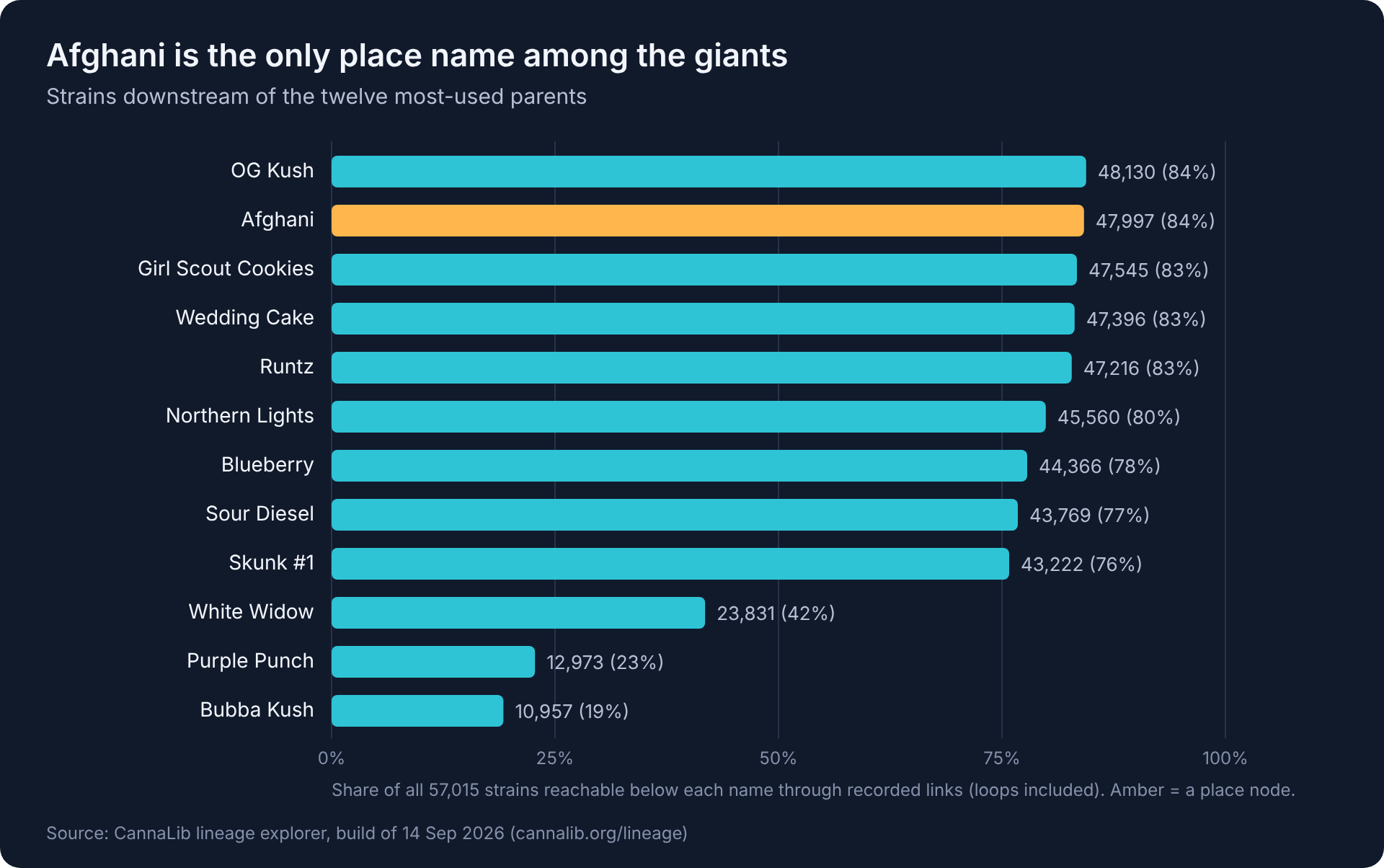
Treat the top end with some suspicion. Wedding Cake and Runtz, strains of the last decade, show up with nearly as many descendants as Afghani. That points to some links running backwards, which our five recorded loops confirm exist. The broad picture, that Afghan genetics are very widespread, matches the history above. The exact figure does not.
The curse of kush#
That concentration has a cost, argue Richmond and Clarke. In a 29 April 2020 column, "The Curse of Kush", they say Afghan landraces evolved in a dry climate with few fungi, so there was little pressure to evolve resistance, and that they proved "highly susceptible to fungal attack". The inbred OG Kush family then spread widely, and breeders crossing in its aroma and appeal passed the susceptibility on. Indoor and greenhouse air is usually more humid than outdoor air, which they say compounds the problem.
Their warning is that this could mean "catastrophic crop losses that will prove to be unsustainable in a normalized agricultural cannabis industry". They also say "nobody is to blame".
This is an argument from two experienced hands in a trade column, not a trial. The molecular work on mildew resistance in cannabis is early: a 2021 genome study of the MLO gene family in 32 cultivars found two candidate susceptibility genes and called the link preliminary. For comparison, Gros Michel, a banana grown from suckers, was the export banana until Panama disease infested most first-class banana soils by the 1950s and the trade moved to Cavendish. We are not saying cannabis is there. We are saying that a narrow base is a well-known way to lose a crop.
What is being lost#
Meanwhile the source populations are under pressure. Richmond and Clarke list three causes. Seed for export production supplanted many regional varieties. The war on drugs made traditional farming too risky for family farmers, and the illicit trade took over. And clone-only varieties "carpet the world", spreading uniformity.
They put the problem bluntly: "although we are spreading and sharing genetically different varieties worldwide, we are not expanding the Cannabis gene pool." The number of named strains keeps climbing. The number of independent ancestors under them does not.
What our data can add is a map of where the diversity is thin. When a "new" strain's recorded pedigree reaches only the same few names, that is worth knowing. When it reaches something rarer, that is worth knowing too.
Start with a strain you know in the lineage explorer, switch to the Origins lens and follow it down. Somewhere near the bottom the paperwork stops, and the farming families who made the plant rarely get a mention.
Figures are from the CannaLib lineage build of 14 September 2026. Sources are listed in full below.
Fact-checked 12 October 2026. Editor verdict: Pass With Edits.
Sources#
- Ren, G., Zhang, X., Li, Y., Ridout, K., Serrano-Serrano, M. L., Yang, Y., Liu, A., Ravikanth, G., Nawaz, M. A., Mumtaz, A. S., Salamin, N. and Fumagalli, L. (2021), "Large-scale whole-genome resequencing unravels the domestication history of Cannabis sativa", Science Advances 7(29): eabg2286. https://doi.org/10.1126/sciadv.abg2286 (open copy: https://pmc.ncbi.nlm.nih.gov/articles/PMC8284894)
- Camacho Villa, T. C., Maxted, N., Scholten, M. and Ford-Lloyd, B. (2005), "Defining and identifying crop landraces", Plant Genetic Resources 3(3): 373-384. https://doi.org/10.1079/PGR200591
- Richmond, M. and Clarke, R. C., "Cannabis landraces: past, present and future?", Cannabis Business Times (March 2018; online 24 February 2020): https://www.cannabisbusinesstimes.com/columns/growing-pains/article/15702583/cannabis-landraces-past-present-and-future
- Richmond, M. and Clarke, R. C., "The Curse of Kush", Cannabis Business Times (29 April 2020): https://www.cannabisbusinesstimes.com/article/the-curse-of-kush/
- Clarke, R. C. and Merlin, M. D. (2016), "Cannabis domestication, breeding history, present-day genetic diversity, and future prospects", Critical Reviews in Plant Sciences 35(5-6): 293-327. https://doi.org/10.1080/07352689.2016.1267498
- Association for Diplomatic Studies and Training, "Cannabis and Cabbages: Serving at the Last Stop of the Hippie Trail" (Edward Gnehm, consular officer in Nepal 1969-71): https://adst.org/?p=18425
- Cannabis Business Times, "Legendary Cannabis Breeder David Watson, aka 'Sam the Skunkman,' Dies" (January 2025): https://cannabisbusinesstimes.com/top-stories/news/15736155/legendary-cannabis-breeder-david-watson-aka-sam-the-skunkman-dies
- Willamette Week, "We Talked to JD Short, Son of Legendary Eugene Breeder DJ Short, About the Origins of Blueberry" (Martin Cizmar, 17 April 2017): https://www.wweek.com/cannabis/2017/04/17/we-talked-to-jd-short-son-of-legendary-eugene-breeder-dj-short-about-the-origins-of-blueberry/
- Leafly strain pages, Gelato, Girl Scout Cookies and Durban Poison (parentage as stated by the publisher; accessed 12 October 2026): https://www.leafly.com/strains/gelato , https://www.leafly.com/strains/girl-scout-cookies , https://www.leafly.com/strains/durban-poison
- Pépin, N., Hebert, F. O. and Joly, D. L. (2021), "Genome-wide characterization of the MLO gene family in Cannabis sativa reveals two genes as strong candidates for powdery mildew susceptibility", Frontiers in Plant Science 12. https://doi.org/10.3389/fpls.2021.729261
- Ploetz, R. C. (2005), "Panama disease, an old nemesis rears its ugly head: Part 1, the beginnings of the banana export trades", Plant Health Progress (21 December 2005). https://doi.org/10.1094/PHP-2005-1221-01-RV
- CannaLib lineage explorer and stats file `publish/lineage-explorer/lineage_graph.stats.json`, build of 14 September 2026 (field definitions from `scripts/build_lineage_graph.py`): https://cannalib.org/lineage/
Pull the thread
Trace Gelato back through its parents and see where the records stop. Everything above is checkable in the same CannaLib tools we used.
- Lineage sky map
See Gelato in the family tree
The family tree, drawn from recorded parent-to-child edges.
Open → - Explorer
Open the Gelato card
Every claim, test and alias for one strain, on one card.
Open →
This opens the real CannaLib page inside the story, so it only loads when you ask.
curl "https://api.cannalib.org/v1/catalogs/strains?q=Gelato&limit=5"
More Strain Stories
- Ep.08Lineage Under the Limelight
Zkittlez: taste the rainbow, spell it with a Z
A candy maker sued the breeder of Zkittlez in 2021 over the name. We lay out the dated court record and both sides' statements, then say what we will test in the plant.
$250Kdamages sought by the candy makerRead the story → - Note05Field notes
57,015 strains in rings: how we drew a family tree that won't stop branching
143,611 named cannabis strains, 118,039 parent links and 7.36 million evidence-backed data points, drawn as a radial map of 57,015 strains. How the graph is built and where the data fights back.
57,015strains drawn in generation ringsRead the story → - Ep.06Lineage Under the Limelight
Girl Scout Cookies: Thin Mints and cease-and-desist letters
In January 2017 the Girl Scouts of the USA sent cease-and-desist letters over the strain name Girl Scout Cookies. We report what the letters said, where sources disagree on the strain's origin, and what our upcoming DNA and lab release will test.
1936year GSUSA's statement says its trademark dates back toRead the story →