
lineagerecordsbreeding
The cannabis family tree has loops in it
We mapped 118,186 recorded parent links between 57,015 strains. The tree is shallow, a dozen names sit behind almost everything, and 578 strains are, on paper, their own ancestors.
In this story
Somewhere in the cannabis records is a strain that is its own ancestor. Not as a metaphor. Follow its recorded parent links far enough and you arrive back where you started.
This is not a quirk of one bad listing. When we built the CannaLib lineage graph in September, joining every published parent claim we hold into one family tree, we found five separate loops. The biggest has 563 strains in it. Every one of those 563 is, according to the paperwork, both an ancestor and a descendant of all the others.
Plants cannot do this. A seed has two parents, and those parents existed first. So a loop proves that somewhere along the chain, somebody wrote a parent and a child the wrong way round, or gave two different plants the same name. The interesting question is not whether the records are wrong. It is what the shape of the whole tree tells you about how cannabis genetics have been passed around, written down and sold for fifty years.
What we actually mapped#
The lineage explorer draws every resolved parent-to-child link in the CannaLib catalogue. The build of 14 September 2026 holds:
- 57,015 strains connected by 118,186 parent links.
- 18,910 of those links (16%) are stated by two or more independent sources. The other 84% rest on a single source.
- 5,395 founders: strains with no recorded parent at all.
- 70 landrace cultivars and 196 place-of-origin nodes (Afghani, Thai, Colombian and so on).
A "founder" in this map is not the same thing as an ancient wild plant. Some founders are genuine landraces. Many are simply where the paperwork stops: a breeder never published the cross, or a cut arrived as an unnamed clone and got its name later. A founder is a record that ends, not proof of a beginning.
A surprisingly shallow tree#
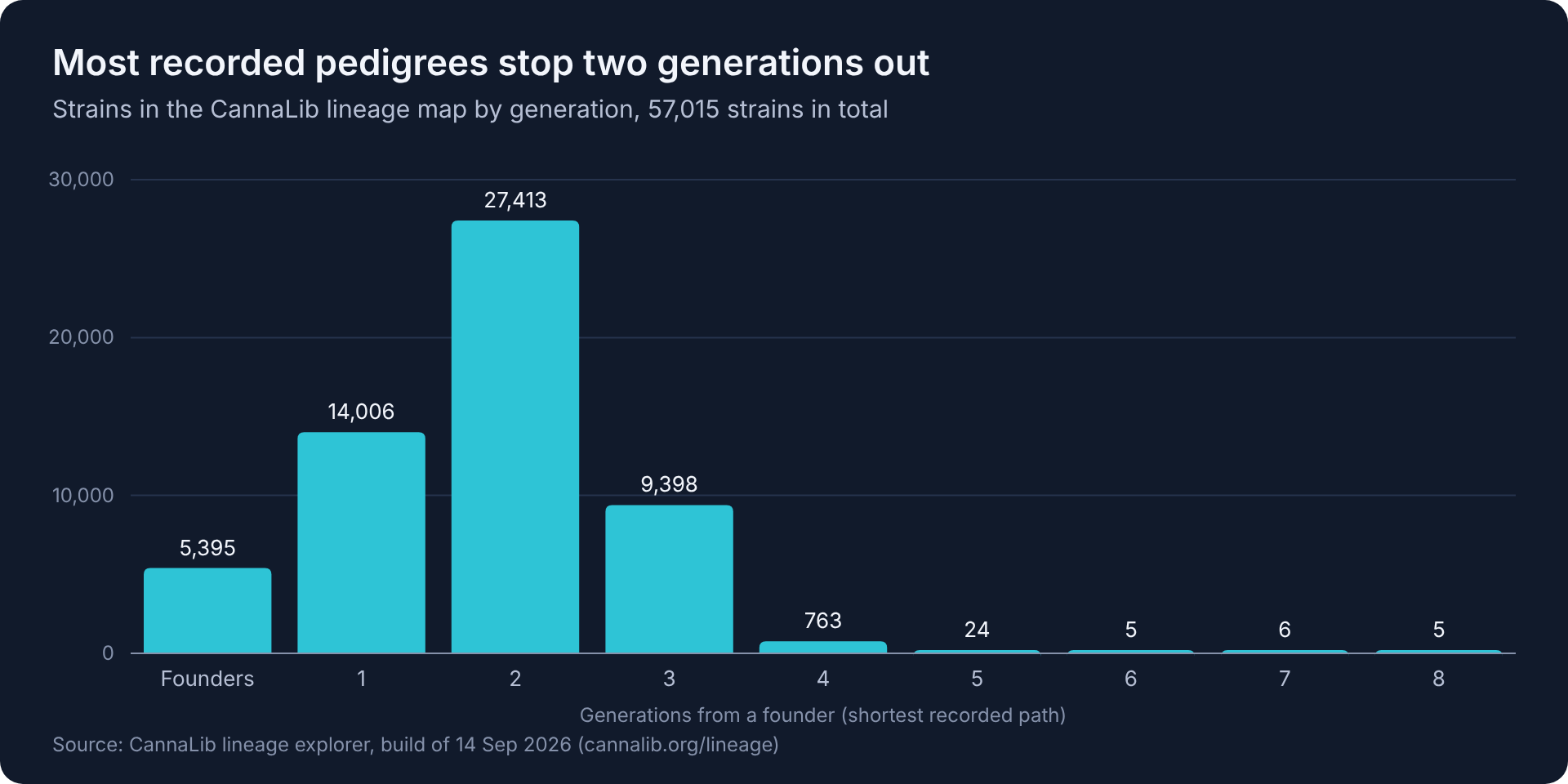
Here is how many strains sit at each generation out from a founder, measured along the shortest recorded path:
| Generation | Strains |
|---|---|
| 0 (founders) | 5,395 |
| 1 | 14,006 |
| 2 | 27,413 |
| 3 | 9,398 |
| 4 | 763 |
| 5 | 24 |
| 6 to 8 | 16 |
Nearly half of all mapped strains (27,413) are two generations from a founder. Only 803 are more than three deep.
That is odd if you think about it for more than a second. Modern commercial cannabis is the product of decades of crossing crosses. Wedding Cake, for example, is a cross of Triangle Kush and Animal Mints, and Animal Mints has its own parents, which have theirs. The real family tree is deep. The recorded one is not.
The reason is that most published lineage stops at the parents. A seed bank lists "Gelato × Runtz" and moves on. It doesn't list what Gelato was made from, because everyone is assumed to know, or nobody does. Depth only appears in our map when the parents themselves have records. So the shallowness is not a fact about the plants. It is a fact about how little of the genealogy anyone bothered to write down.
The handful of names behind everything#
Some strains turn up as a parent again and again. These are the twelve with the most recorded direct children:
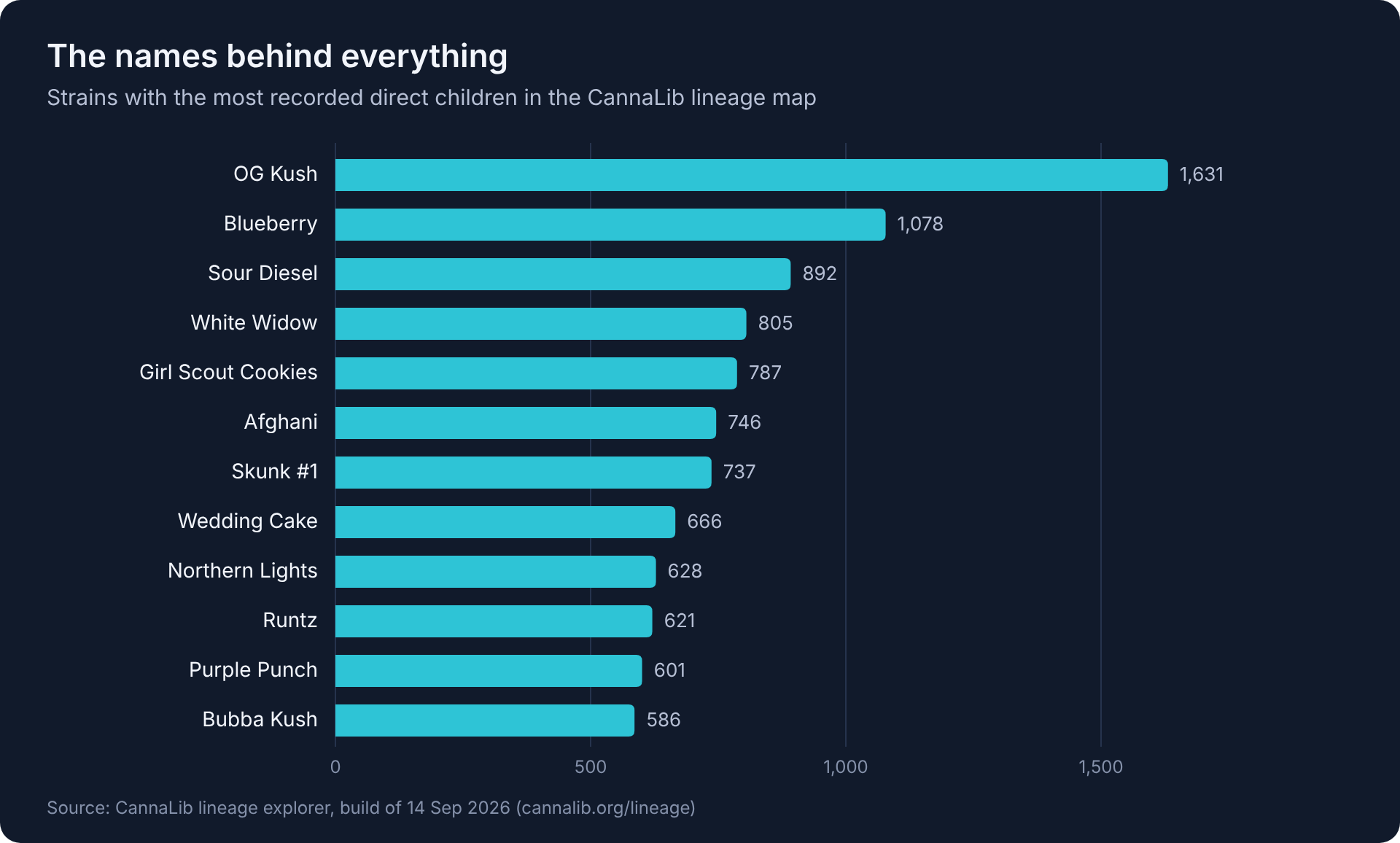
It reads like a potted history of the last fifty years. Skunk #1 traces to David Watson, the breeder known as Sam the Skunkman, credited with combining Afghan, Mexican and Colombian Gold lines; he left Santa Cruz, California, for Amsterdam in 1985 and started a seed company there the following year. Blueberry came out of DJ Short's Oregon breeding, built from Thai, Chocolate Thai, Afghan and Oaxacan stock; his son puts the famous Blueberry phenotype at around 1979. OG Kush is the classic cut with a disputed past: the most common account makes it Chemdawg crossed with a Hindu Kush line, carried from Florida to Los Angeles as a clone-only plant, and nobody can agree what "OG" even stands for.
Then the list jumps straight to the 2010s. Wedding Cake, Leafly's Strain of the Year in 2019 and its most-visited strain page from 2021 to 2023, already has 666 recorded children. Runtz has 621. Breeders don't wait for a strain to age before they cross it. If it's selling, it's a parent by next season.
Count the descendants, not just the kids#
Direct children only tell you so much. The explorer also counts every strain reachable below a node through recorded links: children, grandchildren and so on.
On that measure, OG Kush reaches 48,130 strains. Afghani reaches 47,997. Girl Scout Cookies, Wedding Cake, Runtz, Northern Lights, Blueberry, Sour Diesel and Skunk #1 all reach more than 43,000. In a graph of 57,015 strains, each of those names sits upstream of between 76% and 84% of everything we've mapped.
Some of that is real. Afghani and Skunk genetics genuinely are everywhere. But treat the very big numbers with suspicion. Wedding Cake and Runtz are strains of the last decade, yet the records place nearly as many strains downstream of them as downstream of Afghani, a landrace line with decades of head start. That doesn't fit a family tree that only flows forward in time. It fits one where some links run backwards: one swapped parent and child near the top of a busy family is enough to hand a young strain an old strain's entire bloodline. That's our reading of the numbers, not something the graph can measure directly. But we know backwards links exist, because the loops prove it.
How a strain becomes its own ancestor#
Our build found five loops containing 578 strains in total, the largest holding 563. Inside a loop you can start at any strain, follow its recorded descendants, and eventually arrive back where you began.
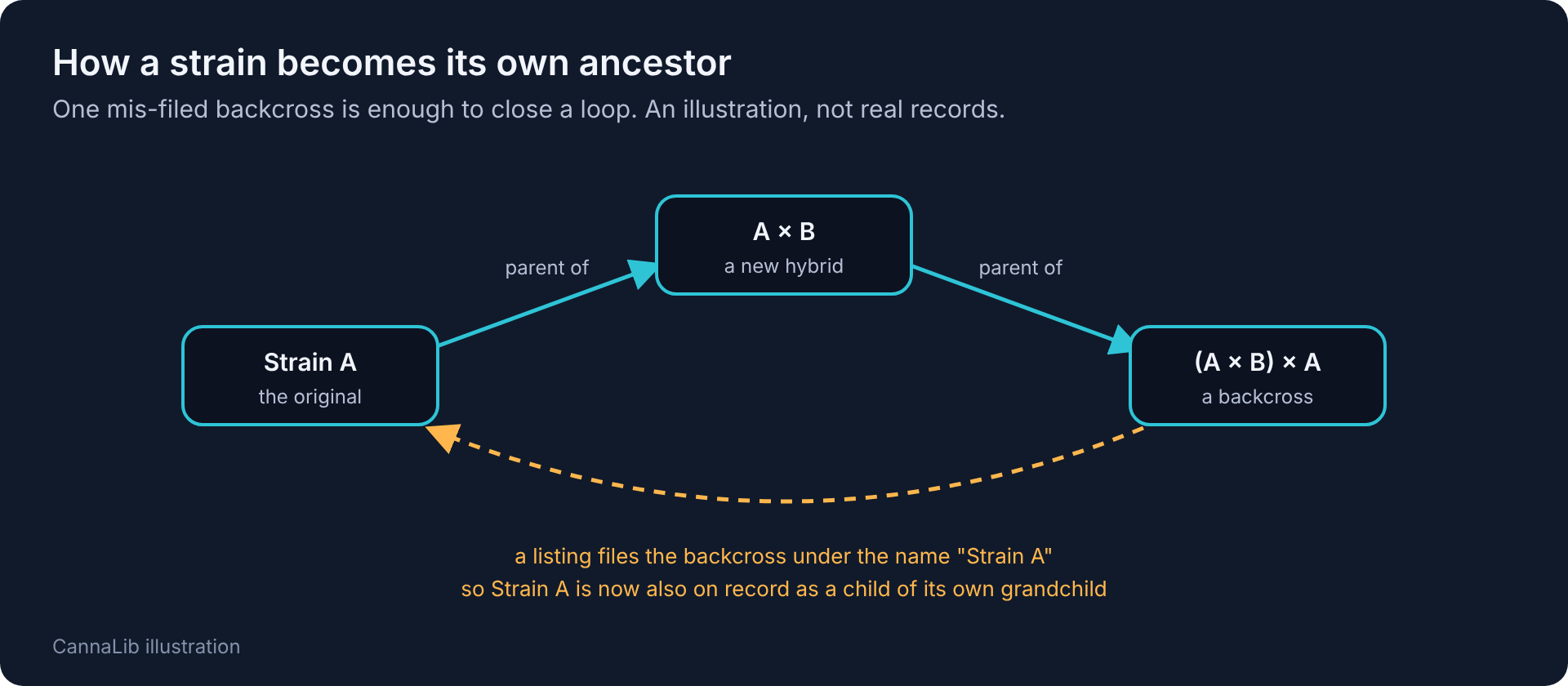
There are a few ordinary ways this happens, and none of them need anyone to be dishonest:
- Backcrosses written sloppily. A breeder crosses a hybrid back to one of its parents to lock in a trait. If a listing records the backcross under the parent's name, the parent now appears to descend from its own grandchild.
- One name, several plants. "Blue Dream", "OG" and "Kush" have each been applied to different plants by different people. When two unrelated plants share a name, their two family histories get stitched together, and the stitching can close a circle.
- Child and parent swapped. A product page lists "Strain A × Strain B" where B was actually bred from A. Do that once in the right place and the graph folds back on itself.
- Renamed cuts. A clone is renamed, crossed, and then the cross is crossed back to the original under its old name.
Once a single link inside a large, busy cluster points the wrong way, every strain on that path joins the loop. That's how you get 563 strains from what might be a handful of errors.
We don't fix loops automatically. Picking which link is wrong would mean deciding which source to believe on no better evidence than a hunch, and our honesty rules say we keep conflicting claims rather than invent a resolution. So the explorer flags every strain in a loop, and the loop itself becomes a signal: somewhere near here, a record is wrong.
Inbreeding, on paper#
One more number worth sitting with. 24,773 strains, about 43% of the map, have two recorded parents that themselves share a parent or grandparent. In breeding terms that's a close cross: half-siblings, cousins, or a hybrid crossed back into its own family.
That's partly the natural result of everybody using the same dozen star parents. If Gelato, Runtz and Wedding Cake all carry Cookies genetics, then crossing any two of them is crossing relatives. It also squares with a complaint you'll hear from growers and smokers alike, that a lot of modern menus taste like variations on the same dessert. The paperwork agrees with them.
Why the paperwork can't settle it#
A pedigree is a claim. It's what a breeder or a seller says was crossed, usually years after the fact, and often with a commercial reason to name a famous parent. The only way to check one is to genotype the plants.
When researchers have done that, the names haven't held up well. A 2019 study in the Journal of Cannabis Research genotyped 122 samples of 30 strains acquired from dispensaries and donors in Colorado, Washington and California, and found that most strains contained at least one genetic outlier: a plant sold under the name that didn't match the others. Strip out the outliers and many strains looked fairly stable, which is roughly what a lineage map would predict: mostly right, with errors you can't see from the label. We look at what that same research says about the indica and sativa labels in a separate piece.
What a lineage map can do is show you where the claims agree, where they contradict each other and where they run out. That's why every link in the explorer carries its source count, and why we'd rather draw a loop than hide one.
What to do with this#
When you read a pedigree on a seed listing, treat one that only a single seller states as a rumour, and one that several independent sources state as a decent bet. If a strain's recorded ancestry folds back on itself, assume the name has been used for more than one plant. And if a "new" strain's parents are two of the same dozen names everyone uses, expect it to taste like something you've had before.
You can trace any of the 57,015 strains yourself in the lineage explorer, see which links have more than one source, and check whether your favourite is caught in a loop. Start with OG Kush. Bring snacks.
Figures are from the CannaLib lineage build of 14 September 2026. Sources are listed in full below.
Fact-checked 12 October 2026. Editor verdict: Pass With Edits.
Sources#
- CannaLib lineage explorer, build of 14 September 2026: https://cannalib.org/lineage/ (stats file `publish/lineage-explorer/lineage_graph.stats.json`).
- CannaLib honesty rules: https://cannalib.org/honesty/
- Cannabis Business Times, "Legendary Cannabis Breeder David Watson, aka 'Sam the Skunkman,' Dies" (January 2025): https://cannabisbusinesstimes.com/top-stories/news/15736155/legendary-cannabis-breeder-david-watson-aka-sam-the-skunkman-dies
- Willamette Week, "We Talked to JD Short, Son of Legendary Eugene Breeder DJ Short, About the Origins of Blueberry" (17 April 2017): https://www.wweek.com/cannabis/2017/04/17/we-talked-to-jd-short-son-of-legendary-eugene-breeder-dj-short-about-the-origins-of-blueberry/
- Culture Cannabis Club, "The Legend of OG Kush": https://culturecannabisclub.com/legend-of-og-kush/
- Leafly, "Top Wedding Cake strains of all time", Matt Jackson (18 September 2024): https://www.leafly.com/news/strains-products/top-wedding-cake-strains-all-time
- Schwabe, A. L. and McGlaughlin, M. E. (2019), "Genetic tools weed out misconceptions of strain reliability in Cannabis sativa: implications for a budding industry", Journal of Cannabis Research 1, article 3: https://doi.org/10.1186/s42238-019-0001-1
Pull the thread
Open OG Kush in the lineage explorer and follow its parents upstream. Everything above is checkable in the same CannaLib tools we used.
- Lineage sky map
See OG Kush in the family tree
The family tree, drawn from recorded parent-to-child edges.
Open → - Explorer
Open the OG Kush card
Every claim, test and alias for one strain, on one card.
Open →
This opens the real CannaLib page inside the story, so it only loads when you ask.
curl "https://api.cannalib.org/v1/catalogs/strains?q=OG%20Kush&limit=5"
More Strain Stories
- Ep.03Lineage Under the Limelight
Purple Urkle: did I do that?
Purple Urkle is said to be named after Steve Urkel. The DNA says the plant sold under it is also sold as Grand Daddy Purple and 13 other names; 707 lab tests put its THC median at 17.6%.
14names for one plant in a DNA panelRead the story → - Ep.02Lineage Under the Limelight
Bruce Banner: the Hulk that wasn't
Bruce Banner wasn't named after the Hulk. Its breeder says it's a joke on his surname (Holck). We checked 2,365 lab tests and the DNA to see how strong it really is, and found a sample sold as Scooby Snacks that measures as the same plant.
Holckthe breeder's surnameRead the story → - No.05Label vs Lab
The stairway is gone, the printouts aren't
A Montreal seed shop's website vanished in 2006. 18 scanned printouts from around 2000 are all we know of it. We fact-checked its claims and toured other lost cannabis resources to show how hard a trustworthy original source is to find.
42strains on 18 printouts of a shop that vanished in 2006Read the story →