
THClab testinglabels
Your THC number is a vibe
Massachusetts pulled 63 flower products off the shelf and retested them. Thirteen missed the rules, and in every case the label was the one that was too high.
In this story
In mid-August 2026, the Massachusetts Cannabis Control Commission (CCC) began telling cannabis companies that their flower was not as strong as the jar said. The regulator had run a "shelf audit": it took 63 flower products from 62 producers off the shelves of retail stores and medical dispensaries and had independent labs retest them. Thirteen came back outside the legal range, a shade over one in five.
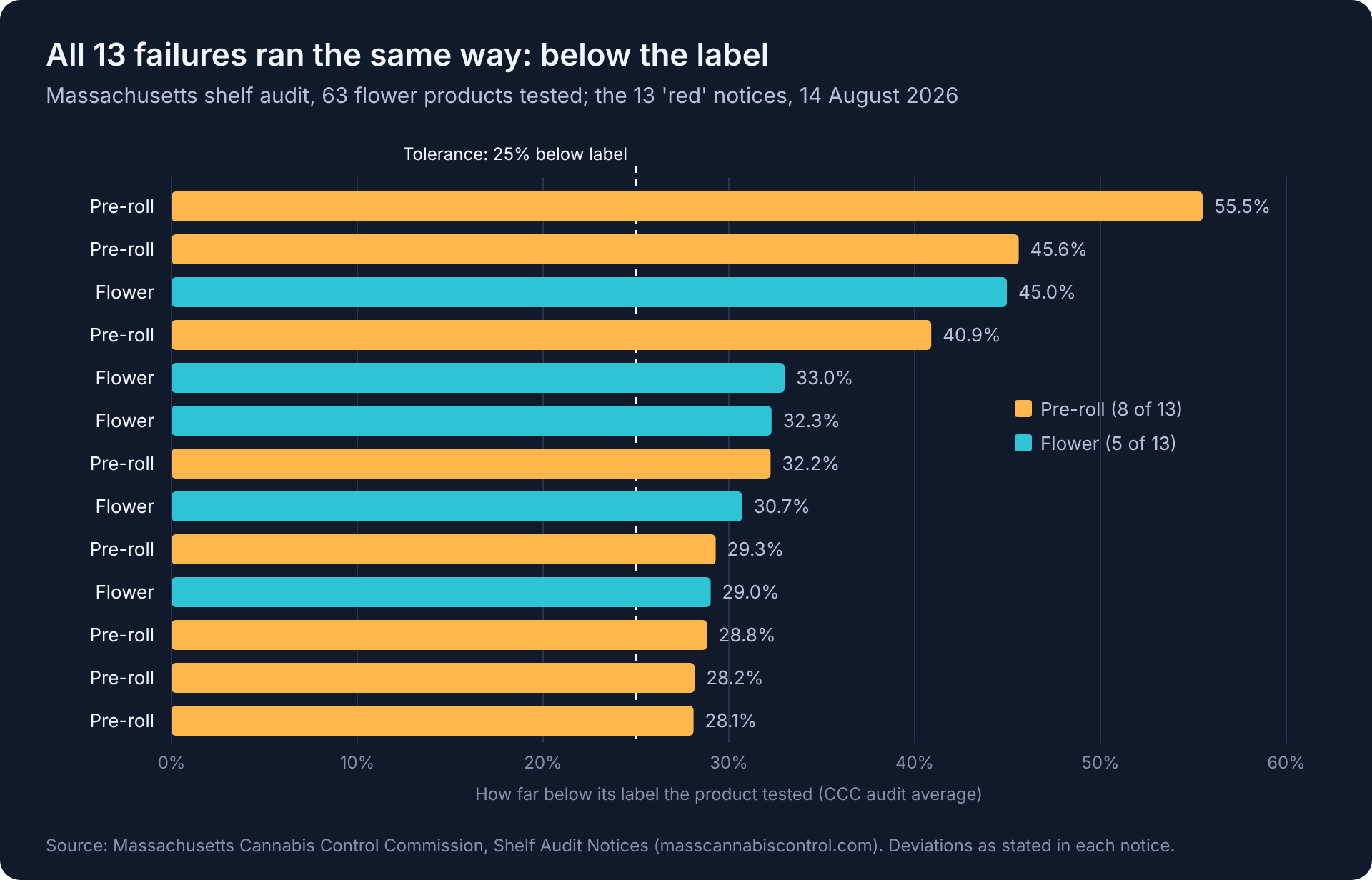
Here is the part the headlines glossed over. Every one of the 13 failed in the same direction. Each tested below its label, by between 28% and 55%. Not one of the failures ran the other way.
That is the story of cannabis potency labels in a sentence, and it is why we do not give you a single THC figure on a strain page. This piece covers why the number drifts up, who has measured it, and what a sensible reader does with it.
What Massachusetts actually found#
The CCC announced the audit in May 2026, retested the products in June, issued its press release on 13 August, dated the red notices 14 August and published the notices on 17 August. Massachusetts treats a label as accurate when the product tests between 75% and 125% of the labelled THC. A jar labelled 20% therefore passes anywhere from 15% to 25%, which is already generous. Products outside that band get a "red" notice and are held from sale until the producer destroys them, relabels them with the audit result, reprocesses them into a new product, or retests them. The notices we read give seven days to choose a corrective action or to challenge the audit by retesting at the licensee's cost, so these are the regulator's findings, not final adjudications.
The notices themselves carry the numbers:
- All 13 red products tested below their labels, by 28.1% to 55.5%, measured as the average of three audit results against the label.
- Eight of the 13 tested more than 30% below, and four more than 40% below. The worst, a pre-roll, missed by 55.5%.
- Eight of the 13 were pre-rolls and five were flower. The Boston Globe reported that pre-rolls were disproportionately non-compliant, making up more than 60 percent of the failures. We cannot compute a pre-roll failure rate, because the CCC has not published how many pre-rolls were in the 63.
- Another 11 notices were "yellow": compliant, but with products 15% to 25% off the label.
We have left the companies out: the notices are public on the CCC's site, and the pattern is the point.
Two honest caveats. First, the audit covered basic flower only, not edibles or mixed-strain products. Second, the retests were done by the state's independent labs, the same system under scrutiny. Megan Dobro of SafeTiva Labs, who was not part of the audit, told the Globe a more rigorous audit would send samples to other labs, and that growers can game the system by submitting a stronger sample than the batch deserves. That is one lab's view, but it points at the real mechanism, below.
Two Colorado studies, same direction#
Massachusetts is not the first to look. Two Colorado studies, both buying products at retail and testing them independently, found the same lean.
The small, sharp one (2023). Anna Schwabe, Vanessa Johnson, Joshua Harrelson and Mitchell McGlaughlin bought 23 flower samples, covering 12 strains, from 10 dispensaries along Colorado's Front Range. One lab tested them all. Average measured THC was 14.98%, against labels averaging 20.27% at the low end of their stated ranges and 24.10% at the high end. Sixteen of the 23 (about 70%) tested more than 15% below the lowest label figure. The worst missed by 56.5%. The paper, in PLOS ONE, is called "Uncomfortably high". It is a small, opportunistic sample from one region, and two of the authors worked for the testing lab, a link the paper discloses. The authors discuss possible causes, including inconsistent protocols and financial incentives, but could not say which applied.
The bigger, calmer one (2025). A team led by Gregory Giordano at the University of Colorado Boulder bought 277 products from 52 recreational dispensaries in 19 Colorado counties between 2022 and 2023: 178 flower and 99 concentrate. Purchasers and testers were blinded to each other's information. Flower labels averaged 22.5% THC; measured, the average was 20.8%. Only 56.7% of flower products landed within 15% of their label. Of the rest, 30.3% were over-labelled (the label above the measurement) and 12.9% under-labelled. Concentrates were far tighter, with 96% inside the 15% band.
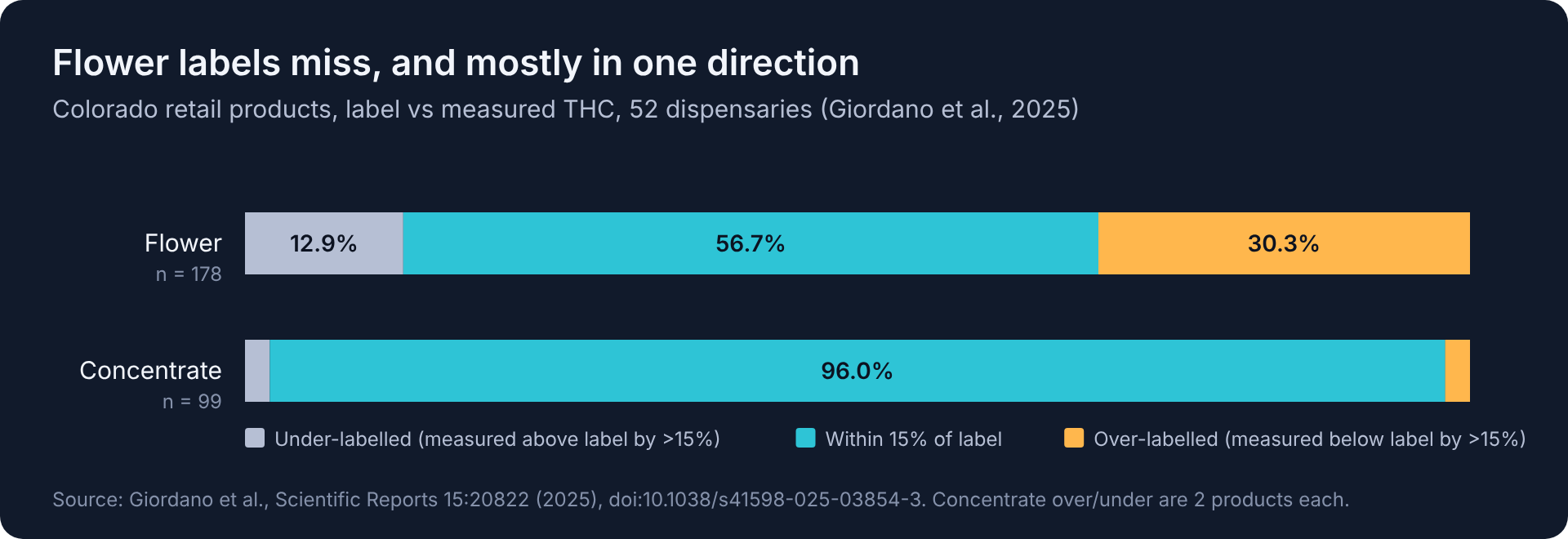
That study has limits. It is one state. Samples were tested on average 20.3 days after purchase (range 2 to 62), a window in which some THC could degrade, so the size of the gap is less certain than its direction. That is our caution, not the authors'. The testing lab collaborated with the team, and two authors were employed by the lab's parent company, which the paper discloses. Even so, over-labelled flower outnumbered under-labelled more than two to one.
Why the number drifts up#
Cannabis is priced by THC percentage, and the seller usually chooses who measures it.
Buyers shop by the number. MJBizDaily reported that cultivators and retailers say flower testing under 20% THC does not sell well, in a Massachusetts market it values at US$1.7 billion. In most places the producer picks the lab, so a flattering number is a commercial asset.
Labs can compete on results. Yasha Kahn, vice president of marketing and data science at the Massachusetts lab MCR Labs, has analysed testing data from several states. MJBizDaily reported in 2023 that his anonymised dataset covered nearly 400,000 flower samples from 70 labs in four states, and that some labs averaged about 25% above others testing the same flower. Chemical & Engineering News reported in 2024 that he had sent records requests to 37 states and got data back from 17, and that labs reporting the highest THC gained market share year after year, with a cliff in results at 20%. Treat this as one analyst's reading of anonymised data. It shows statistical oddities, not what any lab did, and Kahn's own lab says it has lost business for refusing to inflate.
Samples can flatter the batch. You do not have to fake a result to improve it. You can send the lab the best bud. Dobro's point leads here, and the Globe reported that CCC investigations manager Tim Barwise said regulators have begun investigating a few significant cases of fraud related to inaccurate sampling.
Sometimes it is alleged to be worse. On 25 September 2024, Oregon's liquor and cannabis regulator (OLCC) sent notices to seven of the state's eleven accredited labs proposing cancellation, suspension or fines over alleged THC inflation reaching back to 2023, according to the law firm Harris Sliwoski's account of the notices (OLCC's April 2025 settlement document confirms a notice of that date). All seven were accused of lax sampling, such as not having the whole batch available or taking too few increments. Three were also accused of adding kief to samples. These were allegations in proposed sanctions, the labs had until 25 October 2024 to request a hearing, and we have not found outcomes for all of them. OLCC's published settlement agreements do show some. In March and April 2025, two labs settled sampling violations (too few sample increments, and in one case the whole batch not being available) for civil penalties or suspensions smaller than those first proposed. In September 2025, a lab and its sister site agreed to surrender their licences and accept letters of reprimand over violations that included intentionally adding trichomes to samples, under notices dated July 2025. We cannot tell from the documents which of these settlements, if any, arose from the 25 September 2024 notices. We have not named the labs.
Methods differ too. California required labs to use one standardised cannabinoid method for dried flower, pre-rolls included, from 1 January 2024. Chemist Amber Wise, of Medicine Creek Analytics, told C&EN that California flower had often been reported at 30% to 45% THC before the change, and that she typically sees 20% to 25% in Washington. California's own response to public comments on the rule does not frame it as an inflation fix.
What regulators are doing about it#
- Massachusetts voted final secret-shopper regulations on 6 March 2026 and ran this audit under its shelf-audit programme. The commission says it is moving towards random testing for contaminants.
- Oregon funded a state reference lab through HB 2931, designed as a neutral third party that reviews the work of other labs.
- Maryland set up its own state reference lab in 2024, with duties that include auditing independent labs' results.
Missed mould and pesticides matter more for health than a shaky THC figure. But THC is the number on every label, so it is a fair test of whether the rest can be trusted.
Why we show a range, not a number#
We see the downstream effect of all this in our own catalogue. When we measured published THC claims for the catalogue on 13 September 2026, we parsed 120,924 percentage values from 122,189 claims. Of the 20,603 strains with parsed values, 6,051 had sources that disagreed. Even inside a single source, 5,190 name-and-source pairs gave more than one THC figure. We threw out 503 values above 50%, which turned out to be milligram figures from cartridge listings. (Source: CannaLib fact projection, 13 September 2026.)
So a CannaLib strain page does not hand you one tidy figure. It lists every stated THC claim with its sources, and where they disagree it says so. It shows a lab range, defined as the 10th to 90th percentile of flower lab samples, with the number of samples behind it, and never blends the two. In the lineage explorer, 13,445 strains have a lab median because they have three or more flower lab samples; bank claims are not used for that view.
Our lab figures are not immune to what you have just read. A range from many tests dilutes any one lab's habits; it does not cancel a bias that runs through a whole system. We would still rather show the spread and its sample size than a number we cannot stand behind.
How to read a THC label#
- Read it as a claim with a margin. In Massachusetts a 20% label legally covers 15% to 25%.
- Do not pay for a few points. The gap between 26% and 30% sits well inside the legal margin and the errors above.
- Expect the miss to run high on flower. Both Colorado studies and the Massachusetts audit lean the same way. Concentrates in Colorado were far tighter, though that is one state and 99 products.
- Prefer a range with a sample count to one figure from one lab chosen by the seller.
- Do not assume a bigger percentage is a better product. A 2022 study in Psychoactives sent flower from cannabis competitions to 276 volunteers, who logged 3,063 sessions. THC potency was not correlated with how appealing they rated the flower; aroma was. It is one self-reported study with a small sex-linked exception, and we would not hang a buying rule on it. We cite it only to say the percentage is a thin basis for choosing.
A label is a measurement with error bars. We would just like them printed on the jar.
Fact-checked 12 October 2026. Editor verdict: Pass With Edits.
Sources#
- Massachusetts Cannabis Control Commission, Shelf Audit Notices (61 notices: 13 red, 11 yellow, 37 green; page last modified 19 August 2026; notices published 17 August 2026): https://masscannabiscontrol.com/investigations-and-enforcement/shelf-audit-notices (individual "Potency Audit Results" notices linked from that page; dated 13 and 14 August 2026).
- Massachusetts Cannabis Control Commission, "Massachusetts Cannabis Control Commission Releases Potency Audit Results" (press release dated 13 August 2026): http://masscannabiscontrol.com/2026/08/massachusetts-cannabis-control-commission-releases-potency-audit-results/ . Also reproduced by WWLP (13 August 2026, modified 17 August): https://www.wwlp.com/news/massachusetts/ma-cannabis-control-commission-finds-13-cannabis-products-innacurate-labeled-thc-potency/amp/ and Boston.com (17 August 2026): https://www.boston.com/news/local-news/2026/08/17/mass-cannabis-regulators-found-some-products-have-inaccurate-thc-labels .
- MJBizDaily (Chris Roberts), "Massachusetts cannabis regulators catch THC potency inflation in recent sting" (14 August 2026): https://mjbizdaily.com/?p=617424
- The Boston Globe, "Mass. cannabis growers inflated THC levels on labels, per audit" (18 August 2026): https://www.bostonglobe.com/2026/08/18/business/mass-cannabis-growers-inflated-thc-levels-on-labels-per-audit/
- Massachusetts CCC, public meeting minutes, 6 March 2026 (final vote on 935 CMR 500/501 including the Secret Shopper Program): https://masscannabiscontrol.com/document/meeting-minutes-march-6-2026-cannabis-control-commission/
- Schwabe AL, Johnson V, Harrelson J, McGlaughlin ME (2023), "Uncomfortably high: Testing reveals inflated THC potency on retail Cannabis labels", PLOS ONE 18(4): e0282396, 12 April 2023. doi:10.1371/journal.pone.0282396 (PMC10096267).
- Giordano G, Brook CP, Ortiz Torres M, MacDonald G, Skrzynski CJ, Lisano JK, Mackie DI, Bidwell LC (2025), "Accuracy of labeled THC potency across flower and concentrate cannabis products", Scientific Reports 15: 20822, 1 July 2025. doi:10.1038/s41598-025-03854-3
- Plumb J, Demirel S, Sackett JL, Russo EB, Wilson-Poe AR (2022), "The Nose Knows: Aroma, but Not THC Mediates the Subjective Effects of Smoked and Vaporized Cannabis Flower", Psychoactives 1(2): 70-86, 8 November 2022. doi:10.3390/psychoactives1020008
- MJBizDaily, "Marijuana lab-testing analysis finds routine THC inflation, data manipulation" (28 November 2023): https://mjbizdaily.com/?p=381950
- Chemical & Engineering News, "Shopping around for favorable cannabis testing" (vol. 102, issue 28, 2024; no byline or date shown on page): https://cen.acs.org/biological-chemistry/natural-products/Shopping-around-favorable-cannabis-testing/102/i28
- Harris Sliwoski, "Oregon Cracks Down on THC Inflation and Testing Labs" (24 October 2024): https://harris-sliwoski.com/cannalawblog/oregon-cracks-down-on-thc-inflation-and-testing-labs/ ; corroborating: Cannabis Law Report, https://journal.cannabislawreport.com/?p=9881 ; OPB, "Think Out Loud" (24 July 2025), https://www.opb.org/article/2025/07/24/cannabis-thc-level-oregon/
- Oregon Liquor and Cannabis Commission, news release and "Preliminary Technical Report" (17 March 2025; state reference lab funded through HB 2931): https://www.oregon.gov/olcc/Docs/news/news_releases/2025/nr031925-MJ-Technical-Report.pdf
- Maryland Cannabis Administration, "Establishes State Reference Laboratory, First-in-the-nation for a Cannabis Regulatory Authority" (2024 news releases): https://cannabis.maryland.gov/Documents/2024%20News%20Releases/Maryland%20Cannabis%20Administration%20Establishes%20State%20Reference%20Laboratory,%20%20First-in-the-nation%20for%20a%20Cannabis%20Regulatory%20Authority.pdf
- California Department of Cannabis Control, "Test methods FSOR addendum" (standardised cannabinoid method for dried flower including pre-rolls; compliance by 1 January 2024): https://cannabis.ca.gov/wp-content/uploads/sites/2/2023/08/test_methods_fsor_addendum.pdf
- CannaLib fact projection record (13 September 2026), repo `docs/qa/2026-09-13-fact-projection.md` section 1.2 (chemistry.thc).
- CannaLib strain-page rules: repo `website/scripts/cannalib_dossiers.py` (lab range = 10th to 90th percentile of flower lab samples, claims listed with sources, never blended); README "Honesty rules"; `docs/qa/CATALOG-COLLATION-CONTRACT.md`; lineage explorer "Lab THC" lens and `publish/lineage-explorer/lineage_graph.stats.json` (`lab_thc_median`: 13,445; built 2026-09-14).
- OLCC stipulated settlement agreements (marijuana), 20 March 2025, 17 April 2025 and 18 September 2025: https://www.oregon.gov/olcc/Docs/stipulated_settlements/marijuana/SSA-March-2025-MJ.pdf , .../SSA-April2025-MJ.pdf , .../SSA-September-2025-MJ.pdf
Pull the thread
Look up your strain and compare the THC on the pack with the lab results. Everything above is checkable in the same CannaLib tools we used.
This opens the real CannaLib page inside the story, so it only loads when you ask.
curl "https://api.cannalib.org/v1/corpus"
More Strain Stories
- Note03Field notes
Weed has a label problem: a field guide to 10 cannabis strain libraries
A field guide to ten cannabis strain libraries, scored on a rubric CannaLib wrote and disclosed up front. SeedFinder, Kannapedia, GrowDiaries, Leafly and more.
10strain libraries, one disclosed conflict of interestRead the story → - Note02Field notes
Where did your weed actually come from? Stop trusting the jar, check the family tree
Wondering where your favorite strain really came from? CannaLib shows the competing family-tree stories with their sources, and checks cup-winner claims against published results.
1,599of 4,826 award claims confirmed so farRead the story → - No.05Label vs Lab
The stairway is gone, the printouts aren't
A Montreal seed shop's website vanished in 2006. 18 scanned printouts from around 2000 are all we know of it. We fact-checked its claims and toured other lost cannabis resources to show how hard a trustworthy original source is to find.
42strains on 18 printouts of a shop that vanished in 2006Read the story →