
alcoholpollssubstitution
Pints for joints: is cannabis really replacing alcohol?
A Sober October poll says two-thirds of cannabis users drink less, and Americans are drinking at a record low. Here's what the evidence can and can't tell you.
In this story
Every October, someone publishes a poll that says cannabis is killing the beer industry. This year's arrived on schedule.
A survey of 1,005 cannabis consumers in US states with legal markets, run from 24 to 26 September 2026, found that 65.8% said cannabis had led them to cut back on or stop drinking. (That is 65.8% of everyone polled; about one in five said they don't drink at all.) Almost a third, 31.5%, said they had "completely replaced alcohol with cannabis". It was released for "Sober October" and reported by Marijuana Moment.
Meanwhile, drinking is in a slump. Gallup's July 2026 survey found that 54% of American adults say they drink alcohol. That matches the record low it set in 2025, in a series that began in 1939. Put those two facts side by side and a story writes itself.
This is a report on the research, not a recommendation. We looked at what each piece of evidence measured, how big it was and where it falls short. One poll, one survey, one lab study and one review. They don't all say the same thing.
The poll: read the small print#
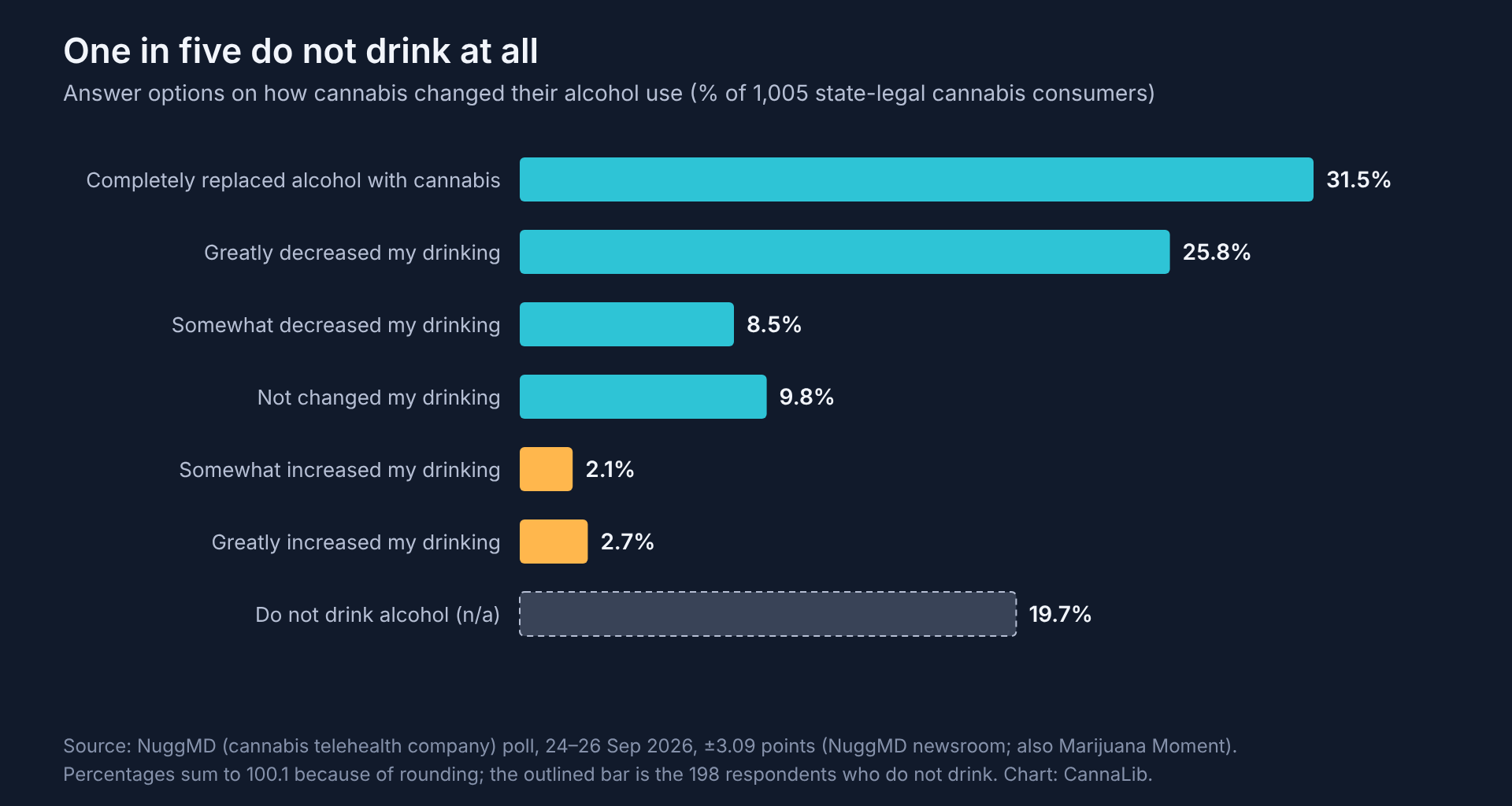
The September poll was run by NuggMD, a cannabis telehealth company, and timed for Sober October. Its stated margin of error is ±3.09 percentage points. NuggMD is a business with a stake in cannabis looking good, and it polled people who already use cannabis. Here are the published answers:
| Since using cannabis, my alcohol consumption... | Share |
|---|---|
| Completely replaced alcohol with cannabis | 31.5% |
| Greatly decreased | 25.8% |
| Somewhat decreased | 8.5% |
| Not changed | 9.8% |
| Somewhat increased | 2.1% |
| Greatly increased | 2.7% |
| I don't drink alcohol, so this doesn't apply to me | 19.7% |
The first three rows add to the headline 65.8%: 317, 259 and 85 of the 1,005 people polled. The last row is the one the news coverage left out. NuggMD's own release lists it: 198 people, 19.7%, said they don't drink alcohol, so the question didn't apply to them. That means the 65.8% is a share of everyone polled, non-drinkers included, not a share of people who drink. (The rows add to 100.1% because of rounding.)
Even taken at face value, the poll has three limits:
- It's self-reported. "Greatly decreased" means whatever each person thinks it means.
- It can't separate cause from effect. Someone who cut back for their own reasons and also uses cannabis would tick the same box.
- Its sample is people who use cannabis. It can't say what share of drinkers in general are swapping anything.
It's still interesting that, in the poll's own numbers, 4.8% said they were drinking more. But it's a company's poll of its own market, and we treat it that way.
The survey: drinks per week roughly halved#
A more careful piece of work, a University at Buffalo survey, was published in the Journal of Psychoactive Drugs and announced in January 2026 (DOI 10.1080/02791072.2026.2614506). Jessica Kruger, Nicholas Felicione and Daniel Kruger surveyed 438 anonymous adults who had used cannabis in the past year, recruited with the help of two licensed dispensaries in the Buffalo area. About a third used cannabis beverages.
Among cannabis-beverage users, the average number of alcoholic drinks per week was 7.02 before they started using the beverages and 3.35 after. And 62.6% said they had reduced (61.5%) or stopped (1.1%) drinking, while 3.3% said they drank more.
The university describes it as a small study, and the limits are familiar: self-reported figures, a sample drawn through dispensaries, and a before-and-after comparison from memory with nothing to show cause. It is peer-reviewed and its questions are specific. But it describes what dispensary customers recalled about their own habits, not what would happen to anyone else.
It also sits inside a growing market. NielsenIQ put US mainstream retail sales of THC drinks at $239 million in its latest 52-week reading, published in April 2026, up 135% on the year. Forbes, reporting the same figures in July, gave the period as the 52 weeks to 27 June 2026 and put $132 million of it, about 55%, through liquor stores. A federal rewrite of the hemp definition, delayed by Congress to 11 December 2026 for most products, would cut many of those drinks out of the hemp category (our piece Last orders: America's petrol-station THC has until 11 December has the detail). Whether drinkers are trying them as a swap or as an extra is a question for the studies, not the sales figures.
The lab: a quarter fewer drinks, for some#
The nearest thing to an experiment is a Colorado study in Drug and Alcohol Dependence in 2025, by researchers at Colorado State University and the University of Colorado (first author Claire Pince, with L. Cinnamon Bidwell and, as last author, Hollis Karoly), with funding from the US National Institute on Alcohol Abuse and Alcoholism.
It enrolled 61 adults aged 21 to 60 who drank heavily and used cannabis flower at least three times a week. Each completed two sessions, in random order, in a mobile lab parked outside their home. In one they drank alcohol alone: a priming drink, then up to four more over an hour, with money for each one declined. In the other they first used their own cannabis, then drank.
On average, they drank roughly a quarter fewer drinks after cannabis. But that average hides three groups. Of the 61, 23 drank less ("substituters", who also reported a drop in craving), 23 drank the same or more (16 the same, 7 more, by the authors' own 2026 follow-up analysis of the same sessions), and 15 abstained in both sessions.
The authors list their own caveats. Cannabis always came first, so order wasn't tested. Participants used their own cannabis, so dose and potency weren't controlled. The mobile lab isn't a pub. And the sample was mostly white and mostly male. It shows that, for some heavy drinkers who already use cannabis, a single hour went differently. It doesn't show what happens over months, or in anyone else. About as many people in the study drank as much or more after cannabis as drank less.
The review: it goes both ways#
The least exciting evidence is the most important. In 2022, Rachel Gunn, Elizabeth Aston and Jane Metrik reviewed 95 studies on cannabis and alcohol use (from over 650 articles screened) in Alcohol Research: Current Reviews, the journal of the US National Institute on Alcohol Abuse and Alcoholism.
Their finding: "compelling evidence for both substitution and complementary effects". In some people cannabis replaces alcohol and use goes down. In others it's used to enhance alcohol's effects and use goes up. The factors that appear to matter include the patterns and context of co-use, the order in which the two are used, the cannabinoid formulation, pharmacokinetic interactions and user characteristics such as diagnostic status.
The review's authors called for research in more diverse samples. That's the state of play: both effects are real, and nobody can yet say reliably who gets which.
Is cannabis behind the slump?#
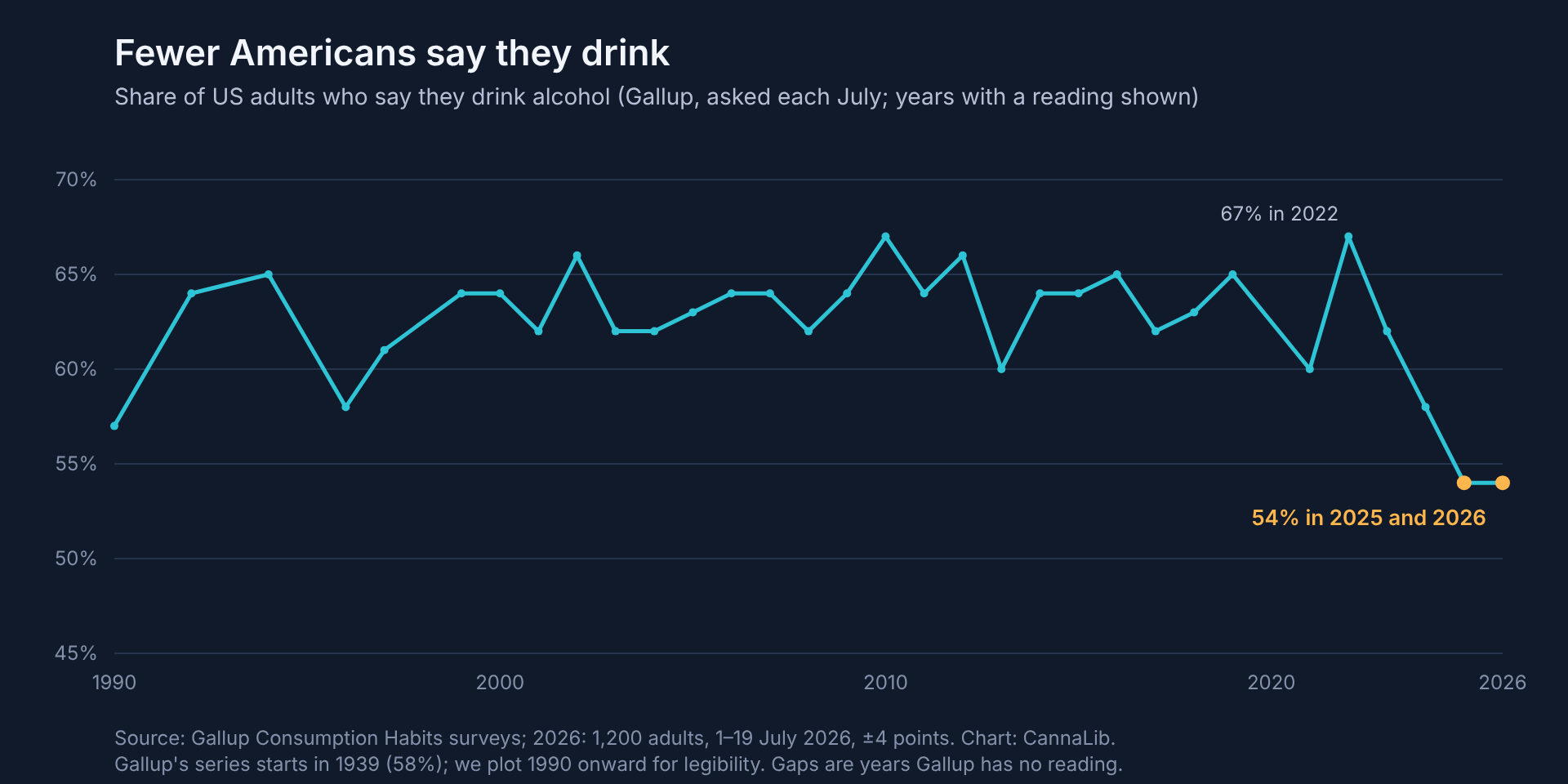
Gallup's drinking rate went 67% in 2022, 62% in 2023, 58% in 2024, 54% in 2025 and 54% again in 2026, from telephone samples of about 1,000 to 1,200 adults, with margins of error of ±4 points.
Gallup's 2026 data shows marijuana smoking at 17%, tying its record, so cannabis use hasn't collapsed. It also shows that adults who drink are more likely to smoke marijuana than those who don't (21% against 12%), which is a snapshot, not a trend. The overlap is what you'd expect if the two are often used together as well as in place of each other, but it can't say which.
In 2025, Gallup's own read was that people didn't appear to be swapping alcohol for other substances. Yale's Gail D'Onofrio disagreed, pointing to federal survey data showing cannabis use rising since 2021 among people over 26, even as it fell among 18 to 25-year-olds.
The clearest shift is in attitudes. In 2025, 66% of 18 to 34-year-olds said moderate drinking is bad for your health, against 50% of 35 to 54-year-olds and 48% of those 55 and over. In 2026, Gallup's overall figure was 51%, essentially unchanged from the record 53% the year before. Gallup's 2026 figures also show the drinking rate among 18 to 34-year-olds at 50%, down from 58% in 2023, with 35 to 54-year-olds at 58% (from 66%) and those 55 and over at 55% (from 61%). A generation that thinks drinking is unhealthy needs no other explanation to drink less.
What the evidence amounts to#
Cannabis is probably one part of the alcohol story, for some drinkers, in some settings. The poll can't say how many. The survey says some dispensary customers recall drinking less. The lab study says some regular users drank less in one session, and that about as many didn't. The review says both directions occur. And the biggest trend in the data, young adults deciding that drinking is bad for them, doesn't need cannabis at all.
Anyone promising that cannabis replaces alcohol is selling a poll. The better headline is "it depends", and nobody has yet worked out on what.
As of 13 October 2026. Cannabis and alcohol laws differ by jurisdiction. This article reports research and isn't health advice. Cannabis and alcohol each carry risks, and people with concerns about their drinking or their cannabis use can talk to a doctor or a local support service.
Fact-checked 13 October 2026. Editor verdict: Pass With Edits.
Sources#
- Marijuana Moment, "Marijuana is helping people to completely eliminate or reduce their alcohol drinking, new poll for Sober October shows" (October 2026), reporting the NuggMD survey (1,005 cannabis consumers in state-legal markets, 24 to 26 September 2026, ±3.09): https://www.marijuanamoment.net/marijuana-is-helping-people-to-completely-eliminate-or-reduce-their-alcohol-drinking-new-poll-for-sober-october-shows/ NuggMD's own release (poll page, "NuggMD Poll: Are Cannabis Patients Drinking Less?", with counts and the "I don't drink alcohol" answer): https://newsroom.nuggmd.com/
- Gallup, "Americans' Drinking Remains at Record Low" (August 2026; survey 1 to 19 July 2026, n = 1,200, ±4): https://news.gallup.com/poll/713534/americans-drinking-remains-record-low.aspx
- Gallup, "U.S. Marijuana Smoking at Record High, Cigarettes at Low" (2026; same survey): https://news.gallup.com/poll/713645/marijuana-smoking-record-high-cigarettes-low.aspx
- Gallup, "U.S. Drinking Rate at New Low as Alcohol Concerns Surge" (13 August 2025; survey 7 to 21 July 2025, n = 1,002, ±4; age breakdown of health views): https://news.gallup.com/poll/693362/drinking-rate-new-low-alcohol-concerns-surge.aspx
- Gallup, "What Percentage of Americans Drink Alcohol?" (year-by-year series): https://news.gallup.com/poll/467507/percentage-americans-drink-alcohol.aspx
- Michigan Public / NPR, "Percentage of Americans who say they drink alcohol hits record low, Gallup says" (13 August 2025), for Gail D'Onofrio's comments on NSDUH: https://www.michiganpublic.org/2025-08-13/percentage-of-americans-who-say-they-drink-alcohol-hits-record-low-gallup-says
- Kruger JS, Felicione N, Kruger DJ (2026), "The Exploration of Cannabis Beverage Substitution for Alcohol: A Novel Harm Reduction Strategy", Journal of Psychoactive Drugs, published online 14 January 2026, doi:10.1080/02791072.2026.2614506 (title, author order and date confirmed from Crossref metadata on 13 Oct 2026; journal page not opened). University at Buffalo release (January 2026): https://www.buffalo.edu/news/releases/2026/01/krugers-cannabis-beverages.html
- Pince CL, Stallsmith VT, Piercey CJ, Weldon K, Ruehrmund J, Dooley G, Bidwell LC, Karoly HC (2025), "Cannabis administration is associated with reduced alcohol consumption: Evidence from a novel laboratory co-administration paradigm", Drug and Alcohol Dependence, doi:10.1016/j.drugalcdep.2025.112860 (ScienceDirect PII S0376871625003138). Authors, volume (276), article number and NIH/NIAAA funding (award K23AA028238) confirmed from Crossref metadata and the University of Colorado PROFILES record (PMID 40915022). The journal page and abstract were not readable from our sandbox; sample size and results are taken from items 9 to 11.
- PsyPost, "Cannabis use associated with a reduction in alcohol intake": https://www.psypost.org/cannabis-use-associated-with-a-reduction-in-alcohol-intake/
- Filter, "Federally Funded Study Links Marijuana Use to Reduced Heavy Drinking": https://filtermag.org/marijuana-reduce-heavy-drinking/
- NORML, "Study: using cannabis prior to drinking results in significantly less alcohol consumption" (4 September 2025). Advocacy group; used as a pointer only: https://norml.org/news/2025/09/04/study-using-cannabis-prior-to-drinking-results-in-significantly-less-alcohol-consumption/
- Gunn RL, Aston ER, Metrik J (2022), "Patterns of cannabis and alcohol co-use: substitution versus complementary effects", Alcohol Research: Current Reviews 42(1): 04, doi:10.35946/arcr.v42.1.04: https://arcr.niaaa.nih.gov/niaaa-50th-anniversary-festschrift/patterns-cannabis-and-alcohol-co-use-substitution-versus
- Forbes (Noel Burgess), "THC drinks face a federal deadline that could upend the market" (20 July 2026), citing NielsenIQ: https://www.forbes.com/sites/noelburgess/2026/07/20/thc-drinks-federal-hemp-deadline-2026/
- Pince CL, Piercey CJ, Stallsmith VT, Weldon K, Ruehrmund J, Dooley G, Karoly HC (2026), "Behavioral phenotypes associated with cannabis and alcohol substitution", Harm Reduction Journal 23: 74, published 6 March 2026, doi:10.1186/s12954-026-01432-y. Open access; same 61 participants as item 8. Confirms 61 completed both sessions, 15 drank at neither, 23 substituters, 16 non-substituters (same amount), 7 complementers (more); funding NIAAA K23AA028238: https://pmc.ncbi.nlm.nih.gov/articles/PMC13078031/ (also https://link.springer.com/article/10.1186/s12954-026-01432-y)
- NielsenIQ, "NIQ Perspective: Buzz Worthy: The High Rise of THC Beverages" (20 April 2026): $239M in the latest 52 weeks, up 135% year over year; liquor and convenience leading channels; no period end date given: https://nielseniq.com/global/en/insights/infographic/2026/niq-perspective-buzz-worthy-the-high-rise-of-thc-beverages/
- Congressional Research Service, "Changes to the Statutory Definition of Hemp and Implications for Agricultural Policy" (IF13136, updated 28 September 2026): 12 November 2026 date applies to cannabinoids a cannabis plant cannot naturally produce; P.L. 119-103 (passed 2 September 2026) delays the rest of the new definition to 11 December 2026: https://www.everycrsreport.com/files/2026-09-28_IF13136_aa36fad7d69289127cbbbafef54e2aede431b2c4.html
Pull the thread
Look up a strain and check what its catalogue entry actually documents. Everything above is checkable in the same CannaLib tools we used.
This opens the real CannaLib page inside the story, so it only loads when you ask.
curl "https://api.cannalib.org/v1/corpus"
More Strain Stories
- No.02Label vs Lab
We found one plant sold under 50 different names
DNA from 2,264 cannabis samples shows one plant sold under 50 names, and 14 Blue Dream samples coming from five different plants. Here's what the genetics say, in plain English.
50names for one genomeRead the story → - Ep.08Lineage Under the Limelight
Zkittlez: taste the rainbow, spell it with a Z
A candy maker sued the breeder of Zkittlez in 2021 over the name. We lay out the dated court record and both sides' statements, then say what we will test in the plant.
$250Kdamages sought by the candy makerRead the story → - No.05Label vs Lab
The stairway is gone, the printouts aren't
A Montreal seed shop's website vanished in 2006. 18 scanned printouts from around 2000 are all we know of it. We fact-checked its claims and toured other lost cannabis resources to show how hard a trustworthy original source is to find.
42strains on 18 printouts of a shop that vanished in 2006Read the story →