
terpenesaromasulfur
It was never just the terpenes
Skunk is a sulfur compound shared with spoiled beer, 'gas' has a faecal relative, and terpene numbers predicted little of what panels smelled.
In this story
Open a dispensary menu and you will find terpenes: limonene for citrus, pinene for pine, certificates of analysis printed to two decimal places. The pitch is simple. Know the terpene numbers, know what the jar will smell like.
The chemistry has been politer about this than the marketing. When researchers went looking for what makes cannabis smell like cannabis, the headline note turned out to be a sulfur compound shared with beer left in the sun. The "gas" smell has a relative in a molecule best known from faeces. And in a 2025 panel study of 91 flower samples, models built on terpene and sulfur measurements explained about 10 to 15% of the variation in what people actually smelled.
This piece walks through four studies, says who paid for them, and ends with what it means for the number on a label.
The skunk is sulfur#
Terpenes give cannabis its floral, citrus and pine notes, but for years nobody could point to the molecule behind the famous skunk. A team led by Iain Oswald at Abstrax Tech, a Californian company that develops cannabis aroma compounds, went looking. The study, published in ACS Omega in November 2021, covered flowers from 13 cultivars. A four-person panel rated each for pungency on a 0 to 10 scale, and the team analysed them on a custom two-dimensional gas chromatography rig with three detectors, one of them built to see sulfur.
Bacio Gelato, which the panel scored a 10 for pungency and which had the highest sulfur concentration of the 13, carried seven volatile sulfur compounds, five of them prenylated, a family the authors describe as new to cannabis. The most abundant in the pungent cultivars was 3-methyl-2-butene-1-thiol, also called prenylthiol. It is the same compound that gives light-struck beer its "skunked" character, formed when light drives a reaction between hop acids and riboflavin. That is why brewers like brown bottles. Added to a mix of ten other major cannabis aroma compounds, the researchers report, it produced a smell very similar to cannabis.
Two details are worth keeping. The amounts are tiny. As Oswald put it to Science News, such compounds "can be in very low concentrations on the flower, but still make a huge impact on the smell." And the timing is odd: in a greenhouse time course, the prenylated sulfur compounds rose towards the end of flowering, peaked during curing, then fell substantially after ten days of storage. For anyone who assumes a longer cure always means a louder skunk, that is one study's evidence otherwise.
Oswald also called the scent polarising. Some people dislike it, and some prize it as a sign of quality.
The gas has an unglamorous relative#
In October 2023 Oswald's group published a second ACS Omega paper, "Minor, Nonterpenoid Volatile Compounds Drive the Aroma Differences of Exotic Cannabis". The authors are drawn from Abstrax, Cal Poly Pomona, SepSolve, Markes International and Denver's 710 Labs, and the work was funded by Abstrax, which the paper declares alongside related patent filings.
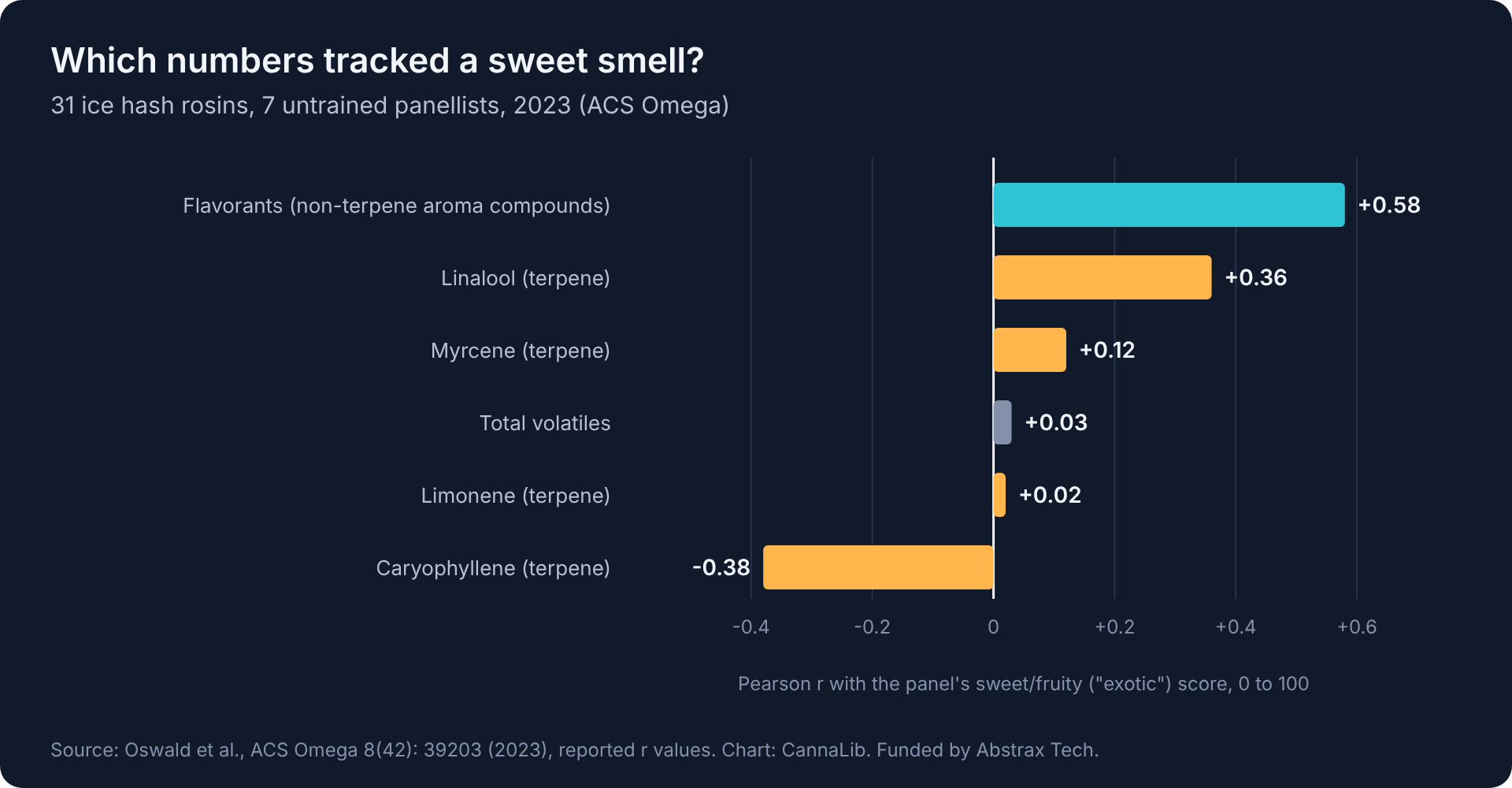
The design: 31 ice hash rosins bought from Los Angeles-area dispensaries, rated for sweetness or fruitiness from 0 to 100 by a panel of seven cannabis users. The panel was untrained, on purpose, to mimic ordinary consumers.
Three findings stand out.
Indole and skatole. Both had previously been detected in cannabis smoke residue, but the authors say they had not been reported in flower or extracts. Indole turned up in many varieties at low levels. Skatole tracked the savoury, gassy cultivars, among them GMO, Garlic Cookies and 710 Chem. The paper notes skatole is best known as a key contributor to the smell of faeces, and also turns up in fragrances and some foods. As Oswald told Cannabis Business Times, it "enhances that gassiness to be even more aggressive." Think about that the next time somebody calls a jar "loud".
Tropical sulfur compounds. A different trio, 3-mercaptohexanol and its acetate and butyrate esters, showed up in samples like Garlic Cocktail #7 and Gorilla Glue. The paper links them to a "petroleum- or sulfuric citrus-like" aroma, and notes the same family occurs in passionfruit, grapefruit, certain grapes and hops. The authors flag that their Gorilla Glue sample may have been mislabelled.
Terpenes that did not sort the samples. The cultivar rated sweetest, Grape Pie × Do-Si-Do, and the one rated least sweet, GMO (1.7 out of 100), had near-identical monoterpene profiles (r = 0.91). Terpenes make up over 95% of the volatile mass in these samples, yet total volatile concentration did not track sweetness (r = 0.03), and limonene barely registered (r = 0.02). The non-terpene "flavorants", a group the paper defines by exclusion and which includes the sulfur compounds, indole, skatole and esters, tracked it far better (r = 0.58).
The caveats are the authors' own. The panel was small and untrained, the samples came from one region and were rosin rather than flower, and just one terpinolene-rich sample (Trainwreck) was included. Oswald told Cannabis Business Times that terpinolene-rich cultivars such as Jack Herer were the exception, where terpenes did drive the differences. That claim needs a bigger sample than this paper provides.
A university check, with a ceiling on it#
Both papers above came from a company that sells aroma compounds. So it matters that a university group reached a similar place by a different route.
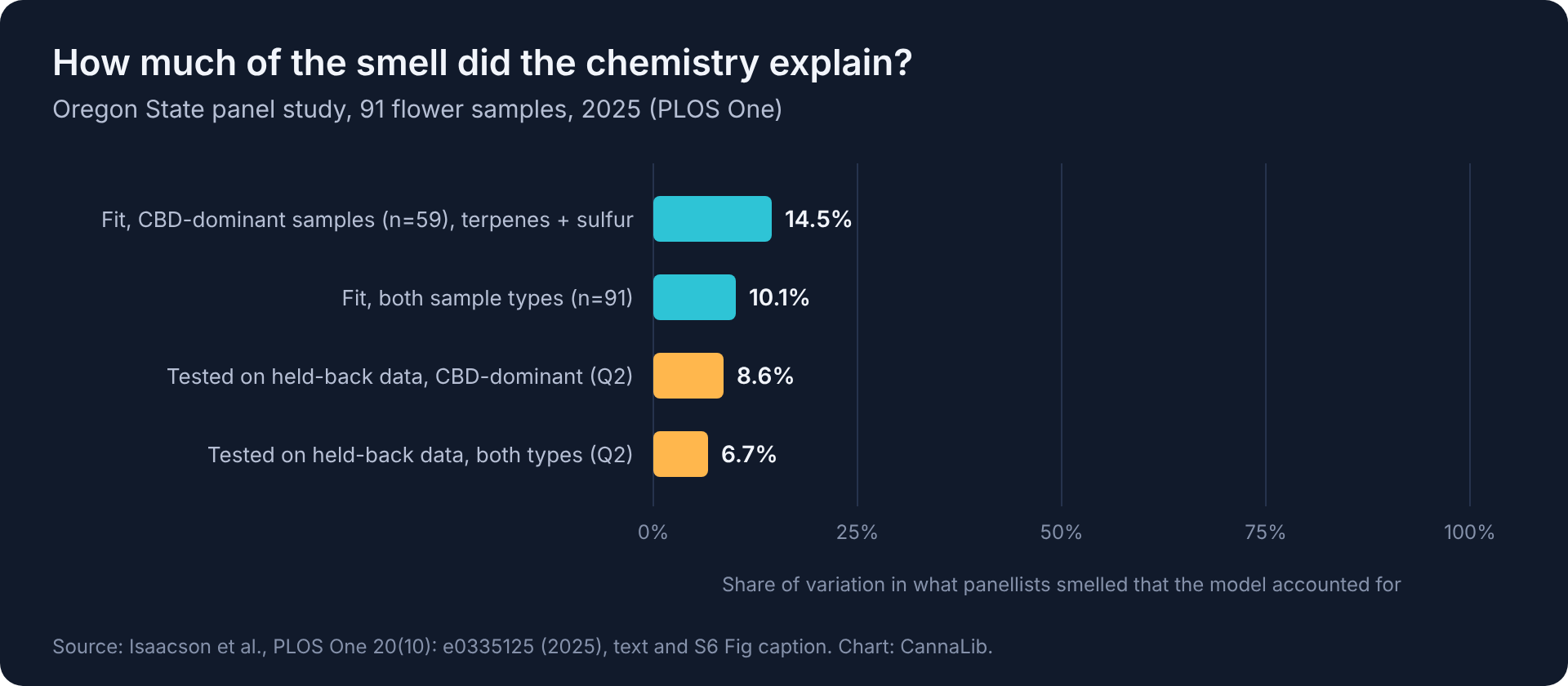
In October 2025, Solomon Isaacson, Thomas Shellhammer and colleagues at Oregon State University, with Adrianne Wilson-Poe of the Legacy Research Institute, published a sensory study in PLOS One. They built a lexicon of 25 aroma descriptors and had panels smell 91 samples of intact flower: 32 THC-dominant and 59 CBD-dominant. Between 21 and 24 panellists logged 8,075 descriptor selections. Commercial lab Columbia Labs measured terpenes (21 of 40 tested were quantifiable); the university measured volatile sulfur compounds in the CBD-dominant samples. The funder was Vectura Fertin Pharma CH, which the authors say played no role in the study, and no competing interests were declared.
The abstract's verdict: "neither terpene nor volatile sulfur compound profiles strongly predicted sensory perception." Numerically, the best model, for the CBD-dominant samples, explained 14.5% of the variation (R² = 0.145). On held-back data, its Q² was 0.086. Across both sample types the fit was R² = 0.101, Q² = 0.067.
Terpinolene was the only terpene consistently linked to descriptors, "citrus" and "chemical". Limonene was "not associated with citrus in this study". The Discussion calls this "crucial given the overreliance on terpene content in current Cannabis industry marketing and labeling practices."
Limits, from the authors: the sample is modest for this kind of modelling, the THC-dominant samples were curated by one licensed retailer in Corvallis, only dimethyl sulfide could be robustly quantified among 43 sulfur peaks, and esters and aldehydes were not quantified at all. The authors suggest key aroma compounds are simply missing from the models. Which, given the previous section, is rather the point.
Does the nose beat the label?#
One more study, because it is the one people quote. In 2022, Jeremy Plumb and colleagues, including Ethan Russo and Wilson-Poe, published "The Nose Knows" in Psychoactives. Oregon residents recruited for the Cultivation Classic competition in Portland in 2019 and 2020 (276 volunteers in all) received kits of 8 to 10 random flower samples, about a gram each, to use at home over 30 days or more, and rated them afterwards. Across 278 flowers, the authors report that how pleasant the aroma was tracked how much people rated a sample's appeal. THC potency, THC dose and total terpene content did not (p = 0.170, 0.270 and 0.444).
Handle with care. "Appeal" here is a composite of a 1-to-7 appeal rating and a 1-to-7 mood scale, and the outcome is self-reported enjoyment, not any measured effect. The volunteers were recent consumers, 13 comparisons went unadjusted for multiple testing, and three authors hold equity in Smart Analytics, the company that built the data-collection tools. A separate author with no such tie analysed the data. It is one study, but it points the same way as the chemistry: the label's potency and terpene totals are weak guides to which jar people end up preferring.
What this means for the label#
None of this says terpenes are fiction. They are real, they dominate the volatile mass, and terpinolene was the one terpene that consistently tracked a descriptor. But three things follow from the evidence above.
- A terpene table is a weak map of smell. Limonene did not track sweetness in one panel or citrus in the other.
- The compounds these papers flag are not terpenes. Oregon State had a commercial lab run the terpenes and a university lab run the sulfur compounds separately, and Abstrax used custom instruments. If a certificate of analysis lists only terpenes, it is not measuring the compounds these studies point to.
- Smell is a moving target. One greenhouse time course shows the skunk compounds peaking during curing and dropping afterwards, so "same cultivar" does not guarantee "same smell".
Until labs report aroma rather than percentages, the most informative instrument on the shelf is the one on your face.
At CannaLib, where we show terpene numbers, we keep the source with them. Where a lab did not state a unit, we say so rather than guess one: as of our 13 September 2026 build, 131,897 terpene values in the catalogue are flagged "unit unstated". If a number can't say what it is, it shouldn't be allowed to say what the jar smells like.
Fact-checked 12 October 2026. Editor verdict: Pass With Edits.
Sources#
- Oswald IWH, Ojeda MA, Pobanz RJ, Koby KA, Buchanan AJ, Del Rosso J, Guzman MA, Martin TJ (2021), "Identification of a New Family of Prenylated Volatile Sulfur Compounds in Cannabis Revealed by Comprehensive Two-Dimensional Gas Chromatography", ACS Omega 6(47): 31667. https://doi.org/10.1021/acsomega.1c04196 (PMC8638000). Details cross-checked via the ACS press release as republished by Lab Manager (https://www.labmanager.com/why-cannabis-smells-skunky-27168) and SepSolve (https://sepsolve.com/articles/new-family-of-aroma-compounds-found-in-cannabis.aspx) because the journal page was not fetchable.
- Ariana Remmel, "Here's the chemistry behind marijuana's skunky smell", Science News (30 November 2021): https://www.sciencenews.org/article/marijuana-skunk-smell-cannabis-pot-plant-chemistry (Oswald quotes, "polarizing", maturity and curing).
- Oswald IWH, Paryani TR, Sosa ME, Ojeda MA, Altenbernd MR, Grandy JJ, Shafer NS, Ngo K, Peat JR III, Melshenker BG, Skelly I, Koby KA, Page MFZ, Martin TJ (2023), "Minor, Nonterpenoid Volatile Compounds Drive the Aroma Differences of Exotic Cannabis", ACS Omega 8(42): 39203-39216. https://doi.org/10.1021/acsomega.3c04496 (PMC10601067). Published 12 October 2023.
- Michelle Simakis, "New research suggests cannabis terpenes aren't solely responsible for aroma", Cannabis Business Times (13 December 2023): https://www.cannabisbusinesstimes.com/business-issues-benchmarks/cannabis-industry-research/news/15687109/new-research-suggests-cannabis-terpenes-arent-solely-responsible-for-aroma (Oswald quotes on skatole and terpinolene/Jack Herer only).
- Isaacson SE, Wilson-Poe AR, Ye T, Qian YL, Shellhammer TH (2025), "Beyond potency: a proposed lexicon for sensory differentiation of Cannabis sativa L. aroma", PLOS One 20(10): e0335125 (21 October 2025; PMID 41118398). https://doi.org/10.1371/journal.pone.0335125 ; https://pmc.ncbi.nlm.nih.gov/articles/PMC12539713/
- Plumb J, Demirel S, Sackett JL, Russo EB, Wilson-Poe AR (2022), "The Nose Knows: Aroma, but Not THC Mediates the Subjective Effects of Smoked and Vaporized Cannabis Flower", Psychoactives 1(2): 70-86. https://doi.org/10.3390/psychoactives1020008 (https://www.mdpi.com/2813-1851/1/2/8). Press pointer only: Cannabis Business Times, 10 November 2022.
- Beer & Brewing, "Off-Flavor of the Week: Lightstruck/Skunky": https://www.beerandbrewing.com/off-flavor-of-the-week-lightstruck-skunky (3-methyl-2-butene-1-thiol, isohumulone, riboflavin, glass colour).
- CannaLib `FOLLOWUPS.md`, item CL-EXTRACTOR-TERPENE (done 2026-09-13): 131,897 terpene facts tagged `unit:unstated`. Catalogue build of 13 September 2026.
- CannaLib honesty rules: https://cannalib.org/honesty/
Pull the thread
Look up Bacio Gelato and see what the lab data records for its aroma. Everything above is checkable in the same CannaLib tools we used.
- Explorer
Open the Bacio Gelato card
Every claim, test and alias for one strain, on one card.
Open → - API
Read the docs and get a key
The same data, as JSON, for your own spreadsheet or app.
Open →
This opens the real CannaLib page inside the story, so it only loads when you ask.
curl "https://api.cannalib.org/v1/catalogs/strains?q=Bacio%20Gelato&limit=5"
More Strain Stories
- Data01Data and culture
Landraces: where the cannabis family tree runs out
Cannabis was domesticated in East Asia about 12,000 years ago. We follow modern strains back to the landraces underneath them, and to where the records stop.
49,956of 57,015 strains reach a place-of-origin recordRead the story → - Ep.07Lineage Under the Limelight
Romulan: the strain from the Neutral Zone
Romulan has at least seven origin stories and four recorded parents, each with a single source. We lined up the dated sources, 702 lab tests and an upcoming DNA finding to see what holds.
37breeders sell it, nobody agrees where it came fromRead the story → - Ep.08Lineage Under the Limelight
Zkittlez: taste the rainbow, spell it with a Z
A candy maker sued the breeder of Zkittlez in 2021 over the name. We lay out the dated court record and both sides' statements, then say what we will test in the plant.
$250Kdamages sought by the candy makerRead the story →