
indicasativagenetics
Indica, sativa and other comforting fictions
Menus sort cannabis into indica, sativa and hybrid, but three large studies find the labels track a few aroma compounds, not the plant's genetics.
In this story
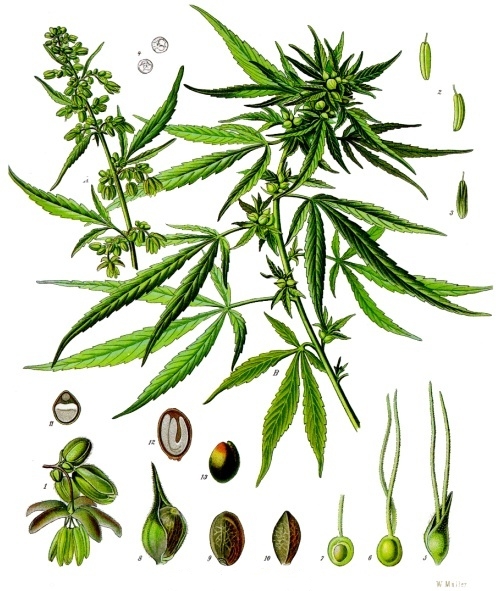
Almost every cannabis menu in the world sorts its products three ways: indica, sativa or hybrid. It is the first filter on most dispensary websites and one of the first questions at the counter. It is also, according to the best genetic and chemical research so far, a poor description of what is in the jar.
The labels are not random noise, and we will get to what they do capture. But three large studies, one on genetics, one on genes plus chemistry and one on lab results, point the same way. The words are a marketing habit with some botany in its family tree, and the plant has largely moved on without them.
Where the words came from#
The names are old botany. Carl Linnaeus described Cannabis sativa in Species Plantarum in 1753, with a fibre (hemp) plant as the type specimen. In 1785 Jean-Baptiste Lamarck described a second species, Cannabis indica, for drug-type plants from India. Botanists have argued over whether that makes one species or two ever since. A 2020 classification in PhytoKeys by John McPartland and Ernest Small treats them as one species and splits them at subspecies level.
The consumer meaning is newer and looser. In market use, "sativa" tends to mean a tall, narrow-leafed plant and "indica" a short, broad-leafed one, with a promised experience bolted on to each. That is two claims in one word: one about how a plant grows, one about what a product is supposed to deliver. Only the first is the sort of thing a botanist can check. Decades of crossing have since made most of what is sold a hybrid of hybrids, but the labels survived because they are short, familiar and easy to print.
Same name, opposite plants (2019)#
In 2019, Anna Schwabe and Mitchell McGlaughlin of the University of Northern Colorado published a genotyping study in the Journal of Cannabis Research. They collected flower from 20 dispensaries and donors in Colorado, Washington and California, 122 samples of 30 named strains, and read their genetic markers. The samples fell into two genetic groups. In the authors' words, that split "does not support the commonly described Sativa and Indica phenotypes."
The examples are the fun part.
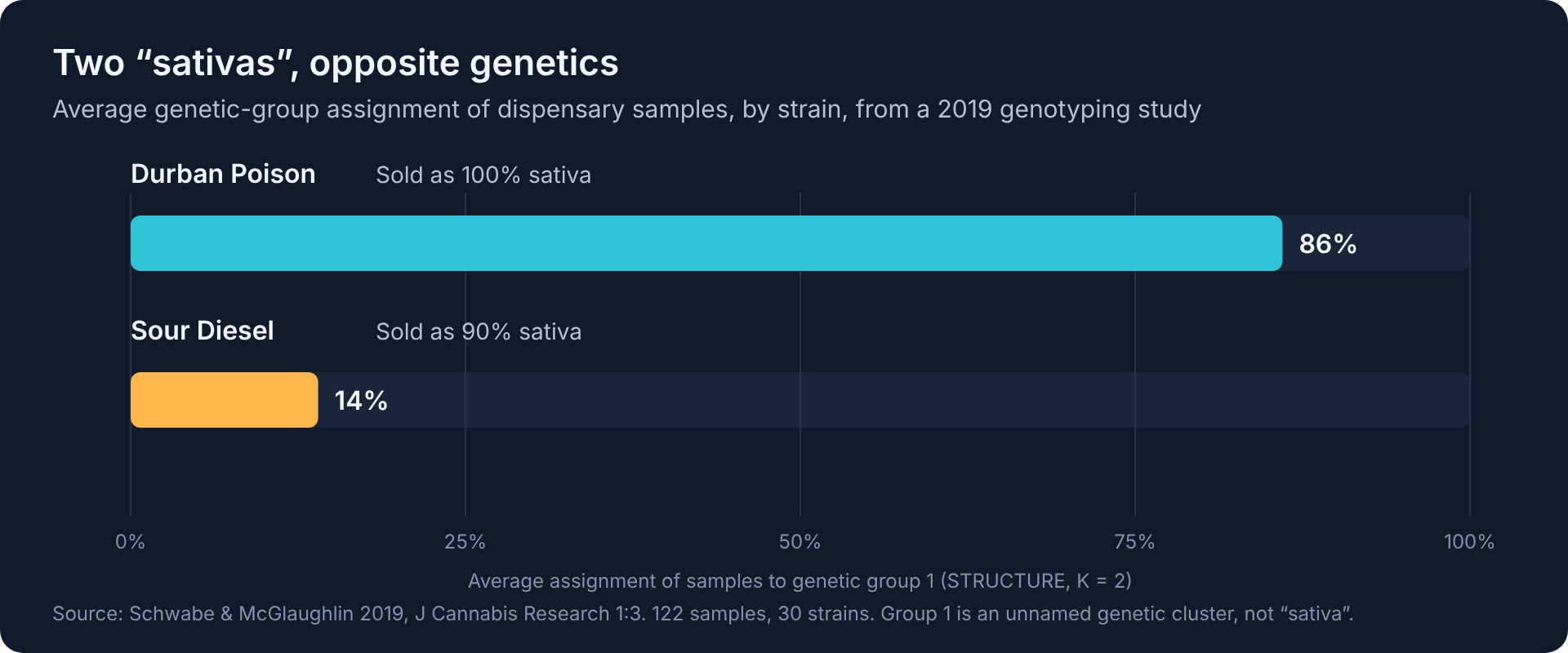
Durban Poison, sold as 100% sativa, averaged 86% assignment to the first genetic group. Sour Diesel, sold as 90% sativa, averaged 14%. The authors called the two strains' genetic assignments "contradicting". Two samples bought under different names, Larry OG and Tahoe OG, had identical genotypes and came from the same dispensary. Coincidence is unlikely, the authors wrote, and mislabelling more likely.
The bigger finding was that most strains contained at least one genetic outlier: a sample sold under the name that was not the same plant as its shelf-mates. Remove the outliers and many strains looked quite stable. But no buyer gets to remove them. You take home whichever jar is on the shelf. (We lean on this paper again in our piece on the cannabis family tree, because it says as much about pedigrees as about labels.)
The labels track a few smells (2021)#
A 2021 Nature Plants paper from Dalhousie University in Canada and the Dutch medicinal cannabis company Bedrocan went further. Sophie Watts is first author and Sean Myles last. The team profiled 297 samples for 40 terpenes and cannabinoids, and 137 of them yielded enough DNA to read more than 116,000 genetic markers. Sativa- and Indica-labelled samples, they found, "were genetically indistinct on a genome-wide scale." They concluded that the scale "poorly captures overall genomic and metabolomic variation."
What the labels did follow was a short list of aroma compounds. Myrcene was the compound most strongly linked to an indica label, along with a few sesquiterpenes, and the genetic signal sat near clusters of terpene synthase genes, the genes that build terpenes. The authors suggest the labelling is "probably driven primarily by a small number of key terpenes."
Read that plainly and the labels begin to look like a smell chart that picked up a pedigree by mistake. A product gets called indica or sativa partly by how it smells, and the smell then gets read as a statement about ancestry. Two disclosures: Bedrocan funded the work, and two authors are Bedrocan employees.
Ninety thousand lab results (2022)#
The third study is the largest. Christiana Smith, Daniela Vergara, Brian Keegan and Nick Jikomes analysed 89,923 flower samples tested by labs in six US states between December 2013 and January 2021, and published the results in PLOS ONE in May 2022. The data came through Leafly, where Jikomes is based.
Products sorted into three broad terpene groups: one high in caryophyllene and limonene, one in myrcene and pinene, one in terpinolene and myrcene. The indica, sativa and hybrid labels did not line up with them. The paper says the nomenclature "does not reliably distinguish samples based on their chemical content."
It is not pure noise, though, and the authors say so. The terpinolene group held roughly twice as many sativa-labelled products, and half as many indica-labelled ones, as chance would predict. Labels lean toward certain chemistry. They just do not sort by it. Strain names fared better than the three-way labels but were "far from ideal": 96% of Purple Punch product averages landed in a single terpene group, against 62.5% for Tangie. Keegan's verdict, as reported by CU Boulder Today, was that a label like this is "like if your cereal box only showed calories and fat and nothing else."
Durban Poison, the same strain that split Schwabe's samples, got a mention too. Jikomes was quoted in the same CU Boulder Today coverage calling it "consistently inconsistent".
What we see in our own records#
Our catalogue shows how deep the habit runs. When we processed 253,699 lineage statements on 13 September 2026, 7,642 of the parent names were pure type descriptors: "indica" 1,348 times, "sativa" 1,282, "ruderalis" 1,114. Sources were writing "indica" in the parent slot as though it were a plant you could buy seeds from.
So our lineage tools refuse those words as parents. Where a source states an indica or sativa share, the lineage explorer has a lens that colours strains by it, and it says what it is: the share as stated by sources, drawn from a heritage percentage where one is given, otherwise from the stated type. Grey means nobody said. It is a record of what the paperwork claims, not a measurement of the plant. The same caution applies to every pedigree link, which is what our piece on the cannabis family tree is about.
How to read a label like a sceptic#
None of this says every product is the same. It says the three-way label is the wrong instrument for telling products apart. A few habits are better:
- Treat "indica", "sativa" and "hybrid" as marketing categories. The studies above measured genes and chemistry, not experiences, so they cannot say what any label feels like. What they can say is that the label does not sort plants by genetics or by overall chemistry.
- Read the lab report, not the tub. Look for the cannabinoid percentages, whether there is a terpene panel, which lab ran it and the date. Where a terpene panel exists, it describes the batch in front of you in a way a one-word label cannot.
- Note the producer and batch, not only the strain name. The 2019 study found the same name could cover different plants.
- Treat the aroma as the part of the label that has some evidence behind it, and no more than that.
- Where a pedigree is quoted, ask who says so. A single seller's claim is a claim.
The indica-sativa split is a comforting system. It turns a complicated plant into a simple choice. It is just not a description of the plant in front of you.
This piece is about labels and genetics. It is not advice to use or buy cannabis, and laws on cannabis differ between countries and between Australian states and territories.
Fact-checked 12 October 2026. Editor verdict: Pass With Edits.
Sources#
- Schwabe, A. L. and McGlaughlin, M. E. (2019), "Genetic tools weed out misconceptions of strain reliability in Cannabis sativa: implications for a budding industry", Journal of Cannabis Research 1, article 3. https://doi.org/10.1186/s42238-019-0001-1
- Watts, S., McElroy, M., Migicovsky, Z., Maassen, H., van Velzen, R. and Myles, S. (2021), "Cannabis labelling is associated with genetic variation in terpene synthase genes", Nature Plants 7, 1330 to 1334 (published 14 October 2021). https://doi.org/10.1038/s41477-021-01003-y
- Smith, C. J., Vergara, D., Keegan, B. and Jikomes, N. (2022), "The phytochemical diversity of commercial Cannabis in the United States", PLOS ONE 17(5): e0267498 (published 19 May 2022). https://doi.org/10.1371/journal.pone.0267498
- McPartland, J. M. and Small, E. (2020), "A classification of endangered high-THC cannabis (Cannabis sativa subsp. indica) domesticates and their wild relatives", PhytoKeys 144. https://phytokeys.pensoft.net/article_preview.php?id=46700
- Lisa Marshall, "What's your weed label? It doesn't tell you much, study suggests", CU Boulder Today (19 May 2022), for the Keegan and Jikomes quotes (not in the paper): https://www.colorado.edu/today/2022/05/19/whats-your-weed-label-doesnt-tell-you-much-study-suggests
- CannaLib lineage explorer, build of 14 September 2026: https://cannalib.org/lineage/ (lens legend "Indica to sativa, as stated by sources").
- CannaLib fact-projection record, 13 September 2026, section 3.1 (parent-token measurement) and section 4 item 5 (descriptor stoplist). Internal document, CannaLib repo `docs/qa/2026-09-13-fact-projection.md`.
- Köhler, F. E. (ed.), Köhler's Medizinal-Pflanzen (Gera, 1887), plate for Cannabis sativa, via Wikimedia Commons "File:Cannabis sativa - Köhler–s Medizinal-Pflanzen-026.jpg".
Pull the thread
Look up Durban Poison and Sour Diesel and compare what the labels say with the records. Everything above is checkable in the same CannaLib tools we used.
- Explorer
Open the Durban Poison card
Every claim, test and alias for one strain, on one card.
Open → - Lineage sky map
See Durban Poison in the family tree
The family tree, drawn from recorded parent-to-child edges.
Open →
This opens the real CannaLib page inside the story, so it only loads when you ask.
curl "https://api.cannalib.org/v1/catalogs/strains?q=Durban%20Poison&limit=5"
More Strain Stories
- Note02Field notes
Where did your weed actually come from? Stop trusting the jar, check the family tree
Wondering where your favorite strain really came from? CannaLib shows the competing family-tree stories with their sources, and checks cup-winner claims against published results.
1,599of 4,826 award claims confirmed so farRead the story → - Note01Field notes
Don't breed blind: check the family tree before you cross
Before you cross two cultivars, check whether they share a grandparent. CannaLib lays out 143,611 named strains, 118,039 parent links and every competing breeder claim with its source.
118,039parent-to-child links to check before you crossRead the story → - Ep.08Lineage Under the Limelight
Zkittlez: taste the rainbow, spell it with a Z
A candy maker sued the breeder of Zkittlez in 2021 over the name. We lay out the dated court record and both sides' statements, then say what we will test in the plant.
$250Kdamages sought by the candy makerRead the story →