
THCpotencypsychosis
Strong cannabis and psychosis: what the big studies can and can't say
The link between high-THC cannabis and psychosis has firmed up, and it's more nuanced than either camp admits. Five major studies, read carefully.
In this story
There are two lazy versions of this story. One says cannabis causes schizophrenia, full stop. The other says the link is reefer-madness scaremongering and all correlation. Neither survives contact with the research of the past seven years.
The more honest version goes like this. Frequent use of high-THC cannabis is consistently associated with a higher risk of psychosis. The association is strongest with daily use and with stronger products, and the population burden falls most heavily on young men. Some of the link probably runs the other way, with people prone to psychosis being more likely to use cannabis. And none of the big studies could measure precisely what the people in them were actually using.
That is less satisfying than either slogan. It is also more useful now that legislatures are writing THC ceilings into law and Australia's prescription market runs mostly on THC-rich products. Here is what the major studies found, in their own terms.
The study that changed the conversation#
In March 2019, a team led by Marta Di Forti at King's College London published a case-control study in The Lancet Psychiatry that is still the reference point on potency and psychosis. It drew on the EU-GEI project: 901 people aged 18 to 64 presenting with a first episode of psychosis at 11 sites in England, the Netherlands, France, Spain, Italy and Brazil, recruited between 2010 and 2015, plus 1,237 population controls from the same areas.
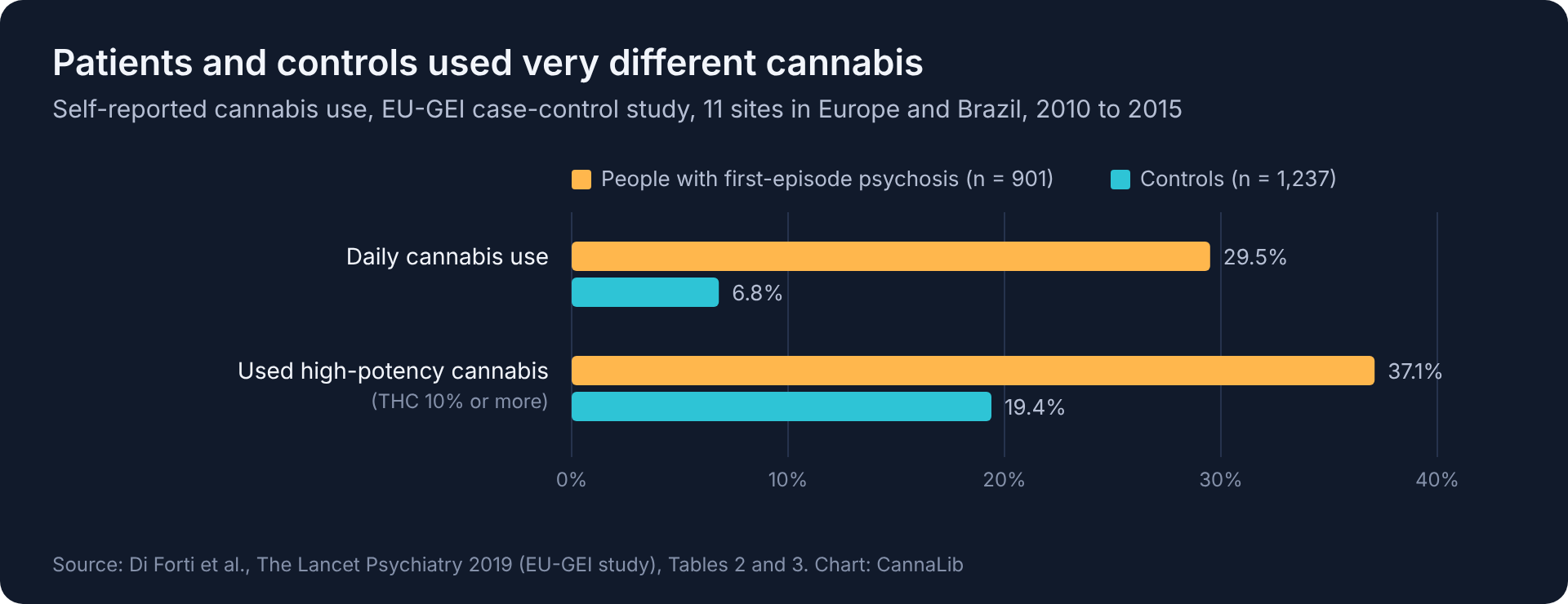
The two groups' cannabis histories looked very different:
- 29.5% of patients reported daily use, against 6.8% of controls.
- 37.1% of patients had used high-potency cannabis, defined as 10% THC or more, against 19.4% of controls.
After adjusting for other factors, daily users had about 3.2 times the odds of a psychotic disorder compared with people who had never used cannabis (95% confidence interval 2.2 to 4.1). For daily use of high-potency cannabis, the adjusted odds ratio was 4.8 (2.5 to 6.3). (Odds ratios are not quite "times more likely", but the direction is clear.)
The figures that made headlines were population estimates. Assuming the link is causal, the team calculated that 30.3% of new psychosis cases in London and 50.3% in Amsterdam could be attributed to high-potency cannabis. In London, the paper notes, skunk-like cannabis averaging about 14% THC made up 94% of the street market. Across all 11 sites the figure was 12.2%. Without high-potency cannabis, they modelled, London's rate of new cases would fall from 45.7 to 31.9 per 100,000 person-years, and Amsterdam's from 37.9 to 18.8.
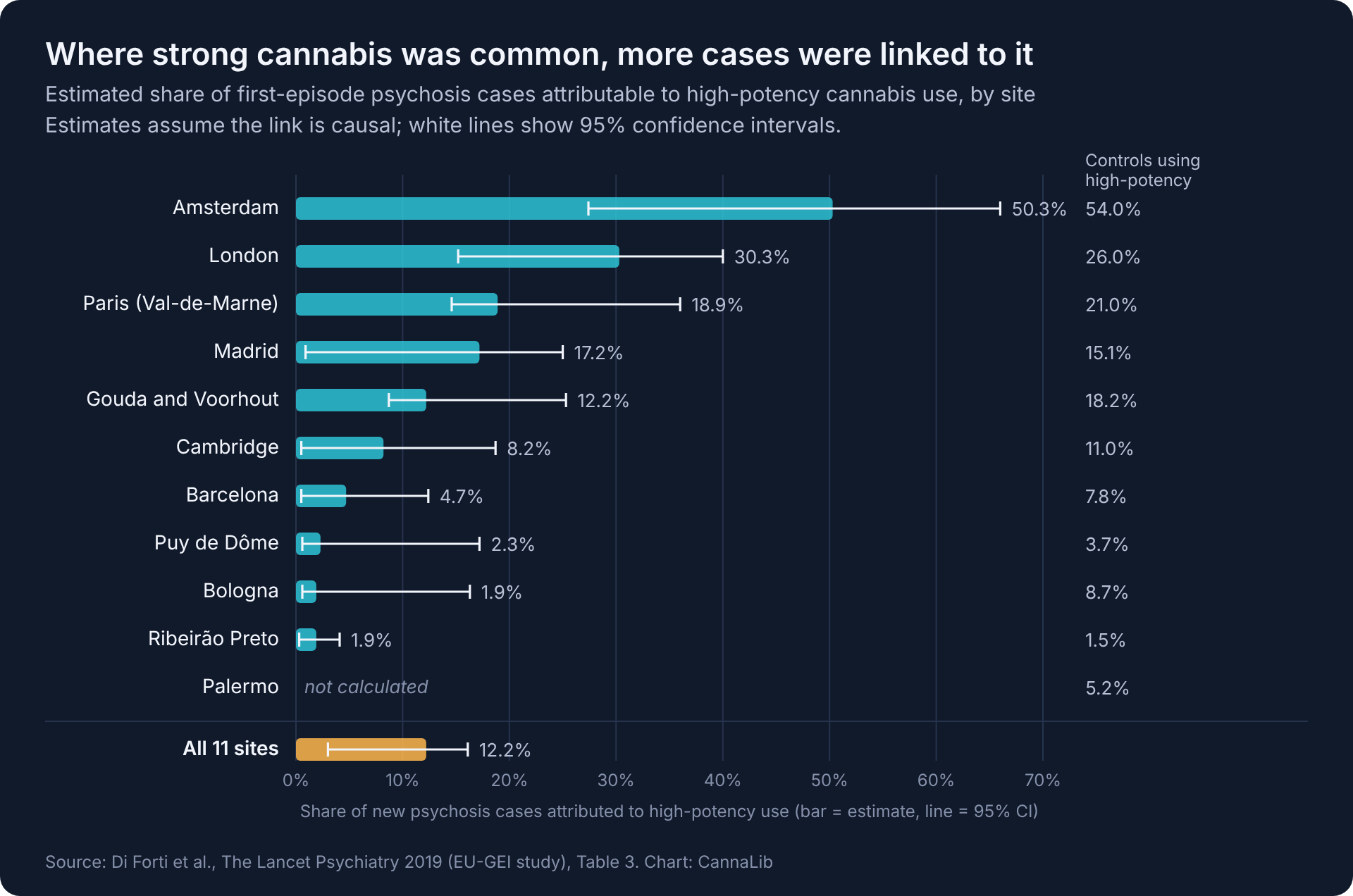
Across the 11 sites, the rate of new psychosis cases tracked how common daily use (correlation 0.8) and high-potency use (0.7) were among local controls.
Two caveats matter. A case-control study compares people who already have a condition with people who don't; it can't watch risk unfold over time. And potency was never measured. Participants named the type of cannabis they used, and the team assigned it an expected THC level from published European drug-market data. The authors argue this crude split probably underestimates the potency effect; it also means nobody tested what anyone actually smoked.
Denmark: the young-men problem#
Denmark's national health registers make it unusually good at this kind of question. In 2023, Carsten Hjorthøj and colleagues, including co-authors from the US National Institute on Drug Abuse, published a register study in Psychological Medicine covering 6,907,859 people who were aged 16 to 49 at some point between 1972 and 2021, with 45,327 new cases of schizophrenia.
The exposure here is not "using cannabis" but a recorded diagnosis of cannabis use disorder, meaning problematic, dependent use. People with that diagnosis had roughly 2.4 times the adjusted rate of schizophrenia among men and 2.0 times among women. The gap between the sexes was widest at ages 16 to 20, where the adjusted rate ratio for men (3.84) was about twice that for women (1.81).
Then the population arithmetic. Assuming causality, in the authors' own words, about 15% of schizophrenia cases among men in 2021 would have been prevented if they had not had cannabis use disorder, against about 4% among women. For men aged 21 to 30 the authors suggest the share "may even be as high as 25–30%". The male share rose by an average of 4.8% a year across five decades, which the authors attribute mainly to more potent cannabis alongside more cannabis use disorder. "Cannabis use is not harmless," Hjorthøj said, and its "risks are not fixed at one point in time."
The paper is candid about its limits. It is observational and, the authors write, "does not directly allow for causal inference". The registers hold no data on how often people used, how much, from what age, or at what THC content, and the analysis couldn't adjust for tobacco. Reverse causation, the authors note, may occur and needs more study.
Ontario: a steady climb, no cliff at legalisation#
A large 2025 study from Canada, led by Daniel Myran and published in JAMA Network Open, followed 13,588,681 Ontarians aged 14 to 65 from 2006 to 2022. Cannabis use disorder was counted only when it led to an emergency department visit or hospital admission, so this captures the severe end of use.
Among the 118,650 people with such a diagnosis, 8.9% went on to be diagnosed with schizophrenia during the study, compared with 0.6% of everyone else. The share of new schizophrenia cases associated with cannabis use disorder rose from 3.7% in the pre-legalisation period (2006 to late 2015) to 10.3% in the legalisation period (October 2018 to 2022). In that later period the figure ranged from 18.9% in men aged 19 to 24 down to 1.8% in women aged 45 to 65.
Two findings complicate the simplest political story. The rise was steady, with no acceleration after medical cannabis access was liberalised from late 2015 or after recreational cannabis was legalised in October 2018. And the overall rate of new schizophrenia diagnoses in Ontario stayed stable across the period; what changed was the share associated with cannabis use disorder. As with Denmark, the attributable share is an estimate that depends on the association being causal.
Potency, across 20 studies#
In 2022, a team at the University of Bath led by Kat Petrilli, with senior author Tom Freeman, published a systematic review in The Lancet Psychiatry: 20 studies, almost 120,000 people. Higher-potency cannabis was associated with a greater risk of psychosis (eight studies looked at this) and of cannabis use disorder (six studies). For anxiety and depression the evidence was mixed. The authors flag that studies measured potency in different ways and that more longitudinal research is needed, and they describe the findings as relevant to public health guidance and to policy on cannabis sales.
The other direction#
Here is the part that doesn't fit on a poster.
In 2018, a team led by Joëlle Pasman, Karin Verweij and Jacqueline Vink published a genome-wide study of lifetime cannabis use in Nature Neuroscience, drawing on 184,765 people. They then used Mendelian randomisation, a method that treats inherited genetic variants as a kind of natural experiment, to test cause and effect. Their abstract reports evidence for "a causal positive influence of schizophrenia risk on cannabis use": people with a higher genetic liability to schizophrenia appear more likely to try cannabis in the first place. Evidence in the other direction, from cannabis use to schizophrenia, was weak in this analysis.
Read that carefully, because it cuts both ways. The study's measure was whether someone had ever used cannabis, which lumps a single experiment together with years of daily use and says nothing about potency. In their preprint the authors also noted that the genetic variants for cannabis use explained very little of the variation in use, so a weak result in that direction is hard to interpret. And other Mendelian randomisation work points the other way: a 2018 study in Molecular Psychiatry by Julien Vaucher and colleagues, using 34,241 people with schizophrenia and 45,604 controls, concluded its results suggested the relationship between cannabis use and schizophrenia is causal. The reasonable reading is that both directions can operate at once: vulnerability nudges some people toward cannabis, and heavy use of strong cannabis may add to risk in people already vulnerable. It is a reason to treat attributable-fraction headlines as upper-bound arithmetic, not a body count.
Why it matters more now#
Every study above points to the same cluster: frequent use, high-THC products, youth, male sex and existing vulnerability. Two policy facts show where markets have got to.
- Ohio caps THC at 35% for flower and, since 20 March 2026, at 70% for extracts, down from 90%, under Senate Bill 56. That a legislature thought a 70% ceiling was a tightening tells you something.
- In Australia, the Penington Institute reports that Category 5 products, the TGA category with less than 2% CBD (in practice, THC-dominant), made up 85% of medicinal cannabis units sold in the first half of 2025. The Australian Health Practitioner Regulation Agency's guidance for prescribers, issued in July 2025, warns of "significant patient harm" from poor prescribing. Among its examples of poor practice: failing to take a mental health history from patients with past schizophrenia who then had psychotic episodes after taking prescribed medicinal cannabis.
What the evidence does and doesn't support#
We don't give health advice, and no catalogue can tell anyone their personal risk. What the studies consistently show is narrower than either slogan:
- Frequency is the strongest signal. The clearest associations are with daily use or diagnosed cannabis use disorder, not occasional use.
- Potency adds to it. Where studies could separate the two, stronger products carried the larger association.
- The population burden is concentrated in young men, in every dataset that split by age and sex.
- Causation is probable in part, not proven in full. Every attributable figure above assumes the link is causal, and the genetic evidence shows at least some of it runs the other way.
- Potency itself is badly measured. Di Forti inferred it from market data; Denmark and Ontario had none. And the label on a jar is a loose guide at best: in one blinded Colorado study we covered in Your THC number is a vibe, 30.3% of flower products were over-labelled by more than 15%.
The honest middle ground is not a shrug. The risk is not evenly spread, and it is not imaginary: it gathers where strong cannabis, daily use and youth meet. Policy built on that, rather than on either slogan, would be a welcome change.
If cannabis use or changes in mental health are worrying you or someone close to you, talk to a GP. In Australia, the National Alcohol and Other Drug Hotline is free and confidential on 1800 250 015. In an emergency, call 000.
Fact-checked 12 October 2026. Editor verdict: Pass With Edits.
Sources#
- Di Forti M et al. (EU-GEI WP2 Group) (2019), "The contribution of cannabis use to variation in the incidence of psychotic disorder across Europe (EU-GEI): a multicentre case-control study", The Lancet Psychiatry 6(5): 427–436, published online 19 March 2019: https://doi.org/10.1016/S2215-0366(19)30048-3. Abstract checked via University of Bath research portal: https://researchportal.bath.ac.uk/en/publications/the-contribution-of-cannabis-use-to-variation-in-the-incidence-of/ ; tables and text checked in the accepted manuscript on UCL Discovery: https://discovery-pp.ucl.ac.uk/id/eprint/10072189/
- Hjorthøj C, Compton W, Starzer M, Nordholm D, Einstein E, Erlangsen A, Nordentoft M, Volkow ND, Han B (2023), "Association between cannabis use disorder and schizophrenia stronger in young males than in females", Psychological Medicine 53(15): 7322–7328, online 4 May 2023: https://doi.org/10.1017/S0033291723000880
- National Institute on Drug Abuse, "Young men at highest risk of schizophrenia linked with cannabis use disorder" (news release, May 2023), source of the Hjorthøj quotes: https://nida.nih.gov/news-events/news-releases/2023/05/young-men-at-highest-risk-schizophrenia-linked-with-cannabis-use-disorder
- Myran DT, Pugliese M, Harrison LD, Solmi M, Anderson KK, Fiedorowicz JG, Finkelstein Y, Manuel D, Taljaard M, Webber C, Tanuseputro P (2025), "Changes in incident schizophrenia diagnoses associated with cannabis use disorder after cannabis legalization", JAMA Network Open 8(2): e2457868, 3 February 2025: https://doi.org/10.1001/jamanetworkopen.2024.57868
- Petrilli K, Ofori S, Hines L, Taylor G, Adams S, Freeman TP (2022), "Association of cannabis potency with mental ill health and addiction: a systematic review", The Lancet Psychiatry 9(9): 736–750: https://doi.org/10.1016/S2215-0366(22)00161-4 ; participant count from University of Bath, "High-strength cannabis linked to addiction and mental health problems" (July 2022): https://www.bath.ac.uk/announcements/high-strength-cannabis-linked-to-addiction-and-mental-health-problems/
- Pasman JA, Verweij KJH, Gerring Z et al. (2018), "GWAS of lifetime cannabis use reveals new risk loci, genetic overlap with psychiatric traits, and a causal effect of schizophrenia liability", Nature Neuroscience 21: 1161–1170, 27 August 2018: https://doi.org/10.1038/s41593-018-0206-1 ; preprint (bioRxiv 234294): https://www.biorxiv.org/content/10.1101/234294v1
- Gage S, "What can genetics tell us about the link between cannabis and schizophrenia?", The Mental Elf (commentary on Pasman et al.): https://www.nationalelfservice.net/mental-health/addiction/what-can-genetics-tell-us-about-the-link-between-cannabis-and-schizophrenia/
- Vaucher J, Keating BJ, Lasserre AM et al. (2018), "Cannabis use and risk of schizophrenia: a Mendelian randomization study", Molecular Psychiatry 23(5): 1287–1292: https://doi.org/10.1038/mp.2016.252
- Ohio Legislative Service Commission, Final Analysis of Sub. S.B. 56 (136th General Assembly), corrected 2 April 2026 (R.C. 3796.06(E); effective 20 March 2026): https://www.legislature.ohio.gov/download?key=27450
- Penington Institute, Cannabis in Australia 2025 (November 2025), pp. 13, 17–18 (Category 5 share citing TGA sales data, FOI 26-2142): https://www.penington.org.au/wp-content/uploads/2025/11/Penington_Institute_Cannabis-in-Australia_Nov_2025.pdf
- Australian Health Practitioner Regulation Agency, "Medicinal cannabis prescribing" (guidance, July 2025; page reviewed 15 September 2026): https://www.ahpra.gov.au/Resources/Medicinal-cannabis-prescribing
- Giordano G, Brook CP, Ortiz Torres M et al. (2025), "Accuracy of labeled THC potency across flower and concentrate cannabis products", Scientific Reports 15: 20822: https://doi.org/10.1038/s41598-025-03854-3 (as fact-checked for CannaLib's "Your THC number is a vibe").
- Australian Government Department of Health, National Alcohol and Other Drug Hotline: https://www.health.gov.au/contacts/national-alcohol-and-other-drug-hotline ; number confirmed via Alcohol and Drug Foundation: https://adf.org.au/help-support/support-services-directory/
Pull the thread
Check the recorded THC range for a strain before you read its label. Everything above is checkable in the same CannaLib tools we used.
This opens the real CannaLib page inside the story, so it only loads when you ask.
curl "https://api.cannalib.org/v1/corpus"
More Strain Stories
- Ep.01Lineage Under the Limelight
Pineapple Express: how a movie killed a lineage
Seth Rogen says Pineapple Express weed didn't exist before the movie. Now 40+ breeders sell it with 7 different family trees, and the one DNA sample we can test fits none of them.
7family trees, none fit the DNARead the story → - Ep.07Lineage Under the Limelight
Romulan: the strain from the Neutral Zone
Romulan has at least seven origin stories and four recorded parents, each with a single source. We lined up the dated sources, 702 lab tests and an upcoming DNA finding to see what holds.
37breeders sell it, nobody agrees where it came fromRead the story → - Brief03Policy watch
Australia's green rush, on prescription
SAS-B approvals for medicinal cannabis tripled from 2020 to 2024. What the TGA and Ahpra say about it, and NSW's new drug-driving law, as of 13 October 2026.
177,762special access approvals in 2024, up from 57,711Read the story →