
entourage effectterpenesevidence
The entourage effect, on trial
Menus sell the entourage effect as fact. The evidence: two small human trials, one mouse study and three lab studies that came up empty.
In this story
"Full spectrum." "Whole plant." "Terpene-enhanced." Anyone who has read a cannabis menu in the past decade has been sold the entourage effect: the claim that the hundreds of compounds in the plant work as a team, so that THC with its natural companions behaves differently from THC on its own.
It is an attractive idea. It also gives a premium price a scientific-sounding reason to exist.
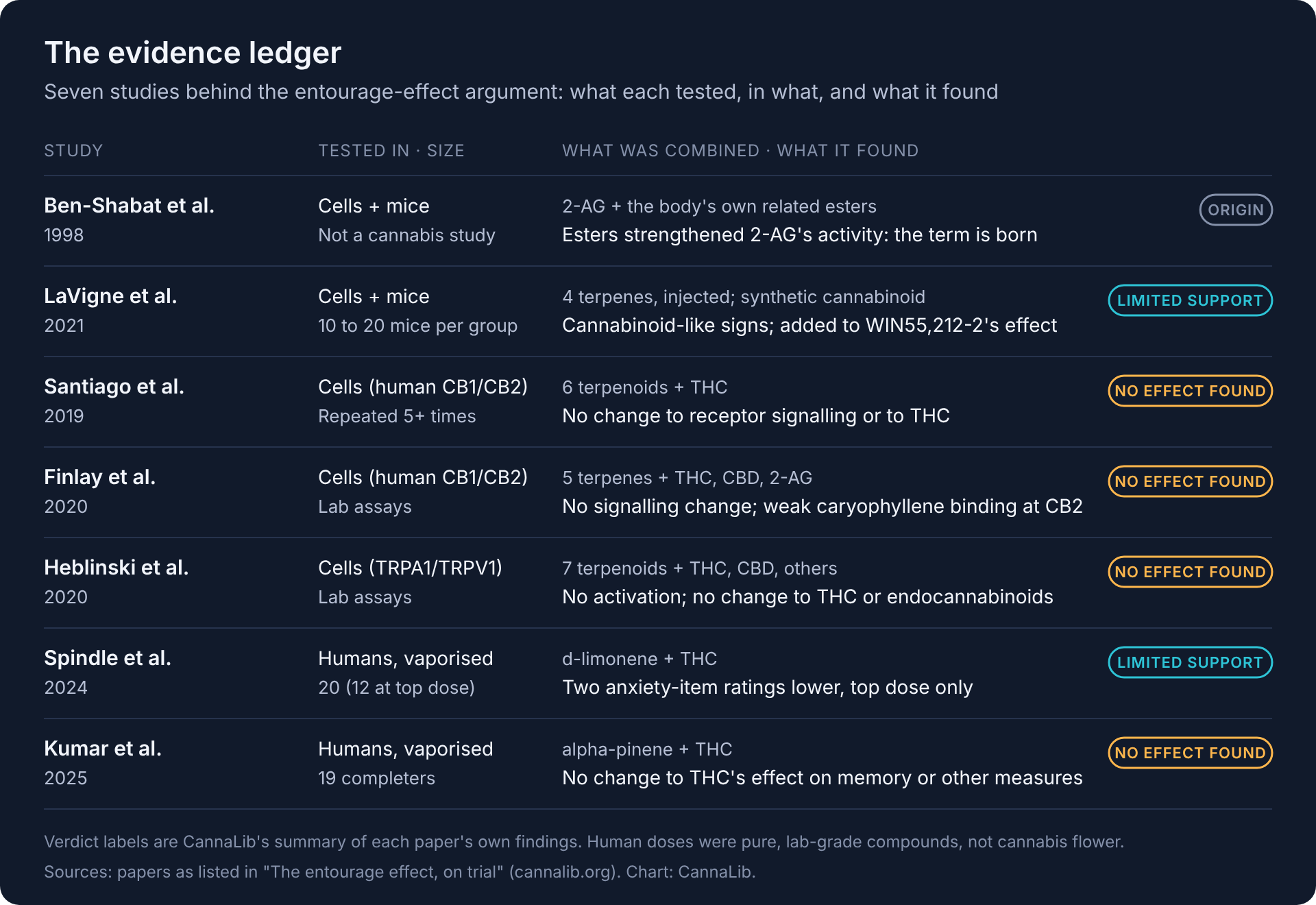
So we put it on trial. Nearly three decades after the term was coined, the evidence a court would actually admit fits on one page: two small human studies from one lab, one mouse study, and three cell studies from Australia and New Zealand that went looking for the mechanism and came back empty-handed. Here is the file, as it stands on 12 October 2026.
The charge, and where it came from#
The phrase did not start with the cannabis plant. In 1998 a team including Raphael Mechoulam, the Israeli chemist who with Yechiel Gaoni first isolated and described THC in 1964, published a paper in the European Journal of Pharmacology about 2-AG, one of the cannabinoids the body makes itself. In spleen, brain and gut, 2-AG turns up alongside related fatty compounds. On their own those companions did nothing at cannabinoid receptors. Mixed with 2-AG, they strengthened its activity in cell tests and in mice. The authors called it an "entourage effect".
That was a finding about the body's own chemistry. The leap to the plant came later. Its best-known advocate is neurologist Ethan Russo, whose 2011 review in the British Journal of Pharmacology, "Taming THC", proposed that terpenoids and minor cannabinoids might act together with THC and modify its effects. Russo was a senior medical adviser to GW Pharmaceuticals, the maker of the cannabis-extract medicine Sativex, from 2003 to 2014.
Not everyone was persuaded. "It's an idea, or theory, that has been co-opted from what it was never meant to cover," pharmacologist Jenny Wiley of RTI International told Nature in 2019.
Exhibit A: limonene, 20 people, one patent#
The strongest evidence for the prosecution comes from Johns Hopkins University. In 2024 Tory Spindle, Ryan Vandrey and colleagues, Russo among them, published a trial in Drug and Alcohol Dependence. Twenty healthy adults who used cannabis occasionally, ten men and ten women, inhaled vaporised pure THC (15 or 30 mg), pure d-limonene (1 or 5 mg), the two combined, or a placebo, across nine double-blind sessions. Twelve of them came back for an optional tenth session: 30 mg THC with 15 mg limonene.
The main measures were self-ratings on a 0 to 100 scale for items such as "anxious/nervous" and "paranoid". Limonene alone scored no differently from placebo. With THC, ratings on those items fell as the limonene dose rose, but the difference from THC alone reached statistical significance only in that tenth-session combination. Limonene did not change THC's other measured effects, or how THC moved through the blood.
That is a controlled human result. Its limits are mostly the authors' own:
- Size. Twenty people, and the decisive comparison rests on twelve.
- Order. The tenth session was not randomised; it always came last. The authors acknowledge order effects or tolerance could have played a part, and argue against it.
- Pure compounds, one route. Lab-grade THC and limonene, vaporised. No cannabis flower, no edibles.
- The ratio. The combination was two parts THC to one part limonene, which the authors say is unlikely to occur in unadulterated cannabis flower.
Then there is the paperwork. After the trial ended and the data were analysed, Johns Hopkins filed a patent application on behalf of Vandrey, Spindle and Russo covering d-limonene's use alongside THC, based on these data. The paper also discloses that Russo is a scientific adviser to True Terpenes, the Oregon company that supplied the limonene. The study was publicly funded by the US National Institute on Drug Abuse and registered before it began. None of that makes the result wrong. It does make independent replication matter, and as of 12 October 2026 we could not find one.
Exhibit B: pinene, and a result the industry didn't order#
The same Johns Hopkins team, with Lakshmi Kumar as first author, ran a second trial on alpha-pinene, the terpene associated with pine needles, published in Medical Cannabis and Cannabinoids in June 2025. The question was whether pinene, which the paper notes has been credited with "purported" cognitive-enhancing properties, would offset THC's well-known effect on short-term memory.
Nineteen people completed six double-blind sessions: 30 mg vaporised THC with 0, 0.5, 5 or 15 mg alpha-pinene, pinene alone, or placebo. Pinene alone did nothing measurable. THC impaired memory and cognitive performance, as expected. Adding pinene, at doses the authors describe as at and above those found in flower, changed nothing. In the paper's words, the result "is inconsistent with some cannabis industry claims and speculation by some cannabis researchers."
Same lab, same funder, same terpene supplier, same adviser. One terpene, one tested effect, no effect found. For a hypothesis usually described as broad, the human record now reads: one narrow, conditional result and one clean miss.
Exhibit C: the mice#
In 2021 John Streicher's group at the University of Arizona reported in Scientific Reports that four terpenes (alpha-humulene, geraniol, linalool and beta-pinene) behaved in some ways like cannabinoids. In cells engineered to carry the CB1 receptor they switched on a signalling pathway, an effect a CB1-blocking drug prevented. In male and female mice, injected at up to 200 mg per kg of body weight, they produced classic cannabinoid-like signs such as lower body temperature and slower tail-flick responses on a heat test. Combined with a synthetic cannabinoid, WIN55,212-2, the heat-test effect was larger.
Evidence, of a kind. But it is mice, the doses were injected into the abdomen at levels no cannabis user inhales, and the cannabinoid partner was a lab compound, not THC from a plant. The study was paid for from university funds; Streicher disclosed an equity stake in a local cannabidiol company and stated no company products were tested.
The defence: three studies, no mechanism#
If terpenes change what THC does, the first place to look is where THC acts: the CB1 and CB2 receptors. Two labs went looking.
At Macquarie University in Sydney, Marina Santiago, Mark Connor and colleagues, working with the University of Sydney's Lambert Initiative, tested six common terpenoids (alpha-pinene, beta-pinene, beta-caryophyllene, linalool, limonene and myrcene) on cells carrying human CB1 or CB2 receptors. Alone, together, or alongside THC, they did nothing to the receptors' signalling. THC's response at CB1 measured 59% alone and 55% with terpenoids: no meaningful difference. The paper's title is a verdict in itself: "Absence of entourage". It was posted as a preprint in March 2019 and published in Cannabis and Cannabinoid Research that September.
Across the Tasman, David Finlay, Michelle Glass and colleagues at the University of Otago tested five terpenes on human CB1 and CB2 in cells, published in Frontiers in Pharmacology in March 2020. Apart from a weak sign that beta-caryophyllene binds CB2, and one small shift in THC binding at CB2 with one terpene mixture, they found no effect on binding and no change in signalling, alone or alongside THC, CBD or the body's own 2-AG. Their conclusion: the entourage effect "cannot be explained by direct effects at CB1 or CB2." One detail worth noting: the study was paid for by Soma Group, a Dunedin company, and the result was not the one a seller of entourage would want.
The Sydney groups then moved the search to two ion channels that some cannabinoids act on, TRPA1 and TRPV1. Seven terpenoids, the same story: no activation, and no change to the channels' responses to THC or the body's own cannabinoids (Heblinski and colleagues, Cannabis and Cannabinoid Research, December 2020).
None of this disproves the idea, as the authors say themselves. Terpenes could act on other targets, through smell and expectation, or by changing how the body handles THC. "There could be something there," Connor told Nature, "but we are always looking for what the molecular basis might be — and at this point we can't say." What has not survived testing is the simplest version of the story: terpenes boosting THC at its own receptors.
The dose problem#
Suppose a terpene does something in a dish. The next question is how much of it reaches a person's brain from an ordinary flower, and nobody has measured that. Nature's 2019 survey of the field found that studies had not determined what concentrations of terpenoids reach the brain when cannabis is consumed.
The trials sharpen the point rather than settle it. The limonene result came at a ratio its own authors think unlikely in natural flower. The mouse doses were injected. And a terpene percentage on a label is weaker evidence than it looks: as we reported in It was never just the terpenes, limonene readings did not even track a citrus smell in one 91-sample panel study. A number that can't predict a smell is a long way from predicting anything else.
Why marketing loves it anyway#
Wiley's worry, as Nature reported it, was that the effect would be used as a marketing tool, a reason for people to keep trying new strains until one seemed to work. "It is a very complicated idea and, in some ways, may be unprovable," she said. An unprovable claim that justifies a price premium is, commercially speaking, a near-perfect product.
What would settle it is not mysterious. Proponents and sceptics told Nature the same thing: double-blind trials with specified quantities, looking at interactions one at a time. Adrianne Wilson-Poe, one of the researchers Nature interviewed, put the reason plainly: "That way, you are taking out bias and expectation." Seven years on, we could find that kind of trial for two terpenes, both from one lab.
The verdict#
- Human trials: two, from one team. Limonene: lower ratings on two anxiety-related questionnaire items at the highest combination, in 12 people, unreplicated, with a patent application on file. Pinene: no effect on the outcome tested.
- Animal work: one mouse study with injected terpenes and a synthetic cannabinoid.
- Mechanism: three cell studies found no terpene effect at CB1, CB2, TRPA1 or TRPV1.
- Dose: unknown for real-world use.
The jury isn't out. Most of the witnesses haven't been called. Until they are, "entourage" on a label is a hypothesis wearing a lab coat.
At CannaLib we record terpene values with their source and unit, and we don't translate them into effects. Now you know why.
This piece reports research. It is not advice to use or buy cannabis or any terpene product, and laws on cannabis differ between countries and between Australian states and territories.
Fact-checked 12 October 2026. Editor verdict: Pass With Edits.
Sources#
- Ben-Shabat, S. et al. (1998), "An entourage effect: inactive endogenous fatty acid glycerol esters enhance 2-arachidonoyl-glycerol cannabinoid activity", European Journal of Pharmacology 353(1): 23 to 31. https://doi.org/10.1016/S0014-2999(98)00392-6
- Gaoni, Y. and Mechoulam, R. (1964), "Isolation, structure, and partial synthesis of an active constituent of hashish", Journal of the American Chemical Society 86(8): 1646 to 1647. https://doi.org/10.1021/ja01062a046
- Russo, E. B. (2011), "Taming THC: potential cannabis synergy and phytocannabinoid-terpenoid entourage effects", British Journal of Pharmacology 163(7): 1344 to 1364. https://doi.org/10.1111/j.1476-5381.2011.01238.x
- Worth, T. (2019), "Unpicking the entourage effect", Nature 572: S12 to S13 (29 August 2019). https://doi.org/10.1038/d41586-019-02528-1
- Spindle, T. R. et al. (2024), "Vaporized D-limonene selectively mitigates the acute anxiogenic effects of Δ9-tetrahydrocannabinol in healthy adults who intermittently use cannabis", Drug and Alcohol Dependence 257: 111267. https://doi.org/10.1016/j.drugalcdep.2024.111267
- Kumar, L. et al. (2025), "The individual and interactive effects of alpha-pinene and delta-9-tetrahydrocannabinol in healthy adults", Medical Cannabis and Cannabinoids 8(1): 144 to 157 (published 25 June 2025). https://doi.org/10.1159/000547014
- LaVigne, J. E., Hecksel, R., Keresztes, A. and Streicher, J. M. (2021), "Cannabis sativa terpenes are cannabimimetic and selectively enhance cannabinoid activity", Scientific Reports 11: 8232. https://doi.org/10.1038/s41598-021-87740-8
- Santiago, M., Sachdev, S., Arnold, J. C., McGregor, I. S. and Connor, M. (2019), "Absence of entourage: terpenoids commonly found in Cannabis sativa do not modulate the functional activity of Δ9-THC at human CB1 and CB2 receptors", Cannabis and Cannabinoid Research 4(3): 165 to 176. https://doi.org/10.1089/can.2019.0016
- Finlay, D. B., Sircombe, K. J., Nimick, M., Jones, C. and Glass, M. (2020), "Terpenoids from cannabis do not mediate an entourage effect by acting at cannabinoid receptors", Frontiers in Pharmacology 11: 359 (25 March 2020). https://doi.org/10.3389/fphar.2020.00359
- Heblinski, M. et al. (2020), "Terpenoids commonly found in Cannabis sativa do not modulate the actions of phytocannabinoids or endocannabinoids on TRPA1 and TRPV1 channels", Cannabis and Cannabinoid Research 5(4): 305 to 317. https://doi.org/10.1089/can.2019.0099
- CannaLib, "It was never just the terpenes", /articles/it-was-never-just-the-terpenes/ (companion article; Isaacson et al., PLOS One, 2025, on limonene and citrus).
- CannaLib honesty rules: https://cannalib.org/honesty/
- Johns Hopkins Medicine news release, "Researchers show chemical found naturally in cannabis may reduce anxiety-inducing effects of THC" (10 April 2024), used only to cross-check the Spindle design and patent wording: https://www.hopkinsmedicine.org/news/newsroom/news-releases/2024/04/researchers-show-chemical-found-naturally-in-cannabis-may-reduce-anxiety-inducing-effects-of-thc
- University of Arizona Health Sciences news release on LaVigne et al. (14 July 2021): https://healthsciences.arizona.edu/news/releases/study-shows-cannabis-terpenes-provide-pain-relief-contribute-entourage-effect
- Santiago et al., bioRxiv preprint (6 March 2019): https://doi.org/10.1101/569079
Pull the thread
Check the terpene and cannabinoid data recorded for your strain in CannaLib. Everything above is checkable in the same CannaLib tools we used.
This opens the real CannaLib page inside the story, so it only loads when you ask.
curl "https://api.cannalib.org/v1/corpus"
More Strain Stories
- Ep.04Lineage Under the Limelight
These aren't the strains you're looking for
Skywalker, Death Star, Jedi OG and Ewok: the Star Wars strains were renamed as a precaution in 2018. We checked the lab data, and a public DNA panel shows three samples sold as Skywalker are two plants, one of them OG Kush.
3 → 2samples sold as Skywalker, two plantsRead the story → - Brief05Policy watch
Last orders: America's petrol-station THC has until 11 December
The US hemp THC ban explained: 0.4 mg per container, THCA counted, 12 November for synthetics and 11 December for the rest. As of 13 October 2026.
11 Dec2026, when most US intoxicating hemp limits startRead the story → - Brief04Policy watch
Germany, two and a half years into legal weed
Germany at 2.5 years: clubs reach at most 3.5% of consumers, home growing is up, medical imports have nearly tripled and the MedCanG bill is stuck.
21.4%of consumers mainly grow their own, up from 5.4%Read the story →