
cupsawardsjudging
Does winning a cannabis cup mean anything?
Two famous cups judge in very different ways. We checked their rules, the early winners and 21,141 results in our map to see what a trophy can tell you.
In this story
The first High Times Cannabis Cup, held in Amsterdam in 1988, had no public voting at all. It was a handful of seed companies judged by a small panel of experts, and the winner was Skunk #1 from Cultivator's Choice. By the fourth cup, about 50 members of the public were voting on the coffeeshop category. Three decades later, you can buy your way onto the judging panel with a kit.
That history matters because "cup winner" now sits on seed listings, jars and menus, and it means different things depending on who did the judging. CannaLib holds 21,141 competition results from 264 competitions. We can show which early winners went on to shape the gene pool, and how differently the big cups decide who wins.
Our view: a cup trophy is a fact about one entry on one day in front of one set of judges. Whether it is worth reading depends almost entirely on how that cup judged.
The early winners that stuck#
High Times founded the cup in Amsterdam in 1988 under then-editor-in-chief Steven Hager, and says the first edition was "judged by a small panel of experts". The winner was Skunk #1 from Cultivator's Choice, the seed company David Watson started in Amsterdam in 1986. Wikipedia's winners list, which we treat as a lead rather than a record, has Northern Lights #5 from The Seed Bank winning in 1990. High Times itself lists White Widow from the Green House as a 1995 winner.
Those three names are now parents of an absurd number of strains. In the CannaLib lineage graph (build of 14 September 2026), Skunk #1 is the recorded direct parent of 737 strains, Northern Lights of 628 and White Widow of 805. All three sit in the top twelve parents in the whole map, which we dug into in our piece on the cannabis family tree.
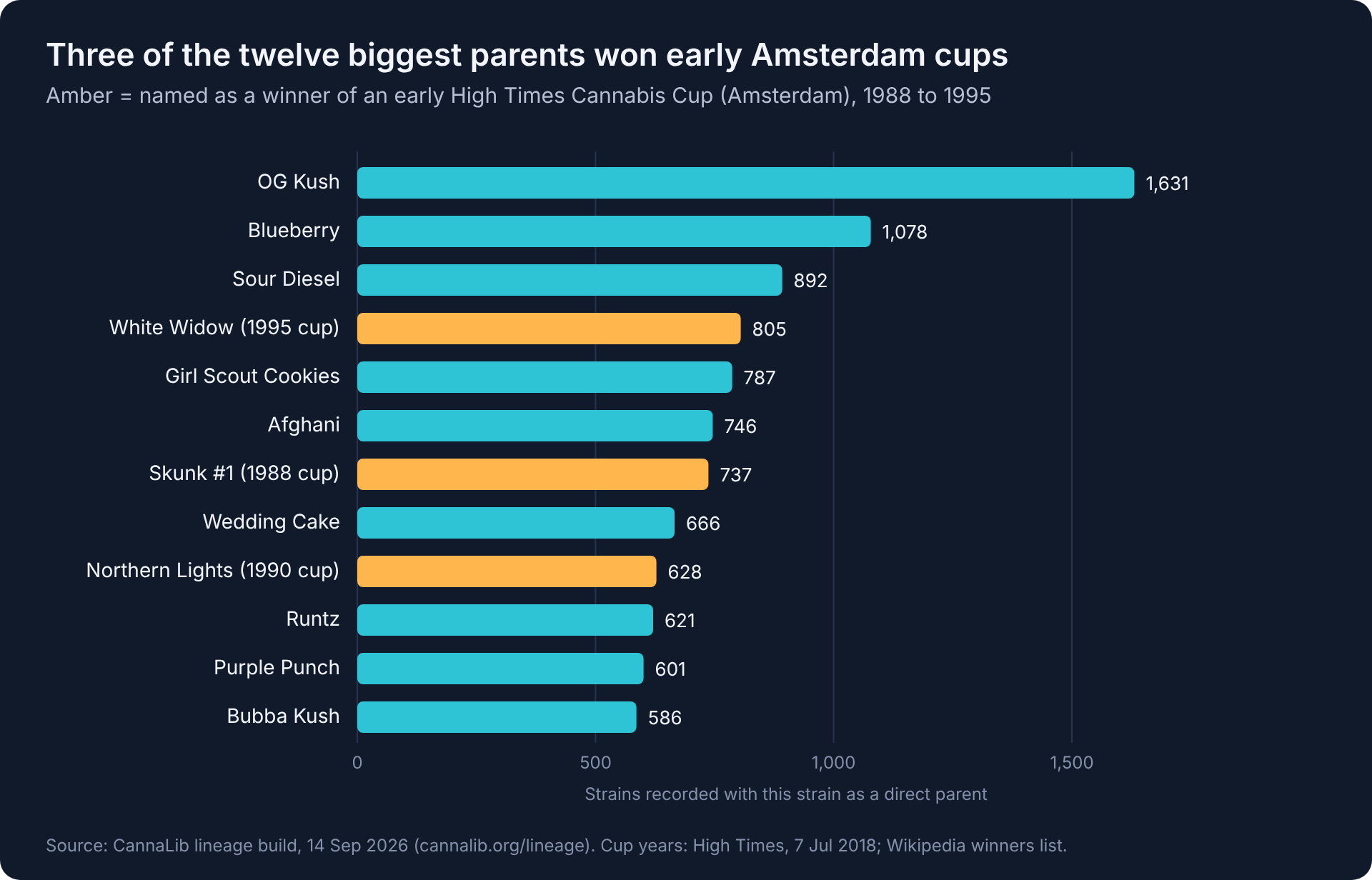
A caution before anyone gets carried away. The graph's nodes are strain names, so "Northern Lights" collects every record filed under that family name, not only the Seed Bank's #5. And the cups did not make these plants important; breeders were already crossing them. What the early cups did was reward the plants that people in Amsterdam were already going crazy for. Whether a trophy picks winners or merely notices them is a fair question, and we can't answer it from the records.
Two ways to judge a cup#
Today's cups range across a wide spread. Two sit near the ends of it.
High Times: the community, with a kit. The Cannabis Cup site says the events "are judged by the community" and that "consumers purchase official Judge Kits and score products themselves." A 2020 High Times explainer by Jon Cappetta, written for the People's Choice format, says each product is rated one to five on look and feel, aroma, burnability and effects, with a written comment, and that scores are pooled across judges. It puts the judge pool at 227 per category in that format, against about 30 in past cups. For Michigan in 2022, local press reported kits of 15 to 35 samples at US$100 to $300 each, with more than 3,300 available.
Is the judging blind? Here the accounts differ. High Times' 2020 explainer says samples are blind, meaning judges don't see brand names. A judge bylined "Illinois Ed" in Illinois News Joint on 15 November 2020 described the Illinois People's Choice edition differently: each product arrived "in the brand's regular packaging and containers", which the writer said invited judges to read reviews first. The writer also noted that Illinois law requires labelling on each container, and did not claim their own review changed any result. We read these as two descriptions of two editions, and we haven't found a published rulebook that settles the question for every edition, so we won't call any result tilted on this evidence. What we can say is that a kit-judged cup measures the preferences of people who paid to take part.
The Emerald Cup: blind, lab-tested, terpene-sorted. California's Emerald Cup began in 2003 with about 35 entries and had roughly 260 flower entries in 2021, according to Nikki Lastreto, a long-time member of its judging panels, writing in The Ganjier. In 2021, SC Labs, the cup's testing partner, tested every flower entry. Entries were anonymised and colour-coded, then sorted by dominant terpene, so judges compared like with like; SC Labs' announcement listed six primary groups (myrcene, β-caryophyllene, limonene, terpinolene, α-pinene and β-ocimene). Judges included growers, dispensary operators and plant scientists, scoring looks, smell, taste and effect. For 2022 the organisers moved to six classes built from each cultivar's chemical profile, with names such as "Jacks + Haze", "Desserts" and "Exotics".
| High Times Cannabis Cup (public format) | Emerald Cup (2021 to 2022 rules) | |
|---|---|---|
| Who judges | Members of the public who buy a kit | Growers, dispensary operators, plant scientists and others |
| Blind? | High Times says samples are blind; one 2020 Illinois judge reported branded packaging | Entries anonymised and colour-coded |
| Lab data used? | Not mentioned in High Times' explainer | Every flower entry tested by SC Labs; entries sorted by terpene profile |
| Judges pay? | Yes, kits cost about US$100 to $300 (Michigan, 2022) | Not reported |
We could not open the Emerald Cup's own rules pages from our desk this month, so the Emerald Cup column rests on its lab partner's and organisers' 2021 and 2022 announcements and on Lastreto's account. Both cups may have changed since; check the current rules before leaning on this table.
What the Emerald Cup learned from its own results#
The terpene sorting came from a problem. SC Labs co-founder Alec Dixon, as reported by Leafly's David Bienenstock in July 2021, said that top-ten finishers in past flower categories often shared similar terpene profiles, which he put down to hype around trendy strains and judges' regional taste biases. His comparison was the Westminster Dog Show: breeds are judged within groups before anyone picks Best in Show.
Dixon also said past winners weren't significantly higher in THC but were "always" about a standard deviation higher in total terpene content. That is the testing partner's description, not a published study, and we can't check it. But it fits the cheeky reading of a cup: the judges are, mostly, rewarding the jar that smells the best.
What a win can tell you, and what it can't#
A win can tell you three things, if the cup judged well. A particular batch impressed a particular panel. The grower can grow and cure. And, at least by Dixon's account, the winner probably smelled striking.
It can't tell you the following:
- The strain, rather than the entry. A cup judges one producer's batch. Genetic testing of same-name plants has found they are not always the same plant: in a 2019 study of 122 samples from 30 named strains bought in three US states, most strains contained at least one outlier (Schwabe and McGlaughlin, Journal of Cannabis Research).
- What you'll get from seed. A seed listing saying "cup winner" usually refers to a grower's flower winning once. Seed grown by someone else is a new individual. (Home cultivation laws vary by country and state; check yours.)
- Which test was passed. A public-kit win and a blind lab-sorted win are different tests, and labels rarely say which.
- Whether the categories make sense. Many cups still sort by indica, sativa and hybrid, which, as our piece on indica and sativa labels explains, the research finds a poor guide to the plant. The Emerald Cup's move to chemical-profile classes in 2022 is one response.
How we record cup results#
CannaLib treats a result as a fact about an event, not a plant. Our competition import reads organisers' published winner lists and cross-checks them against independent sources. Each result row keeps its year, edition, location, category, place, entrant and source links, and a row is marked verified only when two independent sources agree. Where sources conflict we keep the conflict note, and where one competition's podium duplicates another's we flag it as a possible mirror, not a fact.
Of 57,015 strains in our map, 7,256 have at least one competition result matched to them, about 13%. (The 21,141 results also include entries that aren't strains, such as coffeeshops and seed companies of the year, which stay unmatched.) The explorer's cup-results lens colours the whole tree by that count, so you can see whether a strain's reputation rests on one win or a long run. Competitions whose edition year we can't establish say so on their pages, instead of guessing.
Reading a "cup winner" label#
Ask which cup, which year and which category. Ask whether the cup judged blind, and whether anyone tested the entries. Ask whose entry it was, and whether that producer made the thing in your hand. Then look for repeat results across different cups, which say more than one trophy ever will. Our competitions pages list every cup we track with the results we hold, and the lineage explorer shows the family tree behind each winner.
Do cups mean anything? They mean exactly as much as their judging, and that is something you can look up.
Fact-checked 12 October 2026. Editor verdict: Pass With Edits.
Sources#
- High Times, "Welcome to Amsterdam, Birthplace of the Cannabis Cup" (7 July 2018): https://hightimes.com/?p=189308 (founded by then-editor-in-chief Steven Hager; first cup "judged by a small panel of experts"; Cultivator's Choice Skunk No. 1 won 1988; about 50 civilian judges in the fourth year; Green House White Widow 1995)
- Cannabis Business Times, "Legendary Cannabis Breeder David Watson, aka 'Sam the Skunkman,' Dies" (January 2025): https://cannabisbusinesstimes.com/top-stories/news/15736155/legendary-cannabis-breeder-david-watson-aka-sam-the-skunkman-dies (Cultivator's Choice founded 1986; Skunk #1 won the 1988 cup)
- Wikipedia, "Cannabis Cup" (checked 12 October 2026, a lead only): https://en.wikipedia.org/wiki/Cannabis_Cup (winners list 1988 to 1999, incl. 1990 Northern Lights #5, The Seed Bank; 1995 White Widow, Green House)
- Cannabis Cup (High Times), homepage (checked 12 October 2026): https://cannabiscup.com ("judged by the community"; "Consumers purchase official Judge Kits and score products themselves")
- Jon Cappetta, "What It's Like to Judge a Cannabis Cup", High Times (13 May 2020): https://hightimes.com/culture/judging-cannabis-cup/amp/
- Illinois Ed, "My Experience Judging the High Times Cannabis Cup", Illinois News Joint (15 November 2020): https://illinoisnewsjoint.com/my-experience-judging-the-high-times-cannabis-cup/
- Metro Times, "The High Times Cannabis Cup is returning to Michigan and wants you to be a judge" (2022): https://www.metrotimes.com/weed-2/the-high-times-cannabis-cup-is-returning-to-michigan-and-wants-you-to-be-a-judge-29549129/
- SC Labs, "The Emerald Cup 2021 and SC Labs Partner on New Data Driven Approach to Judging" (9 April 2021): https://www.sclabs.com/?p=44048 (also syndicated at https://mogreenway.com/2021/04/09/the-emerald-cup-2021-and-sc-labs-partner-on-new-data-driven-approach-to-judging/)
- Nikki Lastreto, "The Results are In: The SAP Gets Put to the Test at the Emerald Cup", The Ganjier (18 March 2021): https://www.ganjier.com/2021/03/18/the-results-are-in-the-sap-gets-put-to-the-test-at-the-emerald-cup/
- David Bienenstock, "What I learned sitting courtside at the NBA Finals of weed", Leafly (26 July 2021): https://www.leafly.com/news/industry/what-i-learned-sitting-courtside-at-the-emerald-cup
- "Emerald Cup launches a new cannabis classification system for 2022 awards" (organiser press release, 28 February 2022): https://mgretailer.com/press-releases/emerald-cup-launches-a-new-cannabis-classification-system-for-2022-awards/
- Schwabe, A. L. and McGlaughlin, M. E. (2019), Journal of Cannabis Research 1, article 3: https://doi.org/10.1186/s42238-019-0001-1
- CannaLib lineage explorer, build of 14 September 2026: https://cannalib.org/lineage/ (`publish/lineage-explorer/lineage_graph.stats.json`: top_parents, nodes, with_award_results)
- CannaLib corpus counts, freeze of 14 September 2026 (`FOLLOWUPS.md` freeze section 5: competition_results 21,141); `deploy/nas-20260924/ROLLOUT-NOTE.md` (21,141 `competition_result` rows)
- CannaLib `scripts/import_competition_results.py` (how results, verified flags, conflict notes and mirror flags are recorded); `website/docs/CANNALIB-SITE.md` (264 competition pages); `website/docs/SEO-CANNALIB-20260922.md` ("no edition year on record" wording)
- CannaLib competitions: https://cannalib.org/competitions/
Pull the thread
Look up Skunk #1 and see every cup result CannaLib holds for it. Everything above is checkable in the same CannaLib tools we used.
- Awards audit
Check a claim against the cup records
Which "award-winning" claims line up with cup records, and which don't.
Open → - Explorer
Open the Skunk #1 card
Every claim, test and alias for one strain, on one card.
Open →
This opens the real CannaLib page inside the story, so it only loads when you ask.
curl "https://api.cannalib.org/v1/catalogs/strains?q=Skunk%20%231&limit=5"
More Strain Stories
- Ep.02Lineage Under the Limelight
Bruce Banner: the Hulk that wasn't
Bruce Banner wasn't named after the Hulk. Its breeder says it's a joke on his surname (Holck). We checked 2,365 lab tests and the DNA to see how strong it really is, and found a sample sold as Scooby Snacks that measures as the same plant.
Holckthe breeder's surnameRead the story → - Note02Field notes
Where did your weed actually come from? Stop trusting the jar, check the family tree
Wondering where your favorite strain really came from? CannaLib shows the competing family-tree stories with their sources, and checks cup-winner claims against published results.
1,599of 4,826 award claims confirmed so farRead the story → - Ep.08Lineage Under the Limelight
Zkittlez: taste the rainbow, spell it with a Z
A candy maker sued the breeder of Zkittlez in 2021 over the name. We lay out the dated court record and both sides' statements, then say what we will test in the plant.
$250Kdamages sought by the candy makerRead the story →