
heartstrokeepidemiology
Cannabis and the heart: what the big studies actually found
Six times the heart attack risk? Double the risk of dying? We read the four studies behind the headlines. They agree on direction and disagree wildly on size.
In this story
"Cannabis doubles your risk of dying from heart disease." "Six times the heart attack risk." Headlines like these ran through 2024 and 2025, and they still get passed around. The studies behind them are real. They are also observational, built in very different ways, and a lot more interesting once you look at how each number was made.
Four analyses did most of the work: a national survey, a health-records study of young adults, a conference abstract and a meta-analysis that pooled 24 earlier studies. Read side by side, they point the same way. They just can't agree on how far.
The survey: 434,104 Americans on the phone#
In February 2024 the Journal of the American Heart Association (JAHA) published an analysis by Abra Jeffers (Massachusetts General Hospital and the University of California, San Francisco), with Stanton Glantz, Amy Byers and Salomeh Keyhani. They used the Behavioral Risk Factor Surveillance System, a large US government telephone survey: 434,104 adults aged 18 to 74, from 27 states and two territories, surveyed between 2016 and 2020. About 4% said they used cannabis daily.
After adjusting for tobacco use, alcohol, age, sex, race, body mass index, diabetes, education and physical activity, daily users had higher odds than non-users of saying they had ever had:
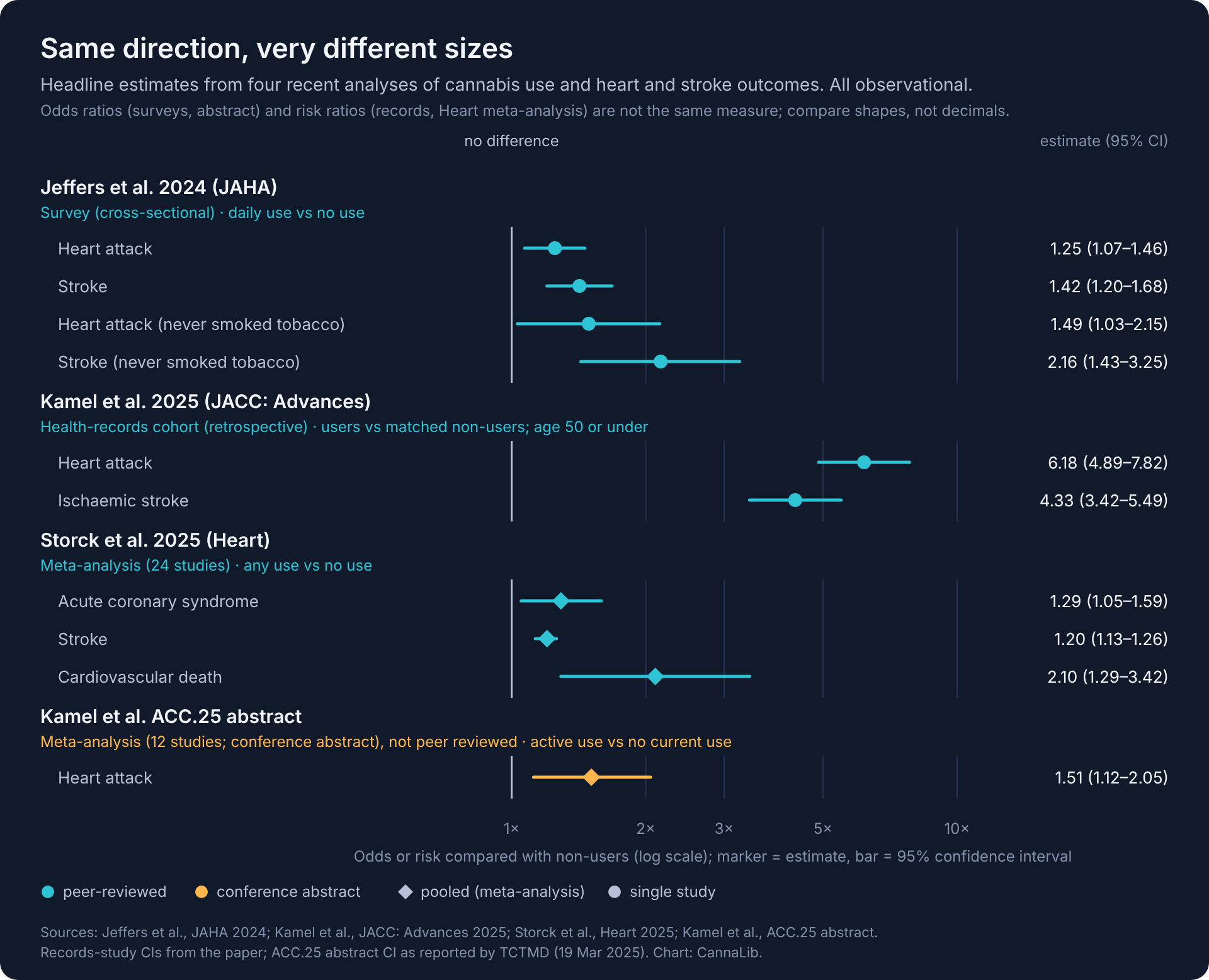
- a heart attack: odds ratio 1.25 (95% confidence interval 1.07 to 1.46)
- a stroke: 1.42 (1.20 to 1.68)
- heart disease, heart attack or stroke combined: 1.28 (1.13 to 1.44)
The link with coronary heart disease on its own (1.16, 0.98 to 1.38) was not statistically significant.
The most quoted result came from people who had never smoked tobacco, the obvious confounder. In that group the association held: odds ratio 1.49 (1.03 to 2.15) for heart attack and 2.16 (1.43 to 3.25) for stroke. The intervals are wider because the group is smaller, but the signal didn't vanish when cigarettes were taken out of the picture.
What it can't tell you. Cannabis use was asked about for the past 30 days; heart attacks and strokes were "have you ever been told". So the design can't show which came first. Everything is self-reported. And the "more use, higher odds" pattern is partly built in: the model scored use as days per month and assumed the odds rose steadily with each extra day, so the smooth climb is an assumption of the analysis rather than something found separately. The authors themselves say prospective studies are needed.
The records study: young, healthy, and a six-fold jump#
On 18 March 2025, JACC: Advances published a retrospective study led by Ibrahim Kamel, a clinical instructor at Boston University's medical school. It's a peer-reviewed paper, and the biggest number in this story.
The team used TriNetX, a network of electronic medical records, to find 4,636,628 adults aged 50 or under who looked cardiovascularly healthy at the start: no high blood pressure or cholesterol, no diabetes, no tobacco use, no known coronary disease. About 2% (93,267) had cannabis use recorded. Each user was matched on baseline characteristics to a non-user, giving 89,776 people per group, followed for about three to four years.
Compared with matched non-users, the cannabis group had a risk ratio of 6.18 for heart attack, 4.33 for ischaemic stroke, 2.02 for heart failure and 3.24 for a combined outcome of cardiovascular death, heart attack or stroke.
Two things belong next to that six. First, the absolute numbers: heart attacks were recorded in 0.56% of the cannabis group and 0.09% of the non-users. That's about 5.6 versus 0.9 per 1,000 people over the follow-up period. A six-fold ratio on a very small baseline. Second, the groups were very different before matching: in the raw data, 30.6% of cannabis users had a recorded depressive episode against 1.9% of non-users, and 18.7% had a BMI over 30 against 3.3%. Matching tries to even that out, but it can only balance what's in the records, and records are poor at capturing how much cannabis someone uses, how they use it, and what else they take.
Kamel was candid about this: "We should have some caution in interpreting the findings," he said in the American College of Cardiology's press release, pointing out that cannabis use often goes with other drugs, such as cocaine, which the study didn't account for. When a records study finds an effect this much larger than everything around it, that's a reason to wait for replication, not to lead with it.
The abstract: 12 studies, 1.5 times#
Kamel also presented a second, separate piece of work: a meta-analysis of 12 earlier studies covering more than 75 million people, at the American College of Cardiology's ACC.25 meeting on 29 March 2025. Active cannabis users had about 1.5 times the odds of a heart attack (odds ratio 1.51, 1.12 to 2.05). Seven of the 12 studies found a significant association, four found none and one leaned slightly the other way. One included study found heart attack risk peaked about an hour after use.
This is a conference abstract, not a peer-reviewed paper, and the press release notes it couldn't account for how long or how much people used, or for tobacco and other drugs. Its number does sit comfortably with the rest of the literature, which is more than can be said for the six.
The meta-analysis: "doubles the risk of death"#
In June 2025 the journal Heart published a systematic review and meta-analysis by Wilhelm Storck, Meyer Elbaz, Cécile Vindis, Amélia Déguilhem, Maryse Lapeyre-Mestre and Emilie Jouanjus, mostly from the University of Toulouse and Toulouse University Hospital. It pooled adjusted estimates from 24 studies published between 2016 and January 2023: 17 cross-sectional, six cohort, one case-control.
Compared with non-users, cannabis users had:
- acute coronary syndrome (which includes heart attack): risk ratio 1.29 (1.05 to 1.59)
- stroke: 1.20 (1.13 to 1.26)
- cardiovascular death: 2.10 (1.29 to 3.42)
That last line became "cannabis doubles your risk of dying". Look at the interval, though: anything from about 30% higher to more than three times higher is compatible with the data. It's the least precise estimate in the paper. Restricting the primary analysis to cohort studies, which can at least establish timing, gave a similar result: 1.32 (1.01 to 1.73).
The authors didn't oversell it. Their paper describes cross-sectional studies as "a design providing a poor level of evidence unable to establish the causal link", says cannabis exposure was too poorly reported across studies to analyse, and rated most included studies at high risk of bias. Jouanjus told TCTMD the goal was "just to make people be aware that there are risks." Robert Page II, a cardiovascular pharmacist not involved in the study, put it best: "I don't put a lot of faith in the magnitude, but I put a lot of faith in that there's an issue here."
The journal ran an editorial alongside it by Glantz (again) and Lynn Silver, titled "It is time to treat cannabis as an important risk factor for cardiovascular disease."
The critics#
In October 2025, the Society of Cannabis Clinicians, an international nonprofit of clinicians who work in medical cannabis, published a commentary from its media response committee. It is not peer-reviewed, and the society's members have an obvious stake in the subject. Its main points still deserve a fair hearing:
- 17 of the 24 studies were cross-sectional, so the review can't establish cause and effect.
- Most included studies were, by the authors' own rating, at high risk of bias; only four raised "some concern".
- Tobacco and alcohol co-use is common among cannabis users, and the methods weren't strong enough to rule it out.
- The pooled relative risks were modest, with several intervals sitting close to 1.
- Only studies from 2016 to 2023 were included, so null results may have been missed.
Most of that is also in the paper's own limitations section, which tells you something: the disagreement is mostly about tone, not facts. The critics read "modest associations from weak designs"; the editorial reads "a risk factor clinicians should be asking about". Both are looking at the same forest plot.
So what do they add up to?#
Every estimate points the same way: cannabis use is associated with more heart attacks, strokes and cardiovascular deaths. The association survives in people who never smoked tobacco, and in the cohort-only analysis. That's a consistent signal across very different designs.
The size is where it falls apart. Pooled estimates sit around 1.2 to 1.5; the health-records study says six. None of this is a randomised trial, and nobody is going to randomise people to daily cannabis for a decade to find out.
There are plausible mechanisms. The American Heart Association's 2020 scientific statement on cannabis, led by the same Robert Page, notes that THC can stimulate the sympathetic nervous system, raising heart rate, blood pressure and the heart's demand for oxygen, and that inhaling cannabis smoke, regardless of THC content, raises carbon monoxide in the blood.
What nobody has sorted out is how much comes from THC and how much from smoke. A small 2025 study in JAMA Cardiology (55 San Francisco adults, cross-sectional) found that both regular smokers and regular THC-edible users had poorer blood-vessel function than non-users. It's tiny, but it's a warning against assuming that taking smoke out of the equation takes the question away.
Where that leaves us#
We don't give health advice, and none of this is a verdict on any individual. What the research supports is narrower:
- "Cannabis is harmless for your heart" is getting hard to defend. Four analyses built four different ways all lean the same direction.
- "Cannabis doubles your risk of dying" overstates what's known. The size of any risk is genuinely uncertain, and the scariest numbers come from the weakest designs.
- The big unknowns are the ones that matter most: how much use, which products, which route, and for whom.
On one point the two camps meet. The study authors want clinicians asking about cannabis the way they ask about smoking; the critics' commentary argues about how to assess it, not whether. If you have questions about your own heart health, that conversation belongs with your doctor.
The heart question isn't settled. It has, however, moved from "probably nothing" to "probably something", and the honest size of that something is still being argued over in forest plots.
Fact-checked 13 October 2026. Editor verdict: Pass With Edits.
Sources#
- Jeffers, A. M., Glantz, S., Byers, A. L. and Keyhani, S. (2024), "Association of Cannabis Use With Cardiovascular Outcomes Among US Adults", Journal of the American Heart Association 13(5): e030178, published online 28 February 2024. Peer-reviewed. https://doi.org/10.1161/JAHA.123.030178 (full text: https://pmc.ncbi.nlm.nih.gov/articles/PMC10944074/)
- Kamel, I., Mahmoud, A. K., Twayana, A. R., Younes, A. M., Horn, B. and Dietzius, H. (2025), "Myocardial Infarction and Cardiovascular Risks Associated With Cannabis Use" (the PubMed/PMC record adds the subtitle "A Multicenter Retrospective Study"; Crossref does not), JACC: Advances 4(5): 101698, published online 18 March 2025. Open access (CC BY-NC-ND), PMID 40104933, PMC12235408. Peer-reviewed. https://doi.org/10.1016/j.jacadv.2025.101698 (full text checked 13 Oct 2026 via source 12)
- American College of Cardiology, "Cannabis Users Face Substantially Higher Risk of Heart Attack" (press release, 18 March 2025; covers source 2 and the ACC.25 abstract "Risk of Myocardial Infarction in Cannabis Users: A Systematic Review and Meta-Analysis", presented 29 March 2025, not peer-reviewed): https://www.acc.org/about-acc/press-releases/2025/03/17/15/35/cannabis-users-face-substantially-higher-risk
- American College of Cardiology, "Cannabis Use Substantially Increases Risk of Heart Attack" (journal scan of source 2, 24 March 2025; absolute event rates, matching and baseline characteristics): https://www.acc.org/latest-in-cardiology/journal-scans/2025/03/24/13/52/cannabis-use-substantially-increases-risk-of-heart-attack-acc-2025
- TCTMD, "Cannabis Use Again Tied to Increased CVD Risk in Young People" (19 March 2025; risk ratios with 95% CIs for source 2, pooled OR with CI for the ACC.25 abstract): https://www.tctmd.com/news/cannabis-use-again-tied-increased-cvd-risk-young-people
- Storck, W., Elbaz, M., Vindis, C., Déguilhem, A., Lapeyre-Mestre, M. and Jouanjus, E. (2025), "Cardiovascular risk associated with the use of cannabis and cannabinoids: a systematic review and meta-analysis", Heart 111(22): 1047–1056, published online June 2025. Peer-reviewed. https://doi.org/10.1136/heartjnl-2024-325429 (article page: https://heart.bmj.com/content/111/22/1047)
- Glantz, S. and Silver, L. (2025), "It is time to treat cannabis as an important risk factor for cardiovascular disease", editorial, Heart 111(22). https://heart.bmj.com/content/111/22/1043
- TCTMD, "Cannabis Use Doubles the Risk of CV Death: Meta-analysis" (23 June 2025; quotes from Emilie Jouanjus and Robert Page II): https://www.tctmd.com/news/cannabis-use-doubles-risk-cv-death-meta-analysis
- Society of Cannabis Clinicians, Media Response Committee, "Cannabis and the Heart: A Clinical Interpretation of the Evidence" (commentary, 23 October 2025; not peer-reviewed): https://www.cannabisclinicians.org/2025/10/23/cannabis-and-the-heart-a-clinical-interpretation-of-the-evidence/
- Page, R. L. II, Allen, L. A., Kloner, R. A. et al. (2020), "Medical Marijuana, Recreational Cannabis, and Cardiovascular Health: A Scientific Statement From the American Heart Association", Circulation, published online 5 August 2020. Summary used: ACC "Ten Points to Remember" (13 August 2020): https://www.acc.org/latest-in-cardiology/ten-points-to-remember/2020/08/13/13/55/medical-marijuana-recreational-cannabis
- Mohammadi, L., Navabzadeh, M., Jiménez-Téllez, N. et al. (2025), "Association of Endothelial Dysfunction With Chronic Marijuana Smoking and THC-Edible Use", JAMA Cardiology, published online 28 May 2025. Cross-sectional, 55 adults. https://doi.org/10.1001/jamacardio.2025.1399 (ACC journal scan: https://www.acc.org/Latest-in-Cardiology/Journal-Scans/2025/06/04/14/21/Chronic-Marijuana-Smoking)
- NCBI PMC Open Access subset, BioC API copy of source 2's full text (used 13 October 2026 to check the Kamel et al. risk ratios, confidence intervals, absolute rates and baseline figures; PMC's own article page is behind a browser check): https://www.ncbi.nlm.nih.gov/research/bionlp/RESTful/pmcoa.cgi/BioC_json/PMC12235408/unicode
Pull the thread
Look up a strain in CannaLib and see which of its numbers are lab-tested. Everything above is checkable in the same CannaLib tools we used.
This opens the real CannaLib page inside the story, so it only loads when you ask.
curl "https://api.cannalib.org/v1/corpus"
More Strain Stories
- Ep.04Lineage Under the Limelight
These aren't the strains you're looking for
Skywalker, Death Star, Jedi OG and Ewok: the Star Wars strains were renamed as a precaution in 2018. We checked the lab data, and a public DNA panel shows three samples sold as Skywalker are two plants, one of them OG Kush.
3 → 2samples sold as Skywalker, two plantsRead the story → - No.04Label vs Lab
"Award-winning"? We could confirm 43% of the claims we could check
We checked 7,627 cannabis award claims against 21,141 published cup results. 54% are too vague to check; of the 797 cleanest claims, 43% matched.
43%of checkable award claims matchRead the story → - Data03Data and culture
Does winning a cannabis cup mean anything?
How cannabis cups judge: paid public kits versus blind, lab-tested panels, what a win can and can't tell you, and the early winners behind today's gene pool.
21,141competition results across 264 competitionsRead the story →