
CHSCDCICD-10-CM
Cannabis hyperemesis got its own code. The count nearly quadrupled
A vomiting illness first described in the Adelaide Hills got a US diagnosis code in October 2025. Recorded cases jumped 3.7-fold. Mostly, the counting changed.
In this story
In 2001, doctors in the Adelaide Hills in South Australia identified a group of patients admitted for profuse, repeated vomiting. All were long-term, heavy cannabis users. Nine of the ten cases in their eventual paper had something else in common: during an attack they took hot showers or baths, again and again, sometimes waking at night to do it, because the heat eased their symptoms within minutes. Two had scalded themselves turning the water hotter.
The team, with J. H. Allen as first author, published the series in the journal Gut in November 2004 and gave the illness a name: cannabinoid hyperemesis. Seven of their patients stopped using cannabis and the vomiting stopped. The ones who kept using kept getting sick.
Twenty-one years later, on 1 October 2025, the condition got something it had never had: its own diagnosis code in the United States. In August 2026 the US Centers for Disease Control and Prevention (CDC) published the first national look at what that code recorded. The rate of emergency visits involving the syndrome jumped more than threefold in a single month. Very little of that jump is new illness. Almost all of it is people finally being counted.
What the syndrome is#
Cannabis hyperemesis syndrome, or CHS (the CDC uses "cannabis", many clinicians "cannabinoid"), is a pattern of recurring bouts of nausea, vomiting and abdominal pain in people who use cannabis frequently over a long period. Between bouts people can feel close to normal. In the original Adelaide series, cannabis use came before the vomiting illness in every case, and stopping cannabis ended it.
The bathing behaviour is so typical that a US National Library of Medicine clinical review (StatPearls, last updated July 2023) calls relief from hot baths or showers "almost pathognomonic": close to a giveaway, though not quite one. The same review notes that standard anti-nausea drugs such as ondansetron often work poorly in CHS, and that opioids, often given for the abdominal pain, are not appropriate because they can worsen nausea and vomiting.
Nobody has pinned down the mechanism. The leading idea is that heavy, long-term stimulation of the body's cannabinoid receptors disrupts the systems that normally regulate nausea. The hot-water clue points at a receptor called TRPV1, which cannabinoids influence and which also responds to heat and to capsaicin, the compound that makes chillies hot. The same review notes that cannabis has shifted since the 1990s towards more THC and less CBD. That is context, not a proven cause.
Neither is the nickname. "Scromiting", from screaming and vomiting, has circulated online for years. A neuroscientist quoted by Axios in December 2025 called it "not a technical term, just a catchy one". It is not a diagnosis.
No code, no count#
Medical records in the US run on ICD-10-CM, the American edition of the World Health Organization's disease classification. Until 30 September 2025 it had no entry for CHS. A doctor who recognised it had to record two things that, together, approximate it: a vomiting code (cyclical vomiting, R11.15, or the general vomiting code R11) plus a code for cannabis use or poisoning. That is how researchers had to find cases: by searching for the combination and hoping doctors had typed in both halves.
On 1 October 2025 the fiscal 2026 code set took effect with R11.16, "Cannabis hyperemesis syndrome": one code, one condition.
The jump#
The CDC report, by Vivolo-Kantor and colleagues in Morbidity and Mortality Weekly Report (MMWR, 6 August 2026), used the National Syndromic Surveillance Program, which draws on about 83% of US emergency departments. To keep the comparison fair, the authors used only the 3,636 departments that reported consistently from January 2023 to May 2026. Across 407.3 million visits, they found 199,565 involving CHS.
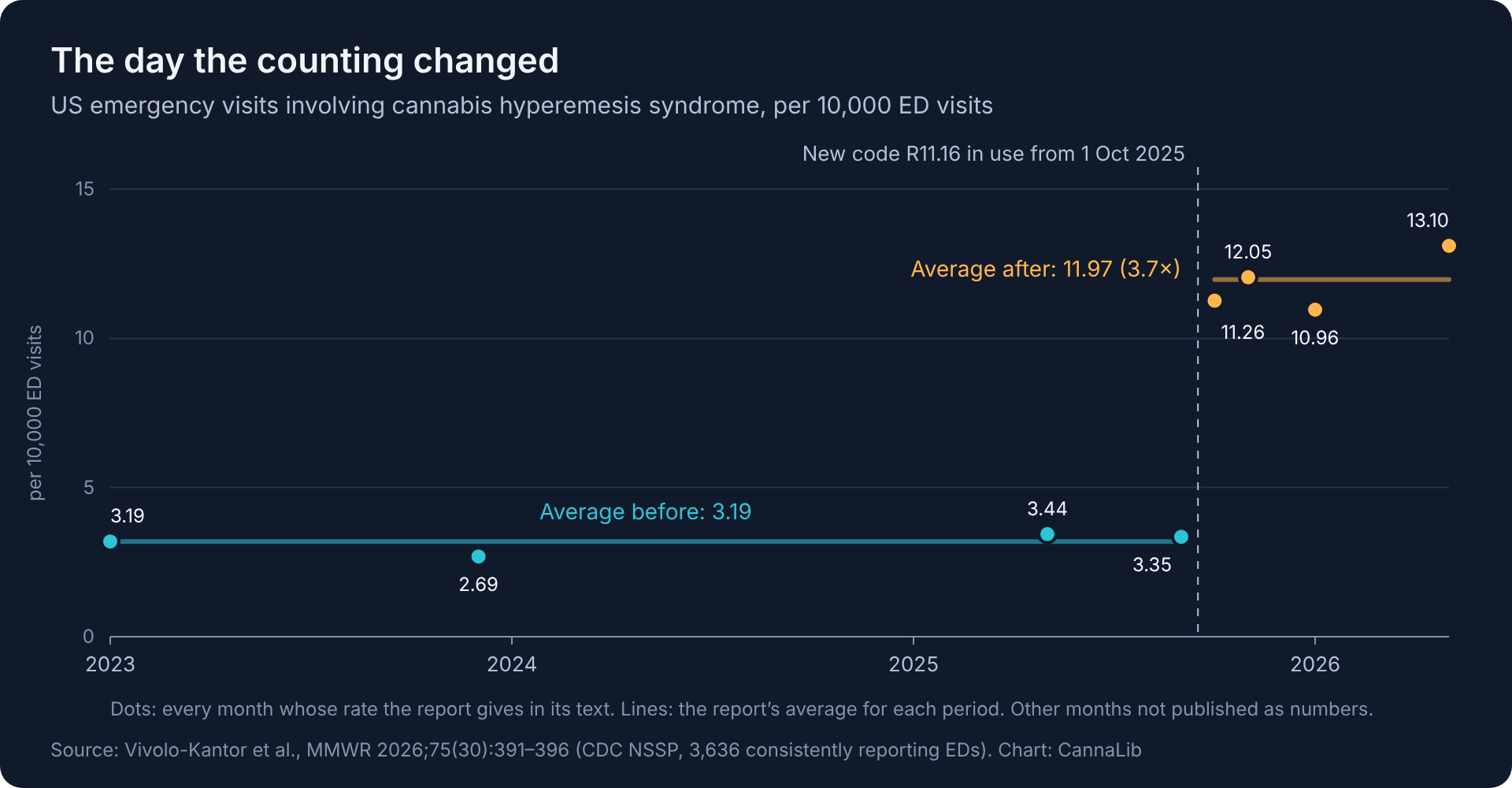
- From January 2023 to September 2025, CHS was recorded in an average of 3.19 per 10,000 emergency visits, and the line barely moved: monthly values stayed between 2.69 and 3.44. September 2025 came in at 3.35.
- In October 2025, the first month of the new code, it was 11.26.
- From October 2025 to May 2026 it averaged 11.97, which the authors put at 3.7 times the earlier average. May 2026 was the highest month reported, at 13.10.
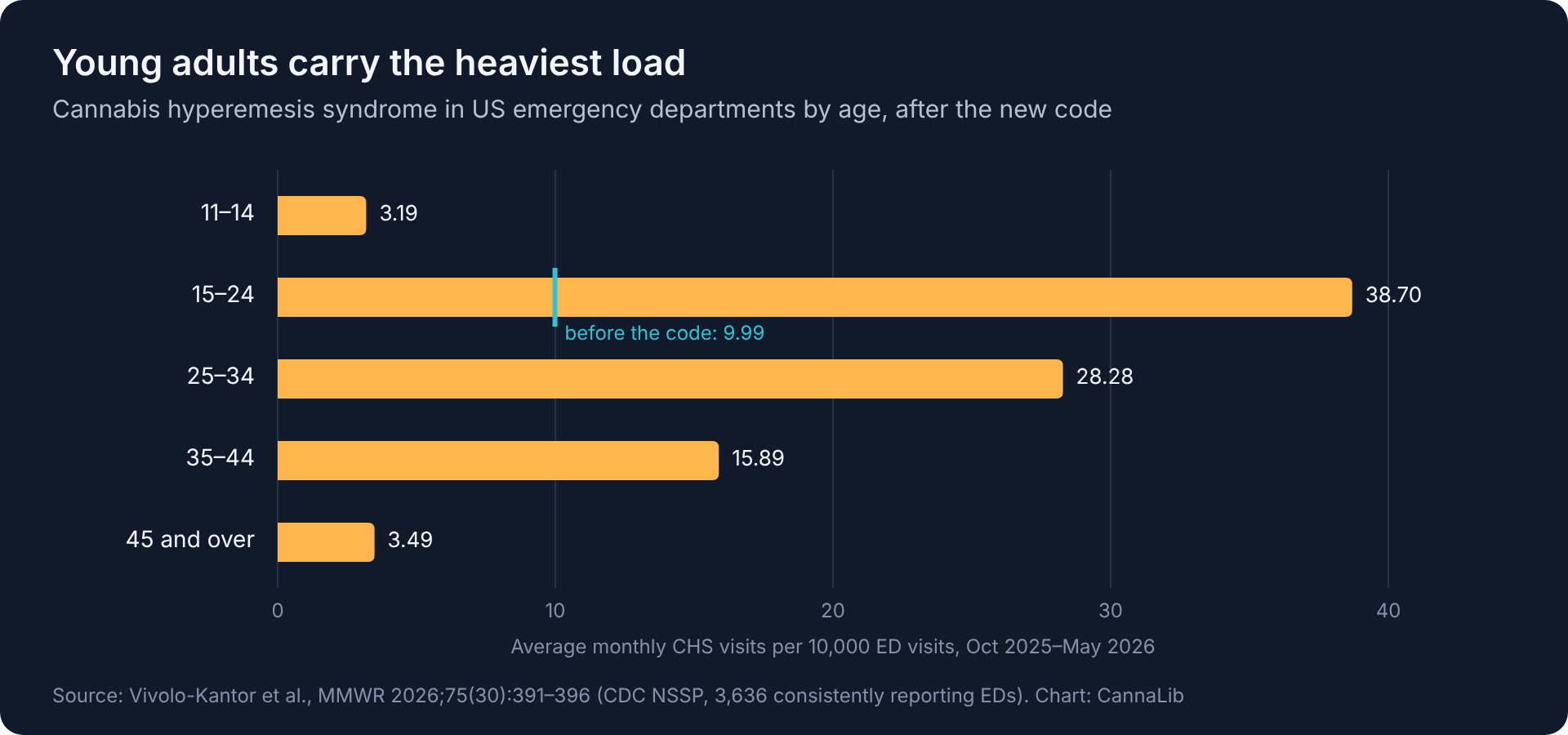
Young adults dominate. People aged 15 to 24 averaged 38.70 per 10,000 visits after the code, up from 9.99 before it, and 25- to 34-year-olds came next at 28.28. After the code, the rate among women (12.65) was a little higher than among men (11.13).
What the jump does and doesn't mean#
It is tempting to write "CHS nearly quadrupled overnight". It didn't. Illnesses do not triple between 30 September and 1 October because a code book was updated.
The authors are careful about this. They say the post-code increase may reflect adoption of the new code rather than a true change in how often CHS occurs, and that the trends "should be interpreted with caution". Their reading is that many earlier cases were never identified, often because they were filed as cyclical vomiting syndrome, and that the higher post-code figures "potentially more accurately" reflect the true burden. In other words, the old number was the floor and the new number is closer to the room.
Even the new number undercounts. It only sees people sick enough to go to an emergency department, depends on doctors recognising CHS and writing it down, relies on patients' own accounts of their cannabis use, and comes from hospitals that may not be typical. The code also caught on fast but not completely: of the 94,950 post-code visits, 14,988 were found only through the old two-code combination.
What the code cannot do is tell you whether CHS is rising now. The report says suspected CHS had already climbed sharply in the US between 2016 and 2022, with the biggest increase during the COVID-19 pandemic, and the authors add that CHS might develop after shorter periods of cannabis use than was previously recognised.
A rise that was visible before the code#
Canada showed that rise in detail. A study in JAMA Network Open (September 2022) by Daniel Myran and colleagues used Ontario's linked health records for everyone aged 15 to 105 with provincial health insurance, about 14.4 million people. Between January 2014 and June 2021 it found 12,866 emergency visits for CHS by 8,140 people. The monthly rate rose 13-fold, from 0.26 to 3.43 visits per 100,000 population. (That is a population rate, not a share of emergency visits, so it can't be laid directly against the CDC numbers.)
The timing is the interesting part. Legalisation in October 2018, when stores and products were tightly restricted, was not associated with any change. The jump came with what the authors call commercialisation, from March 2020, as retail stores multiplied: an immediate 49% increase. The authors suggest access to stores and higher-potency products may be part of the reason. That period also overlapped with the pandemic, and the authors say they couldn't fully separate the two. They also flag a problem the CDC has since put a number on: Canada had no diagnostic code for CHS, so their case-finding "may underestimate the burden".
The trials so far#
There is no established treatment beyond the one the Adelaide team observed: symptoms resolve when cannabis use stops. For acute episodes in the emergency department, the trial evidence is thin. Two small randomised trials stand out, and both are reported here as research, not recommendations.
Haloperidol (HaVOC). A. J. Ruberto and colleagues at Queen's University in Kingston, Ontario, randomised cannabis users with active vomiting to intravenous haloperidol, an antipsychotic, at one of two doses, or to ondansetron. Thirty received treatment (13 haloperidol, 17 ondansetron). Two hours later, haloperidol patients' combined pain and nausea scores had improved more (by 2.3 cm on a 10 cm scale) and they left the department sooner (3.1 hours against 5.6). Two patients came back with acute dystonia, a drug-induced muscle reaction, both from the higher-dose group. The trial was halted after an unplanned interim analysis, short of its enrolment target. It was published in Annals of Emergency Medicine (2021).
Topical capsaicin. D. J. Dean and colleagues at Henry Ford Health in Detroit ran a double-blind pilot in 30 adults with suspected CHS (17 capsaicin, 13 placebo), applying 0.1% capsaicin cream or a placebo cream to the abdomen. The difference in nausea at 30 minutes, the trial's primary measure, was not significant. At 60 minutes, nausea scores were lower with capsaicin, and 29.4% of the capsaicin group reported complete relief against none on placebo. One patient couldn't tolerate the skin irritation. The authors call the results preliminary (Academic Emergency Medicine, 2020).
Sixty patients across two trials is where the acute-treatment evidence stands. Complications of prolonged vomiting, listed in the StatPearls review, include dehydration, electrolyte imbalance, injury to the oesophagus and aspiration.
Counted, finally#
The CDC's recommendations are aimed at clinicians and health agencies: consider CHS in anyone with nausea, vomiting and abdominal pain; ask about cannabis use, including product type and route of use; consider screening for substance use disorders and co-occurring psychiatric conditions; keep watching the role of high-potency THC and hemp-derived products; and do more to explain the risks of frequent use, especially to younger people.
Anyone worried about symptoms like these should talk to a doctor.
The syndrome was named from a handful of patients in the Adelaide Hills. It took two decades and one new line in a code book for the rest of the count to begin.
Fact-checked 12 October 2026. Editor verdict: Pass With Edits.
Sources#
- Vivolo-Kantor AM, Liu S, Tanz LJ, Mattson CL, Schier J. "Trends in Emergency Department Visits Involving Cannabis Hyperemesis Syndrome Identified Using a New Diagnosis Code — United States, January 2023–May 2026". MMWR Morbidity and Mortality Weekly Report 2026;75(30):391–396, published 6 August 2026. doi:10.15585/mmwr.mm7530a2. https://www.cdc.gov/mmwr/volumes/75/wr/mm7530a2.htm
- Allen JH, de Moore GM, Heddle R, Twartz JC. "Cannabinoid hyperemesis: cyclical hyperemesis in association with chronic cannabis abuse". Gut 2004;53(11):1566–1570 (November 2004). https://gut.bmj.com/content/53/11/1566
- National Center for Health Statistics (CDC), ICD-10-CM files: FY2026 release effective 1 October 2025. https://www.cdc.gov/nchs/icd/icd-10-cm/files.html (code R11.16 "Cannabis hyperemesis syndrome"; descriptor cross-checked at https://www.icd10data.com/ICD10CM/Codes/R00-R99/R10-R19/R11-/R11.16)
- Myran DT, Roberts R, Pugliese M, Taljaard M, Tanuseputro P, Pacula RL. "Changes in Emergency Department Visits for Cannabis Hyperemesis Syndrome Following Recreational Cannabis Legalization and Subsequent Commercialization in Ontario, Canada". JAMA Network Open 2022;5(9):e2231937, published 16 September 2022. doi:10.1001/jamanetworkopen.2022.31937
- Ruberto AJ, Sivilotti MLA, Forrester S, Hall AK, Crawford FM, Day AG. "Intravenous Haloperidol Versus Ondansetron for Cannabis Hyperemesis Syndrome (HaVOC): A Randomized, Controlled Trial". Annals of Emergency Medicine 2021;77(6):613–619. doi:10.1016/j.annemergmed.2020.08.021. Trial registration NCT03056482.
- Dean DJ, Sabagha N, Rose K, et al. "A Pilot Trial of Topical Capsaicin Cream for Treatment of Cannabinoid Hyperemesis Syndrome". Academic Emergency Medicine 2020;27(11):1166–1172. doi:10.1111/acem.14062. PMID 32569429. https://pubmed.ncbi.nlm.nih.gov/32569429/
- Cue L, Chu F, Cascella M. "Cannabinoid Hyperemesis Syndrome". StatPearls, NCBI Bookshelf NBK549915, last updated 3 July 2023. https://www.ncbi.nlm.nih.gov/books/NBK549915/
- Scribner H. "This unusual symptom could signal a potentially deadly cannabis condition". Axios, 5 December 2025. https://www.axios.com/2025/12/05/scromiting-symptom-cannabis-hyperemesis-syndrome
Pull the thread
Check a strain's recorded THC range in CannaLib to see how strong it tests. Everything above is checkable in the same CannaLib tools we used.
This opens the real CannaLib page inside the story, so it only loads when you ask.
curl "https://api.cannalib.org/v1/corpus"
More Strain Stories
- Ep.06Lineage Under the Limelight
Girl Scout Cookies: Thin Mints and cease-and-desist letters
In January 2017 the Girl Scouts of the USA sent cease-and-desist letters over the strain name Girl Scout Cookies. We report what the letters said, where sources disagree on the strain's origin, and what our upcoming DNA and lab release will test.
1936year GSUSA's statement says its trademark dates back toRead the story → - Note01Field notes
Don't breed blind: check the family tree before you cross
Before you cross two cultivars, check whether they share a grandparent. CannaLib lays out 143,611 named strains, 118,039 parent links and every competing breeder claim with its source.
118,039parent-to-child links to check before you crossRead the story → - Data02Data and culture
The cannabis family tree has loops in it
CannaLib mapped 118,186 parent links between 57,015 cannabis strains. Most pedigrees stop two generations out, and 578 strains are on paper their own ancestors.
563strains caught in the biggest lineage loopRead the story →