
hempdelta-8THCA
Last orders: America's petrol-station THC has until 11 December
A rewrite of one definition will turn most US hemp THC gummies, flower and seltzers into marijuana. Congress bought them 29 days. Here's what changes.
In this story
Since 2018, a lot of American petrol stations have sold something that gets you high. Not cannabis, legally speaking: hemp. Delta-8 gummies by the register, THC seltzers in the bottle-shop fridge, "hemp flower" that looks, smells and smokes like the stuff that is still federally illegal.
That window is about to shut. As of 13 October 2026, most of the new US federal limits on intoxicating hemp take effect on 11 December 2026. One slice of the market, cannabinoids the plant can't make on its own, goes a month earlier, on 12 November. A product line worth billions is being reclassified not by a ban on any product, but by a rewrite of a single definition.
How a farm law built a THC market#
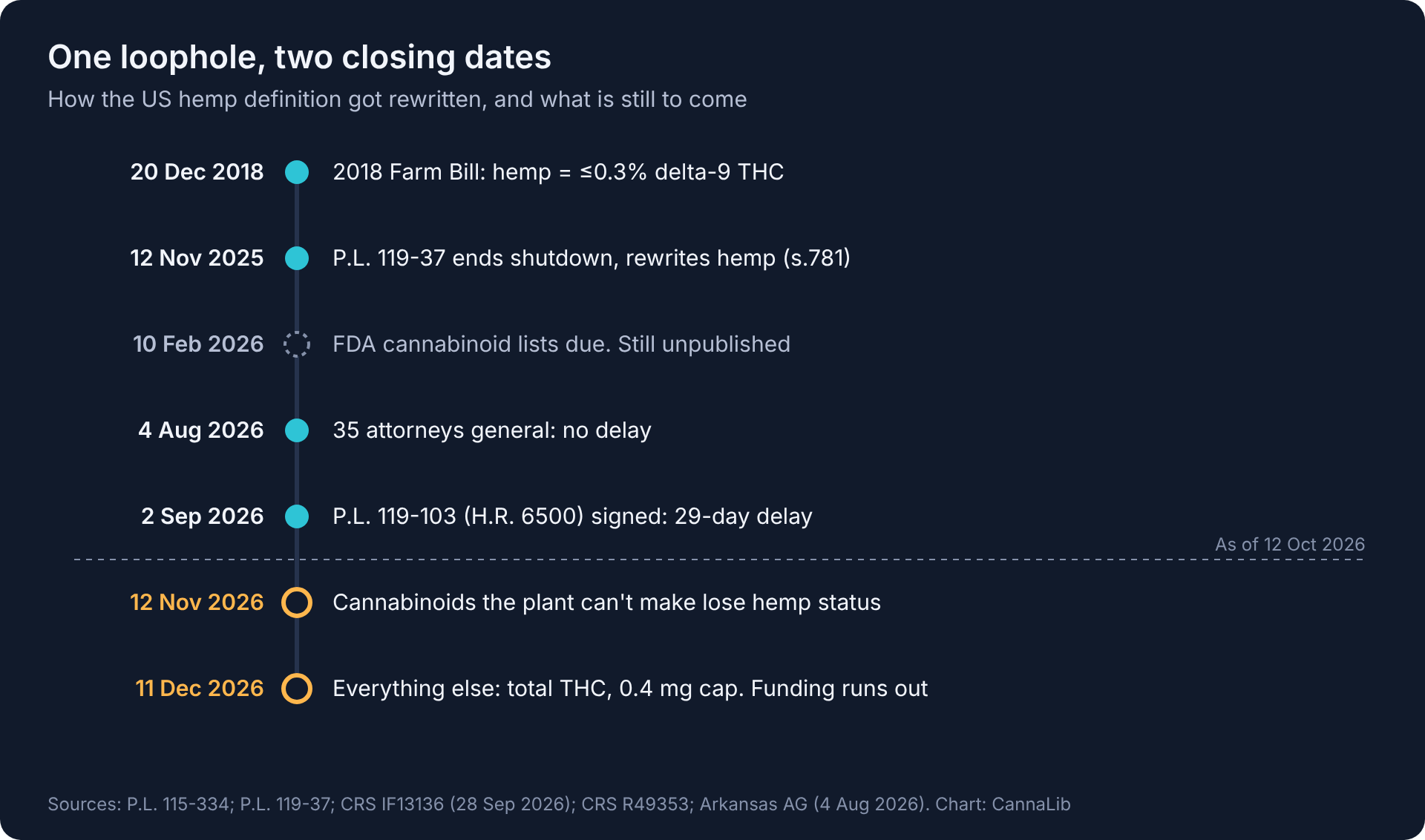
The 2018 Farm Bill, signed on 20 December 2018, legalised hemp: cannabis with no more than 0.3% delta-9 THC by dry weight. The point was fibre, seed and CBD. The law measured one molecule, delta-9 THC, in the plant.
Industry found three ways through that wording.
Chemistry. CBD from legal hemp can be converted in a lab into other intoxicating cannabinoids, delta-8 THC being the famous one. They weren't delta-9, so the test didn't see them.
THCA. Raw cannabis holds most of its THC as THCA, which becomes THC when heated. A test that counts only delta-9 let sellers ship high-THCA flower as "hemp", knowing it turns into ordinary THC the moment it's lit.
Plain delta-9 in heavy products. 0.3% by dry weight sounds tiny until the product is heavy. On our arithmetic, a 4 g gummy at 0.3% can carry 12 mg of delta-9 and still be "hemp".
The result was an intoxicating market that was federally legal, lightly regulated and on sale in places that could never sell cannabis. How big is it now? An estimate from Whitney Economics, a cannabis-industry consultancy, reported by the Associated Press on 5 October 2026, says the ban would wipe US$28.3 billion from retail revenue and 225,000 jobs. That is an industry-side forecast, so read it as the top of the range; nobody disputes that the market is large.
What the new law says#
The rewrite rode on the bill that ended the longest government shutdown in US history, in late 2025. H.R. 5371 became Public Law 119-37 on 12 November 2025, and its section 781 gave the industry a one-year runway. According to the Congressional Research Service (CRS), the new definition does three big things:
- Counts total THC, including THCA. Hemp must be no more than 0.3% total THC on a dry-weight basis. High-THCA "hemp flower" no longer qualifies.
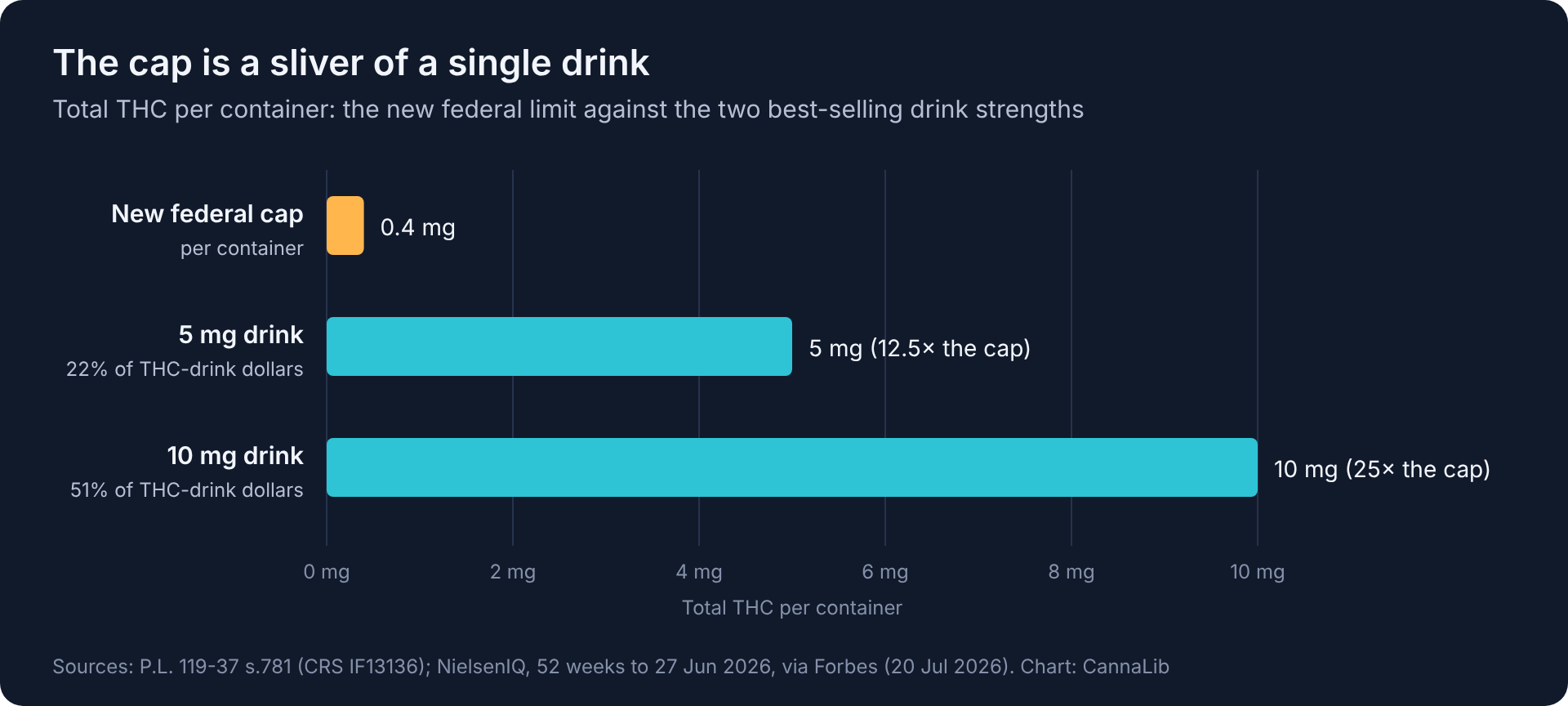
- Caps finished products at 0.4 mg of total THC per container. Not per serving. Per container.
- Excludes cannabinoids the plant can't naturally make, and naturally occurring ones "synthesized or manufactured outside the plant". That is aimed at conversions such as delta-8 from CBD.
Anything that falls outside the definition isn't hemp any more, and CRS says it becomes subject to the Controlled Substances Act as marijuana.
The 0.4 mg cap is the bit that does the damage. NielsenIQ data reported by Forbes in July 2026 show that 10 mg drinks earn 51% of THC-drink dollars and 5 mg drinks another 22%. A 5 mg can is 12.5 times the new limit. A 10 mg can is 25 times. There's no reformulating your way back under 0.4 mg and still selling a drink people buy for its effect.
The 29-day reprieve, on an African trade bill#
The original start date was 12 November 2026. The reprieve arrived in H.R. 6500, which began life as an extension of the African Growth and Opportunity Act and left Congress as the Continuing Appropriations and Extensions Act, 2027: the stopgap that funds the US government to 11 December. The Senate passed it 90 to 6 on 8 August, after tabling an amendment from Senator Ted Budd to strip the hemp delay, 61 to 32. The House agreed 370 to 48 on 1 September, and President Trump signed it on 2 September. It is now Public Law 119-103.
The delay is narrower than the headlines suggested. Until 11 December, section 781 applies only to products containing cannabinoids "not capable of being naturally produced" by the cannabis plant. So:
- 12 November 2026: cannabinoids the plant can't make at all lose hemp status.
- 11 December 2026: everything else, including the total-THC test, the 0.4 mg cap and the rule on natural cannabinoids made outside the plant.
The White House has not been consistent. In April, President Trump called on Congress to "update the Law" so Americans could keep buying full-spectrum CBD products, and in June the Office of Management and Budget asked Congress for either a revised hemp framework or an extension of section 781. By August, the White House's director of legislative affairs, James Braid, reportedly told senators there would be no further extension past 11 December. That's a report, not a statute, and Congress has moved this date once already.
The delta-8 question nobody can answer yet#
Here is the part most explainers skip. Which date applies to delta-8 depends on a list that doesn't exist.
Cannabis makes delta-8 THC naturally, but only in trace amounts, so commercial delta-8 is made by converting CBD. Is it a cannabinoid the plant "can't naturally produce" (12 November) or a natural one "manufactured outside the plant" (11 December)? Lawyers disagree. Attorney Rod Kight reads it as the December bucket; MJBizDaily reported on 5 October that other analyses put lab-made delta-8 in November. The 35 attorneys general who wrote to Congress in August called delta-8 a "synthesized" cannabinoid and HHC an "unnatural" one.
Congress anticipated exactly this. Section 781 told the FDA to publish, within 90 days, lists of the cannabinoids the plant can naturally produce, the THC-class cannabinoids, and others with similar effects, plus guidance on what counts as a "container". That deadline was 10 February 2026. CRS said on 28 September that nothing had been published, and we found nothing newer as of 13 October. The US Hemp Roundtable's general counsel, Jonathan Miller, told MJBizDaily: "We are very frustrated with the FDA's failure to meet this statutory deadline."
Who wants what#
State attorneys general want it to bite. On 4 August, 34 state attorneys general and the US Virgin Islands' attorney general asked congressional leaders not to delay, repeal or weaken the change. Indiana's Todd Rokita told Congress to stand with parents, police and "legitimate hemp farmers", "not the special interests profiting from selling marijuana-like products in gas stations and convenience stores". Arkansas's Tim Griffin said both parties agree "intoxicating hemp products shouldn't be accessible to our kids".
Much of the hemp industry wants regulation instead. None of these bills had passed as of 13 October:
- The Lawful Hemp Protection Act (H.R. 9830), introduced on 22 July by Representatives Andy Barr (R-Kentucky) and Angie Craig (D-Minnesota), would replace the ban with a federal framework: US-only supply, a 21+ purchase age, a ban on synthetic cannabinoids and a per-milligram tax on THC drinks.
- The Beverage Regulatory Parity Act, introduced on 10 August by Representatives Beth Van Duyne (R-Texas) and Greg Landsman (D-Ohio), would regulate hemp THC drinks like alcohol, with federal permits, a 21+ age, a cap of 5 mg per serving and an excise tax per milligram.
- Representative James Comer (R-Kentucky) circulated a draft in July that would delay the ban until a year after the FDA publishes its lists, with age, packaging and testing rules.
CRS also lists bills for a straight two-year delay (H.R. 7010, H.R. 7024, S. 3686) and an outright repeal (H.R. 6209); none has moved beyond committee, and the House's FY2027 agriculture appropriations bill contains no delay. The Roundtable's Miller has said "the important work comes: passing in December robust regulation that cracks down on illicit sales to minors". December is when Congress needs another funding bill, which makes it the obvious vehicle.
Licensed cannabis operators, broadly, don't want a rescue. They pay for licences, testing and heavy state taxes, and hemp has been undercutting them from a much lighter base. Cory Harris, a lobbyist for state-legal operators, told the AP: "If you establish your whole business within a legally questionable loophole, that's just sort of the risk you take."
The drinks problem#
The category with the most to lose, and the most mainstream friends, is THC drinks.
NielsenIQ counted US$239 million in mainstream US retail sales in the 52 weeks to 27 June 2026, up 135% on the year before. Liquor stores sold the most, US$132 million, with convenience stores growing fastest. NIQ found 28% of US adults had tried a cannabis-infused drink. "Nothing in beer, wine or spirits is putting up numbers like that right now," NIQ's Kaleigh Theriault told Forbes. Total alcohol dollars fell 3.3% over the same period.
So you have a fast-growing product, sold largely by alcohol retailers (the AP notes that Total Wine & More has defended it), that federal law is about to reclassify as a controlled substance. That is why the drinks bill exists, and why it is the industry ask with the broadest coalition behind it.
What doesn't change, and what's still argued#
- Industrial hemp survives. Fibre, seed and grain are untouched. The Senate Appropriations Committee said the change preserves "non-intoxicating CBD and industrial hemp products". The Roundtable disputes the CBD half: Miller told the AP that a 0.4 mg cap would also catch non-impairing CBD products such as topical lotions.
- State-legal cannabis is unaffected. A 10 mg drink sold in a licensed dispensary in a legal state was always marijuana federally; this law changes the hemp side of the line.
- States can still go further, and many have. Ohio's SB 56 confined intoxicating hemp sales to licensed dispensaries from 20 March 2026. Retailers have challenged it in court, and a federal judge's injunction of 13 July lets ten drinks companies keep selling while the case runs; the law still applies to everyone else.
So what happens on 11 December#
Unless Congress acts again, products over the line will only be legal where state cannabis law allows them, through licensed cannabis channels. Petrol stations, corner shops and online sellers that relied on the hemp definition can sell what fits under 0.4 mg per container, or stop. What lands on 12 November rather than 11 December depends on a list the FDA was due to publish eight months ago.
There's a fair argument on each side. Supporters of the change point to kids, unlabelled potency and products sold with no age check next to the lollies. Critics point to a working market being pushed back into an unregulated one, and to adults who'd rather have a 5 mg seltzer than a beer.
Either way, the loophole began with a farm law that measured the wrong molecule. Closing it has taken eight years, two spending bills, one shutdown and an African trade bill, and the definition still depends on a list nobody has published.
State of play as of 13 October 2026. This article reports US federal law for general information; it is not legal advice. Laws in Australia and other countries are different.
Fact-checked 13 October 2026. Editor verdict: Pass With Edits.
Sources#
- Public Law 119-37 (H.R. 5371), Continuing Appropriations, Agriculture, Legislative Branch, Military Construction and Veterans Affairs, and Extensions Act, 2026, approved 12 November 2025, Division B section 781 (hemp definition). GovInfo: https://www.govinfo.gov/app/details/PLAW-119publ37
- Congressional Research Service, "Changes to the Statutory Definition of Hemp and Implications for Agricultural Policy", IF13136, first posted 18 December 2025, updated 28 September 2026: https://www.congress.gov/crs-product/IF13136 (mirror read: https://www.everycrsreport.com/reports/IF13136.html)
- Congressional Research Service, "Overview of Continuing Appropriations for FY2027 (Division A of P.L. 119-103)", R49353, 17 September 2026: https://www.everycrsreport.com/reports/R49353.html (H.R. 6500 title and origin as AGOA Extension Act; signed 2 September 2026; House 370-48 on 1 September; CR to 11 December 2026; S.Amdt. 6747 tabled 61-32)
- Public Law 115-334, Agriculture Improvement Act of 2018 (the 2018 Farm Bill), approved 20 December 2018: https://www.govinfo.gov/app/details/PLAW-115publ334
- Lawful Hemp Protection Act, H.R. 9830, introduced 22 July 2026 (Barr; Craig cosponsor). GovInfo: https://www.govinfo.gov/app/details/BILLS-119hr9830ih
- Office of Rep. Greg Landsman, "Landsman Leads Bipartisan Effort to Keep Hemp Beverages Safe and on Shelves" (August 2026): https://landsman.house.gov/posts/landsman-leads-bipartisan-effort-to-keep-hemp-beverages-safe-and-on-shelves
- Arkansas Attorney General, "Attorney General Griffin leads letter with 34 AGs urging Congress to preserve federal hemp reforms…" (4 August 2026): https://arkansasag.gov/news-release/attorney-general-griffin-leads-letter-with-34-ags-urging-congress-to-preserve-federal-hemp-reforms-and-prevent-the-return-of-intoxicating-hemp-products/ ; letter PDF: https://media.ark.org/ag/2026-08-04-Hemp-letter_FINAL.pdf
- Associated Press, "A $28B hemp THC industry is fighting to save itself from a looming federal ban" (5 October 2026), via WCAX: https://www.wcax.com/2026/10/05/28b-hemp-thc-industry-is-fighting-save-itself-looming-federal-ban/ (Whitney Economics estimate; Miller, Harris quotes; Total Wine)
- MJBizDaily, "How the federal hemp ban treats delta-8 THC differently…" (5 October 2026): https://mjbizdaily.com/news/how-the-federal-hemp-ban-treats-delta-8-thc-differently-and-what-operators-are-doing/618459/
- Rod Kight, "News flash: Congress delays federal hemp ban" (1 September 2026): https://cannabusiness.law/news-flash-congress-delays-federal-hemp-ban/
- mg Magazine, Sue Dehnam, "Congress found 61 votes to delay the hemp ban. Why not fix the law?" (3 September 2026): https://mgmagazine.com/policy-regulation/congress-hemp-ban-delay-policy/ (Senate 90-6 on 8 August; Section 2019; H.R. 9830)
- Foley Hoag (M. McQueeny, S. L. Bartlett), "A temporary reprieve for hemp-THC products… but what now?" (15 September 2026): https://foleyhoag.com/news-and-insights/blogs/cannabis-and-the-law/2026/september/a-temporary-reprieve-for-hemp-thc-products%E2%80%A6-but-what-now/ (Braid commitment; Miller "December" quote)
- Akerman (Jonathan S. Robbins), "Congress approves one-month delay of federal hemp THC restrictions" (2 September 2026): https://www.akerman.com/en/perspectives/congress-approves-one-month-delay-of-federal-hemp-thc-restrictions.html
- Forbes (Noel Burgess), "THC drinks face a federal deadline that could upend the market" (20 July 2026): https://www.forbes.com/sites/noelburgess/2026/07/20/thc-drinks-federal-hemp-deadline-2026/ (NielsenIQ data; Theriault quote)
- Axios, "THC hemp products ban in shutdown bill" (15 November 2025): https://www.axios.com/2025/11/15/thc-hemp-products-ban-shutdown-bill (Senate Appropriations Committee summary wording)
- Cannabis Business Times (Tony Lange), "US House lawmakers introduce bill to keep hemp beverages legal" (10 August 2026): https://www.cannabisbusinesstimes.com/hemp/news/15832069/us-house-lawmakers-introduce-bill-to-keep-hemp-beverages-legal
- Cannabis Business Times, "35 attorneys general tell Congress to keep hemp THC ban in place" (4 August 2026): https://www.cannabisbusinesstimes.com/hemp/news/15831608/35-attorneys-general-tell-congress-to-keep-hemp-thc-ban-put
- The Reporter (Indiana), "AG Rokita leads bipartisan attorneys general letter…" (August 2026), carrying the Indiana AG's statement: https://readthereporter.com/?p=198685
- Marijuana Moment, "GOP lawmaker circulates another new bill to keep hemp THC products federally legal" (29 July 2026): https://www.marijuanamoment.net/gop-lawmaker-circulates-another-new-bill-to-keep-hemp-thc-products-federally-legal/
- Ripon Advance, "Bipartisan bill sponsored by Barr would set federal hemp regulatory framework" (July 2026): https://riponadvance.com/stories/bipartisan-bill-sponsored-by-barr-would-set-federal-hemp-regulatory-framework/
- Spectrum News 1, "Marijuana and hemp rules take effect" (20 March 2026): https://spectrumnews1.com/oh/columbus/news/2026/03/20/marijuana-and-hemp-rules-take-effect ; Ohio Capital Journal, "Franklin County judge temporarily blocks Ohio's intoxicating hemp ban for two businesses" (16 April 2026): https://ohiocapitaljournal.com/2026/04/16/franklin-county-judge-temporarily-blocks-ohios-intoxicating-hemp-ban-for-two-businesses/
- 7 U.S.C. § 1639o (definitions, as amended by P.L. 119-37 s.781, with effective-date note), Legal Information Institute, Cornell: https://www.law.cornell.edu/uscode/text/7/1639o
- QuiverQuant bill tracker, H.R. 9830 (introduced 22 July 2026; referred to committee; 7 cosponsors): https://www.quiverquant.com/bills/119/hr-9830
- Marijuana Moment (Tom Angell), "Marijuana reform group asks Congress to keep hemp THC products legal" (9 October 2026): https://www.marijuanamoment.net/marijuana-reform-group-asks-congress-to-keep-hemp-thc-products-legal/
- NORML, "Trump calls on Congress to loosen federal restrictions on hemp-derived CBD, other cannabinoids" (30 April 2026; Truth Social post of 23 April 2026): https://norml.org/news/2026/04/30/trump-calls-on-congress-to-loosen-federal-restrictions-on-hemp-derived-cbd-other-cannabinoids/
- Cannabis Business Times (Tony Lange), "White House asks Congress to revise hemp definition, delay THC product ban" (OMB letter of 24 June 2026): https://cannabisbusinesstimes.com/hemp/news/15828617/white-house-asks-congress-to-revise-hemp-definition-delay-thc-product-ban
- Holland & Knight, "Beyond the midterms: Congress faces converging year-end deadlines" (9 October 2026): https://www.hklaw.com/en/insights/publications/2026/10/beyond-the-midterms-congress-faces-converging-year-end-deadlines
- MJBizDaily, "Hemp THC beverages returning to Ohio shelves after court ruling" (26 June 2026): https://mjbizdaily.com/?p=616675 ; Cannabis Legalization News, "Ohio THC drinks are back, for exactly 10 companies" (18 July 2026; preliminary injunction of 13 July 2026): https://cannabislegalizationnews.com/ohio-thc-drinks-injunction/
- Congressional Research Service, "Change to Federal Definition of Hemp and Implications for Federal Enforcement", IN12620 v2 (3 December 2025): https://www.congress.gov/crs_external_products/IN/PDF/IN12620/IN12620.2.pdf
Pull the thread
Check a strain's recorded THC range in CannaLib before trusting the label. Everything above is checkable in the same CannaLib tools we used.
This opens the real CannaLib page inside the story, so it only loads when you ask.
curl "https://api.cannalib.org/v1/corpus"
More Strain Stories
- Study03Science and health
It was never just the terpenes
Four studies on cannabis aroma: skunk is a sulfur compound, gas has a faecal relative, and terpenes explained only 10 to 15% of what panels smelled.
91flower samples in the 2025 aroma panel studyRead the story → - Data01Data and culture
Landraces: where the cannabis family tree runs out
Cannabis was domesticated in East Asia about 12,000 years ago. We follow modern strains back to the landraces underneath them, and to where the records stop.
49,956of 57,015 strains reach a place-of-origin recordRead the story → - Ep.02Lineage Under the Limelight
Bruce Banner: the Hulk that wasn't
Bruce Banner wasn't named after the Hulk. Its breeder says it's a joke on his surname (Holck). We checked 2,365 lab tests and the DNA to see how strong it really is, and found a sample sold as Scooby Snacks that measures as the same plant.
Holckthe breeder's surnameRead the story →